cordscords
Member
- Joined
- Nov 27, 2008
- Messages
- 94
New video uploaded on youtube recently. Thought I would share it here.
http://www.youtube.com/watch?v=siW0YAAfX6I
http://www.youtube.com/watch?v=siW0YAAfX6I


Most people are not effected by the national minimum wage- about two percent of hourly workers are paid it (though one reason for this is that there are several states which have higher minimum wage rates than the Federal one).

For example: if min wage was $5, and in a company you have people paid $5, 6, 10, 20. What if min wage was dropped to $3? Would you expect the wages to drop to $3, 5, 9, 18? Or, if the min wage was raised to $7, wouldn't you expect both $5 and $6 to turn into $7 and over $7 (as the person previously paid $1 more, would deserve slightly more than the min wage person to be fair)
For example: if min wage was $5, and in a company you have people paid $5, 6, 10, 20. What if min wage was dropped to $3? Would you expect the wages to drop to $3, 5, 9, 18?
Or, if the min wage was raised to $7, wouldn't you expect both $5 and $6 to turn into $7 and over $7 (as the person previously paid $1 more, would deserve slightly more than the min wage person to be fair)
Most people are not effected by the national minimum wage- about two percent of hourly workers are paid it (though one reason for this is that there are several states which have higher minimum wage rates than the Federal one).
Why would you expect that? Absent any legislative forcing, it could be reckoned as "the amount the lowest paid employee earns". As such, a minimum wage (without regard to a legislated definition or mandate) is a floor only.
What kind of logic would even produce that possibility, since the wages of those earning more than the minimum (artificial OR natural) were not in any way derived from the minimum.
There is no "to be fair" about it. If an artificial minimum wage floor was raised to $7, the $5 and $6 would all become $7 (with some percentage laid off if those higher costs cannot be passed on). But who is at or above $7 at the time would not be in a worthless, meaningless "FAIRNESS" paradigm. Everything above $7 would be a free market negotiation between the employee and the firm who is under has no legal "price fixing" obligation with respect to wages.
they're not derived from the minimum? So you're basically saying if minimum wage was abolished, nobody would be affected but those who are paid minimum wage?
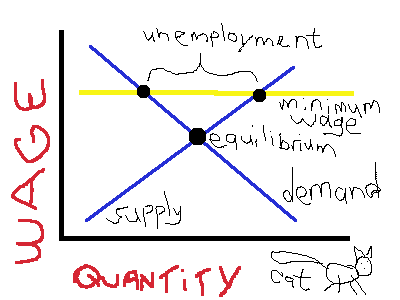
Not even most of them would be affected. The people who would be affected the most, are the ones who are currently unemployed, because their marginal productivity is lower than the minimum wage rate. That's standard microeconomics 101.
That's the first google search illustrating minimum wage laws (and a really good one, imho):

Most people are not effected by the national minimum wage- about two percent of hourly workers are paid it (though one reason for this is that there are several states which have higher minimum wage rates than the Federal one).
are you saying, contrary to the common libertarian complaint that minimum wage laws "causes" unemployment, underemployment, and hurts an economy, it has almost no effect? Saying abolishing it would affect almost nobody is the same saying as having it affects almost nobody...right?
No, not at all! Perhaps I didn't make my point very clearly (although I really believe the nice graphic is quite intuitive).
Minimum wages are a hurdle you have to jump over. Everyone with the ability to jump higher (those with a marginal productivity higher than the minimum wage, who are employed at a higher wages) is not affected by it all. On the other hand, everyone who can't jump as high (those with a lower wage rate (=marginal productivity) than the newly created minimum wage) are not going to make it over it.
Before the minimum wage, everybody could run to the finish line at his own speed. Now, only those who are more productive than the minimum wage are going to make it at all and won't be bothered by it.
First of all, in addition to that 2% of workers who are paid it, you need to add the much larger number of those who are unemployed who would like to be able to offer their labor at below MW and can't.
Second of all, it doesn't matter how many are affected. Those who are affected by it are harmed. The government has no right to interfere with their lives like that.
So basically, as the old complain goes, minimum wage affects most those who cannot produce that which warrants the payment, but only those. And unless a person is unemployed or underemployed due to minimum wage, he is not affected?
Or, one step further, abolishing minimum wage would only affect those whose productivity is close to, or under the wage limit, and nobody else?
First of all, in addition to that 2% of workers who are paid it, ......................
The actual percentage earning $7.25 or less is 5%. BTW, the minimum wage in 1969 was equivalent to $8.20 today, taxes on the 1% were far higher, CEO's made far less money relative to staff........and the economy was far stronger than it is with today. Certainly life was better for ordinary folks.
Y'all need to stop confusing crony capitalism with Free Markets.
you need to add the much larger number of those who are unemployed who would like to be able to offer their labor at below MW and can't.
Y'all need to stop confusing crony capitalism with Free Markets.


