Minimum Wage

I think the individual that explains minimum wage the best is Milton Friedman. In "Free to Choose," "Capitalism & Freedom" and his "Free to Choose" series he touches upon this policy. Thomas Sowell also talks about it in his many interviews and books.

Also, LearnLiberty published a video on the minimum wage and anyone who wants to learn about it should check the video out on YouTube. I can't post the link for some reason.
 
Most people are not effected by the national minimum wage- about two percent of hourly workers are paid it (though one reason for this is that there are several states which have higher minimum wage rates than the Federal one).
 
Most people are not effected by the national minimum wage- about two percent of hourly workers are paid it (though one reason for this is that there are several states which have higher minimum wage rates than the Federal one).

they might not be affected directly by it, but if the adjustment was great enough, would all wages be adjusted accordingly?

For example: if min wage was $5, and in a company you have people paid $5, 6, 10, 20. What if min wage was dropped to $3? Would you expect the wages to drop to $3, 5, 9, 18? Or, if the min wage was raised to $7, wouldn't you expect both $5 and $6 to turn into $7 and over $7 (as the person previously paid $1 more, would deserve slightly more than the min wage person to be fair)
 
For example: if min wage was $5, and in a company you have people paid $5, 6, 10, 20. What if min wage was dropped to $3? Would you expect the wages to drop to $3, 5, 9, 18? Or, if the min wage was raised to $7, wouldn't you expect both $5 and $6 to turn into $7 and over $7 (as the person previously paid $1 more, would deserve slightly more than the min wage person to be fair)

Why would you expect that? Absent any legislative forcing, it could be reckoned as "the amount the lowest paid employee earns". As such, a minimum wage (without regard to a legislated definition or mandate) is a floor only.

For example: if min wage was $5, and in a company you have people paid $5, 6, 10, 20. What if min wage was dropped to $3? Would you expect the wages to drop to $3, 5, 9, 18?

What kind of logic would even produce that possibility, since the wages of those earning more than the minimum (artificial OR natural) were not in any way derived from the minimum.

Or, if the min wage was raised to $7, wouldn't you expect both $5 and $6 to turn into $7 and over $7 (as the person previously paid $1 more, would deserve slightly more than the min wage person to be fair)


There is no "to be fair" about it. If an artificial minimum wage floor was raised to $7, the $5 and $6 would all become $7 (with some percentage laid off if those higher costs cannot be passed on). But who is at or above $7 at the time would not be in a worthless, meaningless "FAIRNESS" paradigm. Everything above $7 would be a free market negotiation between the employee and the firm who is under has no legal "price fixing" obligation with respect to wages.
 
Unfortunately this is not true. Since the minimum wage pushes many people out of a job, there is A LOT of productivity that is sacrificed. This means that everyone pays highers prices, essentially, across the board.

Less productivity = goods and services are more scarce. Scarcity drives prices up.

Most people are not effected by the national minimum wage- about two percent of hourly workers are paid it (though one reason for this is that there are several states which have higher minimum wage rates than the Federal one).
 
Why would you expect that? Absent any legislative forcing, it could be reckoned as "the amount the lowest paid employee earns". As such, a minimum wage (without regard to a legislated definition or mandate) is a floor only.


What kind of logic would even produce that possibility, since the wages of those earning more than the minimum (artificial OR natural) were not in any way derived from the minimum.


There is no "to be fair" about it. If an artificial minimum wage floor was raised to $7, the $5 and $6 would all become $7 (with some percentage laid off if those higher costs cannot be passed on). But who is at or above $7 at the time would not be in a worthless, meaningless "FAIRNESS" paradigm. Everything above $7 would be a free market negotiation between the employee and the firm who is under has no legal "price fixing" obligation with respect to wages.

they're not derived from the minimum? So you're basically saying if minimum wage was abolished, nobody would be affected but those who are paid minimum wage?
 
they're not derived from the minimum? So you're basically saying if minimum wage was abolished, nobody would be affected but those who are paid minimum wage?

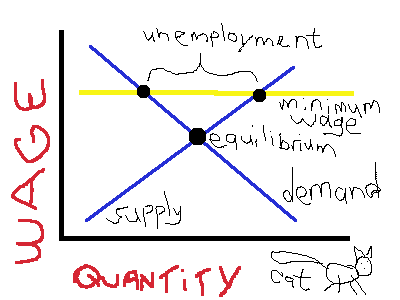
Not even most of them would be affected. The people who would be affected the most, are the ones who are currently unemployed, because their marginal productivity is lower than the minimum wage rate. That's standard microeconomics 101.

That's the first google search illustrating minimum wage laws (and a really good one, imho):

minimum_wage.png
 
Not even most of them would be affected. The people who would be affected the most, are the ones who are currently unemployed, because their marginal productivity is lower than the minimum wage rate. That's standard microeconomics 101.

That's the first google search illustrating minimum wage laws (and a really good one, imho):

minimum_wage.png

are you saying, contrary to the common libertarian complaint that minimum wage laws "causes" unemployment, underemployment, and hurts an economy, it has almost no effect? Saying abolishing it would affect almost nobody is the same saying as having it affects almost nobody...right?
 
Most people are not effected by the national minimum wage- about two percent of hourly workers are paid it (though one reason for this is that there are several states which have higher minimum wage rates than the Federal one).

First of all, in addition to that 2% of workers who are paid it, you need to add the much larger number of those who are unemployed who would like to be able to offer their labor at below MW and can't.

Second of all, it doesn't matter how many are affected. Those who are affected by it are harmed. The government has no right to interfere with their lives like that.
 
are you saying, contrary to the common libertarian complaint that minimum wage laws "causes" unemployment, underemployment, and hurts an economy, it has almost no effect? Saying abolishing it would affect almost nobody is the same saying as having it affects almost nobody...right?

No, not at all! Perhaps I didn't make my point very clearly (although I really believe the nice graphic is quite intuitive).

Minimum wages are a hurdle you have to jump over. Everyone with the ability to jump higher (those with a marginal productivity higher than the minimum wage, who are employed at a higher wages) is not affected by it all. On the other hand, everyone who can't jump as high (those with a lower wage rate (=marginal productivity) than the newly created minimum wage) are not going to make it over it.

Before the minimum wage, everybody could run to the finish line at his own speed. Now, only those who are more productive than the minimum wage are going to make it at all and won't be bothered by it.
 
No, not at all! Perhaps I didn't make my point very clearly (although I really believe the nice graphic is quite intuitive).

Minimum wages are a hurdle you have to jump over. Everyone with the ability to jump higher (those with a marginal productivity higher than the minimum wage, who are employed at a higher wages) is not affected by it all. On the other hand, everyone who can't jump as high (those with a lower wage rate (=marginal productivity) than the newly created minimum wage) are not going to make it over it.

Before the minimum wage, everybody could run to the finish line at his own speed. Now, only those who are more productive than the minimum wage are going to make it at all and won't be bothered by it.

So basically, as the old complain goes, minimum wage affects most those who cannot produce that which warrants the payment, but only those. And unless a person is unemployed or underemployed due to minimum wage, he is not affected?

Or, one step further, abolishing minimum wage would only affect those whose productivity is close to, or under the wage limit, and nobody else?
 
First of all, in addition to that 2% of workers who are paid it, you need to add the much larger number of those who are unemployed who would like to be able to offer their labor at below MW and can't.

Second of all, it doesn't matter how many are affected. Those who are affected by it are harmed. The government has no right to interfere with their lives like that.

Very true. In fact, those 2% are likely not even affected at all. It's just those who are unemployed.

As Hayek pointed out: "The role of the economist is precisely to identify the features of the market process that are 'hidden from the untrained eye'.

It are precisely the people NOT working any longer, because of minimum wage laws, that are affected by it.
 
So basically, as the old complain goes, minimum wage affects most those who cannot produce that which warrants the payment, but only those. And unless a person is unemployed or underemployed due to minimum wage, he is not affected?

Or, one step further, abolishing minimum wage would only affect those whose productivity is close to, or under the wage limit, and nobody else?

Well, at least in a perfectly competitve market, if we only consider demand and supply labor dependend on the wage rate.

It may very well be, that in reality there are some people close to the minimum wage rate who are actually benefitting. And in the long run you would also have to consider that goods and services that cannot any longer be provided at the same price would have a negative impact on real wealth across the board, etc.

But overall and in the long run, minimum wage rates have either no effect, or a negative one on the economy.
 
First of all, in addition to that 2% of workers who are paid it, ......................

The actual percentage earning $7.25 or less is 5%. BTW, the minimum wage in 1969 was equivalent to $8.20 today, taxes on the 1% were far higher, CEO's made far less money relative to staff........and the economy was far stronger than it is with today. Certainly life was better for ordinary folks.

Y'all need to stop confusing crony capitalism with Free Markets.
 
The actual percentage earning $7.25 or less is 5%. BTW, the minimum wage in 1969 was equivalent to $8.20 today, taxes on the 1% were far higher, CEO's made far less money relative to staff........and the economy was far stronger than it is with today. Certainly life was better for ordinary folks.

Y'all need to stop confusing crony capitalism with Free Markets.

Who confuses anything? There is no free market in labor, true. One main obstacle put in the free market's way by the cronies is exactly the minimum wage.

Just because some big corporations get tax deductions or subsidies doesn't mean that suddenly all laws of economics cease to exist. Minimum wage laws are counter-productive and always will be.
 
you need to add the much larger number of those who are unemployed who would like to be able to offer their labor at below MW and can't.

I have never in my life met a person that wanted to work for less than minimum wage.

Being unemployed... even minimum wage isn't enough to make you bother to work..
You can have a higher slandered of living collecting federal and state subsidizes, than you can have working 28hours a week a week at walmart.

Here in CT, unemployment max benefit is $555 a week. A minimum wage job here pays $330/week ($8.25/hr).
So, would you go work 40 hours a week for $1320 before taxes, when the state is offering you $2200/mo to sit home??
Oh and since your unemployed, you qualify for a bunch of other stuff.
You can get on MLIA, free health, dental, and vision! So that is $300/mo your not spending on healthcare.
You get $200+ a month in SNAP (food stamps).
You get $600 credit for heating towards your electric, oil, or gas.
You get free cell phone with 250 min, 250 texts a month.
You get free housing paid by section 8..

That right there is the problem.
 
Y'all need to stop confusing crony capitalism with Free Markets.

The Fed's counterfeiting system is the very foundation of crony capitalism, without regard to any other special laws, tax policies, minimum wage, wage disparities (that are none of anyone's business) or anything else. There are no "Free Markets" so long as counterfeiting is tolerated, with legal barriers to entry for other currencies, and legal tender laws that serve as BARRIERS TO EXIT from the existing pool of fiat currency swill.

Follow the debased currency from its thin air source. There are two main spigots, public and private sector, for injecting debased currency into the economy, which waters down the exchange value of everyone's currency holdings over time; the largest by far of those crony capital spigots is on the commercial lending side. It doesn't matter either way, as it's all crony capitalism, with massive trafficking in stolen goods and services.
 
Back
Top