Minimum Wage Vicious Cycle

Of course raising the minimum wage had a negative effect on the economy and had to be a factor in causing and worsening the recession.

When was the last time it was raised prior to the recent ones in 2013/14? 2006? 2001?
 
We can look at recent examples. In 2006, the minimum wage was $5.15 an hour. http://money.cnn.com/interactive/economy/minimum-wage-since-1938/
By 2008, that was raised in steps to $6.55 an hour. .

Wait - what? Hold right there.

2008 was one of the worst economic periods most of us have had the absolute displeasure to live through. Of course the rise in the minimum wage didn't single-handedly pop the housing bubble, but simple logic seems to indicate that it is indeed probable that artificially inflated wages were some of the culprits in the run up of artificially inflated housing prices.
 
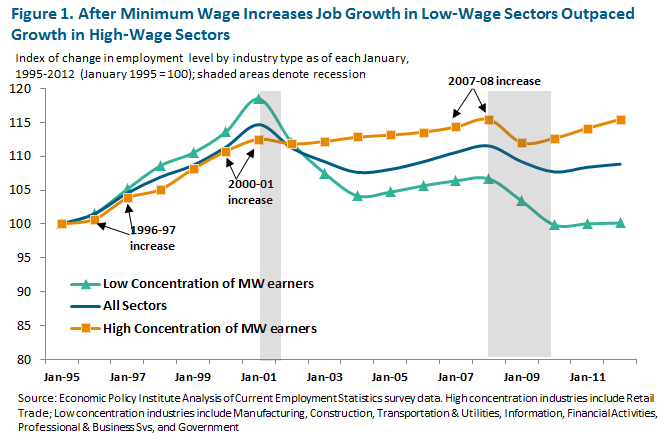
1995- 1997, Federal Minimum wage was raised from $4.25 to $5.25. People employed went from 116 million in 1995 to 131 million by 2000 (allowing time for the wage changes to take effect).

Is it really that hard to understand that if there's no MW then the people employed in 1995 would have been 116 million + workers whose potential wages are below $4.25; similarly, in 1997, it would have been 131 million + workers whose potential wage is below $5.25? Really, it's not that hard to understand!

I don't know why you can't grasp the basic fact that the moment MW is raised, at least some of people whose wages lie in between $4.25 to $5.25 could IMMEDIATELY be facing a lay off because their labor isn't worth the price; not to mention, newer workers whose potential wage is below $5.25 can't enter the workforce. Moreover, as I've already pointed EVERYONE whose labor is worth less that MW is kept out of the workforce. That's a loss of productivity for the economy, plus, these people will add to the unproductive consumers in the economy with all the socialist programs out there!

I know you'd now go back to your usual defense that people kept out of workforce due to MW are only a small fraction of the workforce (I disagree but let's presume it is an insignificant numbers of people) but why should even ONE PERSON's right to work, his right to be self-sufficient & productive member of the society be taken away? It's still injustice to treat even one person unjustly, & here we're probably talking about millions. Why should even one person be treated unjustly just so that the liberals can feel better about themselves?
 
Last edited:
Wait - what? Hold right there.

2008 was one of the worst economic periods most of us have had the absolute displeasure to live through. Of course the rise in the minimum wage didn't single-handedly pop the housing bubble, but simple logic seems to indicate that it is indeed probable that artificially inflated wages were some of the culprits in the run up of artificially inflated housing prices.

Don't you think the artificially loose mortgage rules were the main and primary culprit? I mean, let's say artificial wages were inflated, and it hasn't gone down at all (ok, maybe, if you count unemployed people as making zero and took an average), wages gone up, but loans were not made easier, would there have been a bubble? Would the bubble only be caused by sudden unemployment and slowly reinflated by people who had jobs? After all, if it wasn't for out of control loans, what else would promote quick inflate, quick pop, quick deflate?
 
I was under the impression that many union contracts have the aside that a union workers wage is tied to minimum wage in that if the minimum wage goes up, so does their pay. So, it is rather dishonest to say "well, only 2% of workers work for minimum wage...and that is all that is affected..". Others have brought up the point that if Jim is working $15/hr painting houses as a skilled laborer, and minimum wage is raised to $15 (or whatever) - how is his skill quantified now. Is he now gonna make equal to min. wage? No.
 
Last edited:
  • Like
Reactions: PRB
When was the last time it was raised prior to the recent ones in 2013/14? 2006? 2001?

1997 was the last raise prior to 2006. From my earlier post:

1995- 1997, Federal Minimum wage was raised from $4.25 to $5.25. People employed went from 116 million in 1995 to 131 million by 2000 (allowing time for the wage changes to take effect).

1989- 1991, Federal Minimum Wage raised from $3.35 an hour to $4.25 an hour. Employed people went from 107 million to 112 million by 1993.

There was not a decline in employment following those increases.
 
There was a decline relative to what would have happened without those MW increases.

Was there? Evidence to support the theory?

Yes, some employers were hit with higher labor costs. But how did they respond to those costs? Did they pass the costs along in the form of higher prices? Did they lower their own profit margins? Did they reduce the hours worked by current employees or did they fire employees?

On the other hand, now those people who had minimum wage jobs have more money to spend on things and that helps to create more jobs. Do they offset the ones reduced by higher labor costs?

Between 1995 and 1997, the Federal Minimum wage rose one dollar per hour. Chart of what happened to jobs:

image1.png


http://www.massbudget.org/report_window.php?loc=minimum_wage_job_creation.html
 
Last edited:
I included jobs for several years after the increase went into effect. There was no decline. You can check my links above.

When there is a decline, you say that it was from some other factor.

When there is not a decline, you disregard other factors.

It's not possible in real-life examples to separate out the effect of the minimum wage from all the other things that affect the economy. But we know for sure, as a mathematical certainty that is proven beyond any shadow of a doubt that raising the minimum wage costs jobs.
 
When there is a decline, you say that it was from some other factor.

When there is not a decline, you disregard other factors.

It's not possible in real-life examples to separate out the effect of the minimum wage from all the other things that affect the economy. But we know for sure, as a mathematical certainty that is proven beyond any shadow of a doubt that raising the minimum wage costs jobs.

I'm willing to concede that if the raise is only a nickel or a dime, the effect is hard to notice. But you gotta be kidding if you think a raise for $5 to $15 as liberals are demanding will have no effect on employment.
 
When there is a decline, you say that it was from some other factor.

When there is not a decline, you disregard other factors.

It's not possible in real-life examples to separate out the effect of the minimum wage from all the other things that affect the economy. But we know for sure, as a mathematical certainty that is proven beyond any shadow of a doubt that raising the minimum wage costs jobs.

Well, if there is mathematical certainty (which I am sure you can share with us)....

It's not possible in real-life examples to separate out the effect of the minimum wage from all the other things that affect the economy

Real life is what matters. Yes, there are other things which effect the economy and since raising minimum wage in the past has not led to job losses, then the minimum wage effect must not be very large on the overall economy.

Sticking with the year chosen earlier of 1995, there were 125 million people employed. http://www.dlt.ri.gov/lmi/laus/us/usadj.htm If two percent were paid the Federal Minimum wage, that means that applied to 2.5 million of them. Many minimum wage jobs are part time but some may be full time. I will figure an even 30 hours a week worked on average for them. Adding one dollar an hour costs $30 a week to an employer. Is that a lot of money? That will depend on his margins. Let's figure 50 weeks a year (two weeks off also to keep numbers simple). $30 a week is $1,500 a year more (before taxes).

So what is the impact on the overall economy? GDP in 1995 was $7.7 trillion (about half what it is today) and 2.5 million minimum wage workers times $1500 a year is $3.75 billion (which is now a bigger number) comes out to 0.05% of GDP.
 
Last edited:
I'm willing to concede that if the raise is only a nickel or a dime, the effect is hard to notice. But you gotta be kidding if you think a raise for $5 to $15 as liberals are demanding will have no effect on employment.

You are right- the larger the increase, the bigger the impact. I have not heard calls for raising the minimum wage by $15 an hour though.
 
Well, if there is mathematical certainty (which I am sure you can share with us)....

Sure.

400px-Surplus_from_Price_Floor.svg.png


Real life is what matters. Yes, there are other things which effect the economy and since raising minimum wage in the past has not led to job losses, then the minimum wage effect must not be very large on the overall economy.

There has never been an instance where raising the minimum wage didn't result in job losses compared to what the employment level would have been if the minimum wage weren't raised.
 
Last edited:
It depends on elasticity- the slope of the lines for demand for labor and supply of labor. If demand is inelastic, changes in prices (for labor or anything else) do not lead to changes in demand. If elasticity is high, then small changes in price can lead to large changes in demand.

There has never been an instance where raising the minimum wage didn't result in job losses compared to what the employment level would have been if the minimum wage weren't raised.

which is impossible to measure. Remember also that while higher labor costs may mean fewer jobs offered by some employers, the higher wages people get also leads to more spending on goods meaning higher demand and need for more labor to produce those additional goods. Or if an employer is able to pass along the higher labor costs to his customers, he may not decrease his workforce (in total hours or total numbers of workers). There is no absolute "this will lead to fewer jobs".

A ten percent hike in the minimum wage does not lead to an automatic ten percent decline in minimum wage jobs. As you said earlier, once you move to the real economy and out of the classroom, there are many other factors also at work.
 
Last edited:

Ah.

But you gotta be kidding if you think a raise for $5 to $15 as liberals are demanding will have no effect on employment.

Thought you meant increases of $5 an hour up to a $15 an hour increase. Sorry. (Fed minimum wage is only $7.25 currently so I assumed an increase of those amounts since raising it $5 would not get it to $15).
 
Last edited:
  • Like
Reactions: PRB
We can get rid of the minimum wage once the Border is sealed and the rent seeking 14th amendment corporate person is abolished. Good idea also to eliminate rent seeking law/regulation in the professions- especially medicine and law.
 
Back
Top