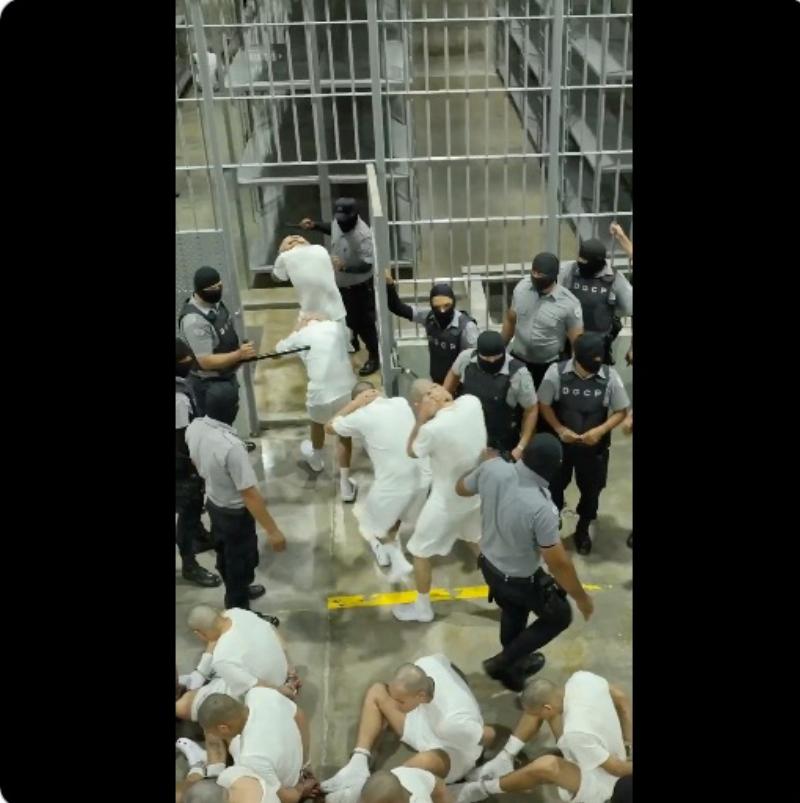
Joe Rogan : "You gotta get scared that people who are not criminals are being set to El Salvador prisons."

Shows you don't know anything about the Alien Enemies Act.

Can you make that stick? Can you prove it is an executive order, makes executive orders possible, or has anything else to do with executive orders? Let's see it.
 
Can you make that stick? Can you prove it is an executive order, makes executive orders possible, or has anything else to do with executive orders? Let's see it.
The Alien Enemies Act of 1798 lets the president authorize citizens of enemy nations to be “apprehended, restrained, secured and removed” if they are deemed a threat to the US during wartime.


The act was last used following the Dec 7, 1941, attack on Pearl Harbor, when Franklin D. Roosevelt ordered non-citizens from Japan, Germany and Italy to “preserve the peace towards the United States and to refrain from crime against the public safety, and from violating the laws of the United States and of the States and Territories thereof: and to refrain from actual hostility or giving information, aid or comfort to the enemies of the United States or interfering by word or deed with the defense of the United States or the political processes and public opinions thereof” — on pain of arrest, incarceration, or deportation.


The invocation of the act would, in theory, allow Trump to order summary deportation of illegal immigrants without first getting permission from an immigration judge.

Code:
https://nypost.com/2024/10/11/us-news/trump-plans-to-use-1798-law-to-dismantle-illegal-immigrant-gang-tren-de-aragua-and-kick-criminals-out-of-the-us/

 
And that has what to do with executive orders?

I suppose you're going to say an executive order is created every time Trump steps up to the counter at McDonald's?
 
And that has what to do with executive orders?

I suppose you're going to say an executive order is created every time Trump steps up to the counter at McDonald's?
Executive orders are law just like any other Executive powers are constitutional powers granted to the executive branch by the constitution and the constitution is the law.
 
Can you make that stick? Can you prove it is an executive order, makes executive orders possible, or has anything else to do with executive orders? Let's see it.
The AEA is one of our nation’s oldest statutes, enacted in 1798, 11 years after America’s founding. Many of the same men who drafted the Constitution later drafted and approved the Act. It provides:

Whenever there is a declared war between the United States and any foreign nation or government, or any invasion or predatory incursion is perpetrated... against the territory of the United States by any foreign nation or government, and the President makes public proclamation of the event, all natives, citizens, denizens, or subjects of the hostile nation or government...who shall be within the United States and not actually naturalized, shall be liable to be apprehended, restrained, secured, and removed as alien enemies... (Emphasis added.)

The left insists the Act can only be invoked in wartime and is subject to judicial review. The Supreme Court has already held that the left is wrong on both claims.

In 1814, the Supreme Court decided Brown v. United States, which examined whether Congress, merely by declaring war (in this case, the War of 1812), simultaneously gave ordinary American citizens the right to seize enemy aliens’ property on American soil. The Court, with the early Americans’ tremendous respect for property rights, concluded that it did not, for a congressional declaration of war only makes official a state of hostility between two nations.

On the way to this conclusion, the Supreme Court enunciated an important principle that has never been challenged: While an individual alien enemy’s property is not automatically up for grabs, the AEA sets a very different standard for the executive’s control of an alien enemy’s person:

The act concerning alien enemies, which confers on the President very great discretionary powers respecting their persons, affords a strong implication that he did not possess those powers by virtue of the declaration of war.

In other words, Congress conferred on the president a unique power entirely separate from war itself.

In 1948’s Ludecke v. Watkins, the Supreme Court affirmed and expanded upon this interpretation of the Act. The plaintiff, a German citizen, was arrested before the U.S. declared war on Germany, held for the war’s duration, and then ordered deported two months after Germany’s surrender under an order President Truman issued using his powers under the Act.

The Ludecke Court understood something Judge Boasberg missed: In light of the Brown decision, the federal courts have no authority to second guess the president’s decision under the AEA:

As Congress explicitly recognized in the recent Administrative Procedure Act, some statutes “preclude judicial review.” [Citation.] Barring questions of interpretation and constitutionality, the Alien Enemies Act of 1798 is such a statute. Its terms, purpose, and construction leave no doubt. The language employed by the Fifth Congress could hardly be made clearer, or be rendered doubtful, by the incomplete and not always dependable accounts we have of debates in the early years of Congress. [Fn. omitted.] That such was the scope of the Act is established by controlling contemporaneous construction. “The act concerning alien enemies, which confers on the president very great discretionary powers respecting their persons,” Marshall, C.J., in Brown v. United States... “appears to me to be as unlimited as the legislature could make it.”

Moreover, said the Ludecke court, decisions virtually contemporaneous with the act itself held that the president’s power could not come under judicial scrutiny:

[The Act] “appears to me to be as unlimited as the legislature could make it.” Washington, J., in Lockington v. Smith [citation]. The very nature of the President's power to order the removal of all enemy aliens rejects the notion that courts may pass judgment upon the exercise of his discretion. [Fn. omitted.] This view was expressed by Mr. Justice Iredell shortly after the Act was passed, Case of Fries [citation], and every judge before whom the question has since come has held that the statute barred judicial review.

The Ludecke court added that, while these old decisions are helpful, they’re unnecessary: “We would so read the Act if it came before us without the impressive gloss of history.”

Nor is there any need for a shooting war to trigger the president’s power. As to any matters involving a threat to the U.S., the Court concluded, “These are matters of political judgments for which judges have neither technical competence nor official responsibility.”

The Court also summarily rejected the dissent’s claim that the Act violated Ludecke’s right to a hearing, holding that the Act’s validity was so unquestionable that any challenge was wrongful judicial politicking:

The Act is almost as old as the Constitution, and it would savor of doctrinaire audacity now to find the statute offensive to some emanation of the Bill of Rights.

Then, quoting Case of Fries (decided one year after the Act’s passage), the Court issued a warning that the anti-Trump judges would be wise to heed:

Such great war powers may be abused, no doubt, but that is a bad reason for having judges supervise their exercise, whatever the legal formulas within which such supervision would nominally be confined. In relation to the distribution of constitutional powers among the three branches of the Government, the optimistic Eighteenth Century language of Mr. Justice Iredell, speaking of this very Act, is still pertinent:

“All systems of government suppose they are to be administered by men of common sense and common honesty. In our country, as all ultimately depends on the voice of the people, they have it in their power, and it is to be presumed they generally will choose men of this description; but if they will not, the case, to be sure, is without remedy. If they choose fools, they will have foolish laws. If they choose knaves, they will have knavish ones. But this can never be the case until they are generally fools or knaves themselves, which, thank God, is not likely ever to become the character of the American people.”

With those principles in mind, the Ludecke Court concluded that the Enemy Alien Act vests in the president the sole power to decide whether enemy aliens should be deported:

Accordingly, we hold that full responsibility for the just exercise of this great power may validly be left where the Congress has constitutionally placed it -- on the President of the United States. The Founders, in their wisdom, made him not only the Commander in Chief, but also the guiding organ in the conduct of our foreign affairs. He who was entrusted with such vast powers in relation to the outside world was also entrusted by Congress, almost throughout the whole life of the nation, with the disposition of alien enemies during a state of war. Such a page of history is worth more than a volume of rhetoric.

In sum, no federal court, from a district court to the Supreme Court, can interfere with the president’s decisions about deporting enemy aliens.

Code:
https://www.americanthinker.com/articles/2025/03/the_supreme_court_has_long_held_that_the_alien_enemies_act_gives_the_president_plenary_power.html

 
What does this have to do with EOs?
You really can't read.

the President makes public proclamation of the event, all natives, citizens, denizens, or subjects of the hostile nation or government...who shall be within the United States and not actually naturalized, shall be liable to be apprehended, restrained, secured, and removed as alien enemies...

“The act concerning alien enemies, which confers on the president very great discretionary powers respecting their persons,” Marshall, C.J., in Brown v. United States... “appears to me to be as unlimited as the legislature could make it.”

With those principles in mind, the Ludecke Court concluded that the Enemy Alien Act vests in the president the sole power to decide whether enemy aliens should be deported:

Accordingly, we hold that full responsibility for the just exercise of this great power may validly be left where the Congress has constitutionally placed it -- on the President of the United States. The Founders, in their wisdom, made him not only the Commander in Chief, but also the guiding organ in the conduct of our foreign affairs. He who was entrusted with such vast powers in relation to the outside world was also entrusted by Congress, almost throughout the whole life of the nation, with the disposition of alien enemies during a state of war. Such a page of history is worth more than a volume of rhetoric.
 
You really can't read.

What does that have to do with the official government instrument known as an Executive Order?

Only you can read? What were you doing instead when I asked you if an Executive Order was created every time Trump steps up to the counter at McDonald's?
 
What does that have to do with the official government instrument known as an Executive Order?

Only you can read? What were you doing instead when I asked you if an Executive Order was created every time Trump steps up to the counter at McDonald's?
the President makes public proclamation of the event

EOs are how a President directs the government to act on his orders.
The President has sole authority to declare the invasion and to order the removal of the Aliens.

You are grasping at straws that aren't even there.
 
Well guys we can go back to open borders now because the media found someone who said "it wasn't me".

It was good while it lasted.
By my count they're up to at least three people who had no business being sent to a slave labour camp.
 
Ron Paul's position from 2007:

The talk must stop. We must secure our borders now. A nation without secure borders is no nation at all. It makes no sense to fight terrorists abroad when our own front door is left unlocked. This is my six point plan:


  • [*=left]Physically secure our borders and coastlines. We must do whatever it takes to control entry into our country before we undertake complicated immigration reform proposals.
    [*=left]Enforce visa rules. Immigration officials must track visa holders and deport anyone who overstays their visa or otherwise violates U.S. law. This is especially important when we recall that a number of 9/11 terrorists had expired visas.
    [*=left]No amnesty. Estimates suggest that 10 to 20 million people are in our country illegally. That’s a lot of people to reward for breaking our laws.
    [*=left]No welfare for illegal aliens. Americans have welcomed immigrants who seek opportunity, work hard, and play by the rules. But taxpayers should not pay for illegal immigrants who use hospitals, clinics, schools, roads, and social services.
    [*=left]End birthright citizenship. As long as illegal immigrants know their children born here will be citizens, the incentive to enter the U.S. illegally will remain strong.
    [*=left]Pass true immigration reform. The current system is incoherent and unfair. But current reform proposals would allow up to 60 million more immigrants into our country, according to the Heritage Foundation. This is insanity. Legal immigrants from all countries should face the same rules and waiting periods.


http://archive.is/XoV0h#selection-311.1-349.26
"I remember I got into trouble with Libertarians because I said there may well be a time when immigration is like an invasion and we have to treat it differently." - Ron Paul on Meet The Press 23 Dec 2007

http://archive.is/HW9aj

MR. RUSSERT: You say you're a strict constructionist of the Constitution, and yet you want to amend the Constitution to say that children born here should not automatically be U.S. citizens.REP. PAUL: Well, amending the Constitution is constitutional. What's a--what's the contradiction there?
MR. RUSSERT: So in the Constitution as written, you want to amend?
REP. PAUL: Well, that's constitutional, to do it. Besides, it was the 14th Amendment. It wasn't in the original Constitution. And there's a, there's a confusion on interpretation. In the early years, it was never interpreted that way, and it's still confusing because people--individuals are supposed to have birthright citizenship if they're under the jurisdiction of the government. And somebody who illegally comes in this country as a drug dealer, is he under the jurisdiction and their children deserve citizenship? I think it's awfully, awfully confusing, and, and I, I--matter of fact, I have a bill to change that as well as a Constitutional amendment to clarify it.


I don't see the part where he says 'abandon any forms of checking the legal or citizenship status of a person and just guess based on skin tone"
 
By my count they're up to at least three people who had no business being sent to a slave labour camp.
So a 1 in 100 million chance. You're more than twice as likely to be killed by a spider bite.
 
What does it actually mean to be a gang member? I mean legally.

Is there some concrete objective thing that we can point to for any given person that indicates gang membership?

Associating with some other person or group of people can't possibly be a valid way to do this. You can associate with people who are in a gang without being in their gang.

Gangs don't register their membership with the government like employers do with their employees.

If a given person is proven guilty of a specific crime, as in the kind where there's a victim, then their guilt of that crime is just a real whether they're in a gang or not. Status as a gang member doesn't change anything.

This is not a rhetorical question. Seriously, when the government identifies a person as a gang member, what are the actual objective factual criteria they base that on?
I guess prison systems go by tatoos
 
I don't see the part where he says 'abandon any forms of checking the legal or citizenship status of a person and just guess based on skin tone"
This is Abrego Garcia, that the OP mentioned as being held without cause in CECOT.

aHQ9MTE0OQ


He's as white as I am.

So what does skin tone have to do with this case?
 
I don't see the part where he says 'abandon any forms of checking the legal or citizenship status of a person and just guess based on skin tone"
That's not what's happening.
And he says when it gets bad you have to treat it like war, that means ejecting the enemy without drawn out court cases.
 
Still trying to falsely conflate due process with that? Sad!
Tell it to Rand, and everyone else who isn't fantasizing or weasel wording.
That's exactly what is being demanded, and they are already getting everything they could but that.
 
Back
Top