FEDERAL DEBT PRIMED TO EXPLODE...

I guess you want more laws saving people from their own bad decisions...

Bad guess. Whatever did I say to lead you to that? Here's a quick test: Does advocating for sound money sound like an argument for what you just guessed?

I don't understand what is stopping people from saving? Anyone can buy treasuries or CDs if they just want to hold cash.

True. They're safe enough so far, they almost keep up with inflation, and almost any idiot can do it, and has enough sense to do it.

Almost.

So why don't you tell me what's the matter with sound money?
 
Because he, she or they want to have wiser, more loyal, less distracted, longer term, more invested, and happier people on the workforce than the competition has.

Which flies in the face of way companies operate today. No idea why you think that would change because legal tender laws are removed.

Companies can already do things for employees like better benefits, yet the trend has been decreasing benefits over time.

And at the end of the day, people get fleeced. They either lose value to devaluation.

I don't get "fleeced" due to devaluation because I don't save my money in dollars.

You seem to be saying this is desirable. What is desirable about it? Other than some vague fears about there being an insufficient amount of something or another to handle all the transactions of a thriving economy (and even you must admit that they will get the job done, but demand raising their value will just lead to smaller amounts being used), where is the catastrophe that lurks down that road?

If there isn't enough money in an economy to allow the business that wants to get done, two things will happen, prices will adjust and/ or unemployment will result.

Since workers are both an expense (salaries) and a source of potential income (consumption). When there is a lack of money in a growing economy, companies will move away from consumption as a source of growth to cutting costs. When salaries or labor is cut in order to increase profit, the business benefits, but the economy overall suffers as unemployment affects aggregate consumption.

You keep saying the system has troubles, but the only thing worse is any alternative. But you aren't saying what makes the alternatives worse. We've said some of the things that make alternatives better. What makes the alternatives worse? If repealing the legal tender laws won't make a difference, then can you say why they don't get repealed?

No, I didn't say it "it won't make a difference", I said that nothing would change with respect to the way people spend FRN's and commodity money. I refrained from speculating on the negative impacts on the economy overall.

Can you even stop hedging long enough to state unequivocally whether you can support that repeal?
I thought I was pretty clear in my objection to answering the question in my reply to Devil21.
 
Bad guess. Whatever did I say to lead you to that? Here's a quick test: Does advocating for sound money sound like an argument for what you just guessed?

You did leave out the second part "or are ou just pointing out that some people are gullible . Actually no. There have been stock scams under every monetary system going back to the South Sea Bubble in the 1700's. I don't think sound money has even a little bit to do with stock schemes.

So why don't you tell me what's the matter with sound money?​


What is sound money? You mean a gold standard? If the question is what is wrong with a gold standard, then the answer is a lot. For one thing, you can't have a gold standard with the massive entitlement state that currently exists. The people on this forum don't even want cut Social Security and Medicare. That alone makes it a non-starter.

You also had constant banking panics under a gold standard 1873, 1884, 1890, 1893 and 1907.

 
What is sound money? You mean a gold standard? If the question is what is wrong with a gold standard, then the answer is a lot. For one thing, you can't have a gold standard with the massive entitlement state that currently exists. The people on this forum don't even want cut Social Security and Medicare. That alone makes it a non-starter.

You're painting the people on this forum with a broad brush. You've also been here far too long to be perpetuating the myth that there is no middle ground between forcing the use of a fiat currency and establishing a gold standard.

You also had constant banking panics under a gold standard 1873, 1884, 1890, 1893 and 1907.

And we've had constant banking panics since. 1919. 1929-1932-for a freaking decade. 1958. 1973 for nearly another decade. 1987. 2008 for yet another decade (don't go all Zippy on me and tell me the recessions didn't last that long--a modest amount of growth after falling into the bargain basement does not a recovery make). The fiat has not done one single solitary thing to prevent them, and has generally lengthened the recovery time greatly after they hit.

So?
 
Last edited:
You're painting the people on this forum with a broad brush. You've also been here far too long to be perpetuating the myth that there is no middle ground between forcing the use of a fiat currency and establishing a gold standard.


And we've had constant banking panics since. 1919. 1929-1932-for a freaking decade. 1958. 1973 for nearly another decade. 1987. 2008 for yet another decade (don't go all Zippy on me and tell me the recessions didn't last that long--a modest amount of growth after falling into the bargain basement does not a recovery make). The fiat has not done one single solitary thing to prevent them, and has generally lengthened the recovery time greatly after they hit.


So?


Sooooo....


5 out of the 6 depressions in US history were in the gold era.


There has been one depression in the last 105 years and one "great recession".


You know what all of the depressions had in common?


In every single case, the government tried to run a sustained surplus (sustained 3+ years) right before they happened.


1817-1821: U. S. Federal Debt reduced 29%. Depression began 1819.
1823-1836: U. S. Federal Debt reduced 99%. Depression began 1837.
1852-1857: U. S. Federal Debt reduced 59%. Depression began 1857.
1867-1873: U. S. Federal Debt reduced 27%. Depression began 1873.
1880-1893: U. S. Federal Debt reduced 57%. Depression began 1893.
1920-1930: U. S. Federal Debt reduced 36%. Depression began 1929.


1998-2001: U. S. Federal Debt reduced 9%. Recession began 2001
In 1998-2000 US federal debt growth slowed to 1.4% annually (President Clinton’s surplus). A recession began in 2001


The last case is that of the 1998-2001 surplus. Compared to other attempts at debt reduction in the past it was extremely modest. Yet it was followed by the recession of 2001 which, as I'm sure you know was obscured by the internet frenzy that created the .com bubble which just encouraged wild speculative private sector borrowing and bank leverage followed by the even deeper housing bubble where Congress threw out the up-tick rule and Glass-Steagal and ignored the Commodities and Trade Commision and let the finance industry police itself through the rating agencies (privately companies that are funded by the industry they are supposed to rate) that were giving highest grades to junk assets....


That's just a short recap, but it wasn't paper money that caused the problems of the GFC, it was greed and lack of oversight. It was the ideas that "markets regulate themselves" that caused the mess. They don't and they never will, it makes no difference if the money has intrinsic value or extrinsic value.


In conclusion, trying to run fiscal surpluses in a growing economy (growing in the sense that population and per-person productivity are increasing) causes a shortage of money, which causes unemployment and results in a lack of demand.


Despite what Austrians claim, salaries and prices are "sticky" and don't adjust as easily as they would like us all to believe. The result is unemployment as we saw in the years following the GFC.
 
So, correlation equals causation? Or did debts generally get paid back during good times, and do good times generally end in recessions?

So, is the fact that after the Great Depression, politicians grew leery of using the world, and coined the world 'recession', mean something? Anything at all?

The less you actually say, the sillier you get.

So, you're telling us debt is good. It creates liquidity, right? So, is your model sustainable? How much can the government sell, in the end? Is there a limit to the market for U.S. government debt? What happens when that market is sated?

I know you think the market for U.S. government debt is inexhaustible, but humor me on this one: If the government is forced to choose between restricting liquidity by living within its means and trying to pump and dump its own debt on the world market, which do you recommend?
 
Last edited:
Sooooo....

The last case is that of the 1998-2001 surplus. Compared to other attempts at debt reduction in the past it was extremely modest. Yet it was followed by the recession of 2001 which, as I'm sure you know was obscured by the internet frenzy that created the .com bubble which just encouraged wild speculative private sector borrowing and bank leverage followed by the even deeper housing bubble where Congress threw out the up-tick rule and Glass-Steagal and ignored the Commodities and Trade Commision and let the finance industry police itself through the rating agencies (privately companies that are funded by the industry they are supposed to rate) that were giving highest grades to junk assets....


Glass-Steagall had absolutely nothing to do with the financial crisis. Glass-Steagall had no impact on the majority of investment banks like Goldman Sachs and Morgan Stanley because most aren't commercial banks. It had no impact on the types of mortgage securities that were bough and sold. And it had no impact on loan companies like Countrywide or Washington Mutual they aren't investment banks. It is a BS Elizabeth Warren talking point that even Politifact shoots down. http://www.politifact.com/truth-o-m...linton-glass-steagall-had-nothing-do-financi/

The repeal of the uptick rule is the most bonkers talking point. The uptick rule didn't stop a market panic in 1987. It didn't keep the Nasdaq from dropping 80% in the early 2000s. No company went under because of short sellers. Mentioning the uptick rule is a way to scapegoat those "evil" short sellers and speculators. Investment banks went under because they were so heavily leveraged that even a small move in their equity was enough to wipe them out. Companies are not their stocks. I noticed there is no downtick rule on the escalator up. The uptick rule adds an insanely high cost to short selling which already has too high of a cost. If the goal is to eliminate financial fraud, short selling should be made easier not harder. Short selling also has the benefit of stabilizing. Every seller becomes a buyer so it thickens markets up during panics. Maybe the uptick rule made sense when markets were illiquid in the 30's. It sure as hell doesn't make sense now.


In conclusion, trying to run fiscal surpluses in a growing economy (growing in the sense that population and per-person productivity are increasing) causes a shortage of money, which causes unemployment and results in a lack of demand.

Australia hasn't hasn't had a recession in 20 years and they have run budget surpluses at different points throughout that time. How do you explain that?
 
Last edited:
T
In conclusion, trying to run fiscal surpluses in a growing economy (growing in the sense that population and per-person productivity are increasing) causes a shortage of money, which causes unemployment and results in a lack of demand.

Fiscal policy in practice has almost no effect. If you run a budget surplus that reduces demand and lowers inflation then monetary policy will just be used to offset it.

http://econlog.econlib.org/archives/2016/08/monetary_offset_1.html

If fiscal policy becomes more expansionary, central banks will simply offset it. (and vice versa)
 
Glass-Steagall had absolutely nothing to do with the financial crisis. Glass-Steagall had no impact on the majority of investment banks like Goldman Sachs and Morgan Stanley because most aren't commercial banks.


.


Glass-Steagall was not technically repealed in 1999, but it was effectively neutered. Legislation was passed that year that allowed bank holding companies to engage in previously forbidden commercial activities, such as insurance and investment banking.


The change in the law opened the floodgates for giant mergers, such as the $33 billion deal between J.P. Morgan and Chase Manhattan in September of 2000. During the darkest days of the financial crisis, Bank of America acquired two troubled financial companies — Countrywide Financial Services and Merrill Lynch, deals that wouldn't have been possible before 1999.

The "repeal" allowed banks to become much larger than they were prior concentrating risk into fewer "too big to fail" institutions

Some critics [of the "repeal" of G-S], such as Nobel laureate Joseph Stiglitz, have long seen the changes to Glass-Steagall as a major factor in the 2008 crash. By bringing "investment and commercial banks together, the investment bank culture came out on top," Stiglitz wrote in 2009. "There was a demand for the kind of high returns that could be obtained only through high leverage and big risk-taking."


So the impact was partially cultural and the rest was that there were more eggs in fewer baskets.


The repeal of the uptick rule is the most bonkers talking point. The uptick rule didn't stop a market panic in 1987. It didn't keep the Nasdaq from dropping 80% in the early 2000s. No company went under because of short sellers.

As Lehman Brothers Holdings Inc. struggled to survive in 2008, as many as 32.8 million shares in the company were sold and not delivered to buyers on time as of Sept. 11, according to data compiled by the Securities and Exchange Commission and Bloomberg. That was a more than 57-fold increase over the prior year's peak of 567,518 failed trades on July 30.

Source-https://web.archive.org/web/20101202193111/http://www.bloomberg.com/apps/news?pid=newsarchive&sid=aB1jlqmFOTCA&refer=home


Australia hasn't hasn't had a recession in 20 years and they have run budget surpluses at different points throughout that time. How do you explain that?

Yeah, that's complicated. Usually I use my own words to explain stuff like this, but there are several moving parts here and Steve Keen, a Professor of economics in Australia has pretty much nailed it......

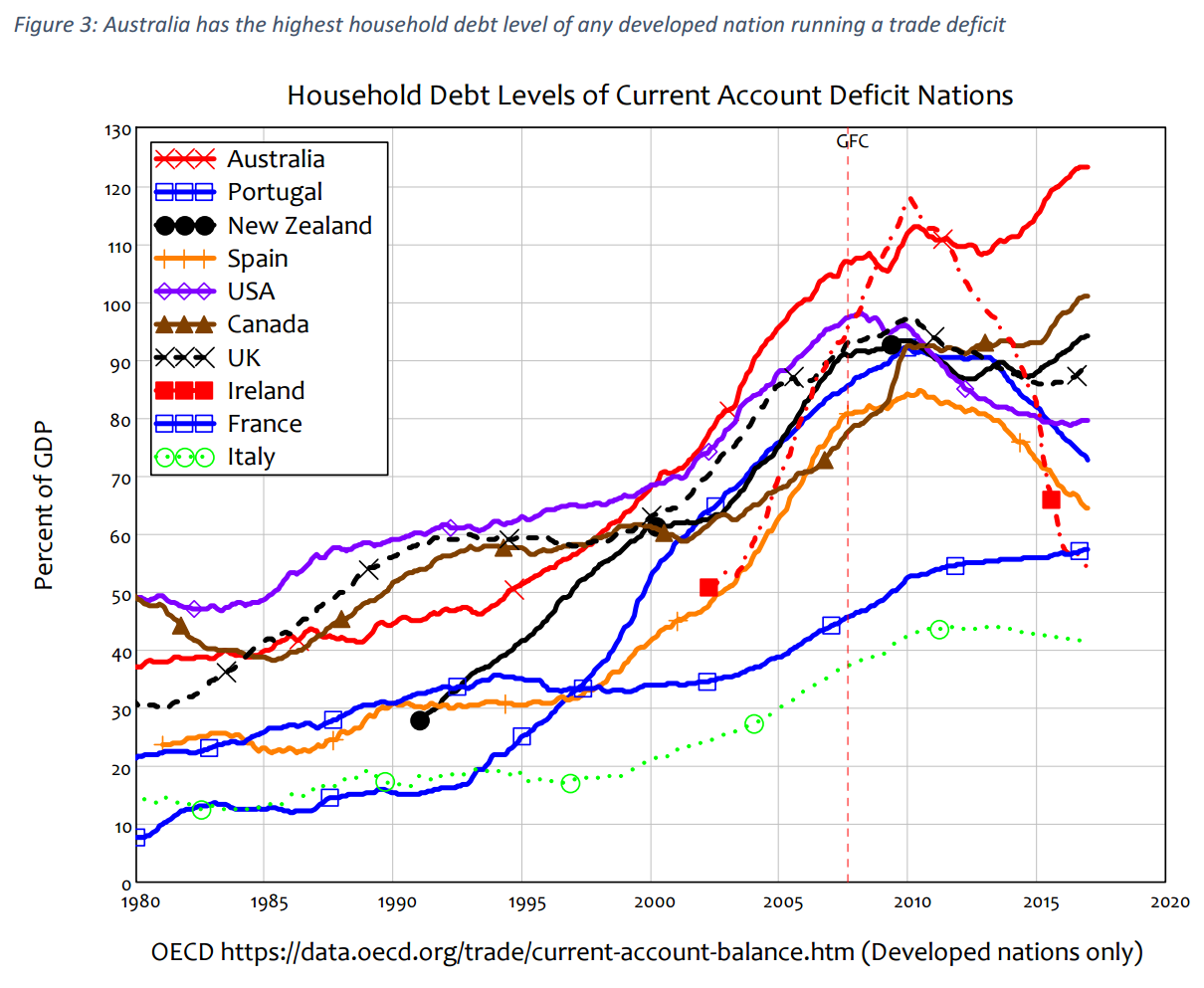
Australia’s household debt level of 123% of GDP has been exceeded only by Switzerland (population 8.3 million, household debt of 128% of GDP in 2016 Q3) and Denmark (population 5.6 million, 139% of GDP in 2009).2 Australia also stands apart from its household leverage competitors in another important respect: Denmark, Switzerland and The Netherlands also run significant current account surpluses—Switzerland’s average surplus since 2000 has been the highest on the planet at over 10% of GDP; Denmark’s has averaged 5.75% since 2005; The Netherlands’ average current account surplus is around 8% of GDP.
Australia, in contrast, has averaged a current account deficit of 3.2% of GDP since 1960, and 4.3% since 2000. Australia therefore holds the record of the highest level of household debt for a country running a trade deficit, and has done so since 2010, when it overtook the previous record-holder: Ireland. Ireland’s household debt level has also plunged since then, from a peak of 118% of GDP in 2010 to 54%. Australia’s closest competitor now is Canada, which has a household debt level 22% lower than Australia’s, and an average trade deficit of 1.4% of GDP, versus Australia’s long-run average of 3.2%.

3-32.png


There is a lot more in the article...

Source-https://www.macrobusiness.com.au/2017/06/steve-keen-on-the-secret-source-of-eternal-australian-growth/

Basically, Australia has avoided an economic crash (which BTW is inevitable) though private sector debt expansion and leverage. When it's over either the government will do what other nations did, which will be to create the money it needs and move all if the private sector debt over to the government sector in order to keep it's institutions and economy functioning, or it will deleverage and economic calamity will ensue.
Australia has run a net trade surplus, thus it is importing dollars, thus it can run a net government surplus.

The US on the other hand runs a massive trade deficit and must create dollars to fill the hole left by dollars that don't return to the US economy.

In a simplified formula it looks like this:

(Government spending [GS]-Taxes [T])+(net exports [E]-net imports )+(Savings-Investment)

I created this chart (below) to show relative levels of debts....I don't include savings or investment because generally they offset....

Basically, just take the sum of government spending (GS) - taxes (T) + Imports (I) - Exports (E)

The formula above determines the government sector economic balance. If the number is negative the amount of money in the US economy (not including the private sector) declines. Take the sum from each year and make it the starting point for the next year so we can visualize increases and decreases in the government's contributions over time.
If E+I is larger than GS+T the government's contribution to the economy will be negative. But like in Australia, the private sector can also create money (credit) in yellow. The yellow bars show how as the government's contribution declined staring in 1996 (as we went into the surplus) the private sector increased its share. This is how decreases in the government share can be hidden for quite some time. This is exactly what is happening in Australia now. Australia is a zombie. it's dead on its feet.

The US government can carry perpetual debt (not infinite amounts of debt, don't get confused), the private sector on the other hand is limited in its credit creation by increases in income. When increases in loan payments exceed increases in income dollar destruction in the private sector begins wich we saw in 2008, 2010, 2011 and thus began the liquidity crisis.

The Blue line is the government's contribution only, the red line includes US household revolving credit and mortgage credit borrowing.
vGhTwWo.png


We can see in relative terms that the US government's surplus in 1998 began a downward slope of money available in the economy. The Fed's response was to lower rates which simply encouraged unsustainable levels of private debt into assets that would eventually be worth less than the debt they secured.
 
.

As Lehman Brothers Holdings Inc. struggled to survive in 2008, as many as 32.8 million shares in the company were sold and not delivered to buyers on time as of Sept. 11, according to data compiled by the Securities and Exchange Commission and Bloomberg. That was a more than 57-fold increase over the prior year's peak of 567,518 failed trades on July 30.

Source-https://web.archive.org/web/20101202193111/http://www.bloomberg.com/apps/news?pid=newsarchive&sid=aB1jlqmFOTCA&refer=home

What you linked to with Lehman has nothing to do with the uptick rule. They quoted a Senator talking about the uptick rule and blaming it on naked shorting, but he of course is an idiot. It has to do with Reg Sho, which wasn't as firmly enforced as it should have been. The rules are insanely enforced on shorting now.

It makes sense that a lot of shares would fail to deliver and that number would be up substantially. Lehman stock was extremely hard to borrow because everyone in the world wanted to be short Lehman. It was a king zero. Lehman was was leveraged 50-1. A 2% move in equity was enough to wipe them out.
 
What you linked to with Lehman has nothing to do with the uptick rule. They quoted a Senator talking about the uptick rule and blaming it on naked shorting, but he of course is an idiot. It has to do with Reg Sho, which wasn't as firmly enforced as it should have been. The rules are insanely enforced on shorting now.

It makes sense that a lot of shares would fail to deliver and that number would be up substantially. Lehman stock was extremely hard to borrow because everyone in the world wanted to be short Lehman. It was a king zero. Lehman was was leveraged 50-1. A 2% move in equity was enough to wipe them out.

You make a good point with respect to the uptick rule. I've been reading a little more on the topic and it seems there is quite a bit of sentiment that agrees with your position. Thank you for sharing your position on this. I conceded that you are probably correct. I also agree with your original assessment (as I've stated in other posts) that leverage and unstable assets prices firmly undermined Sterns and Lehman's positions and were largely responsible for their failures.

Respectfully,

E4E1
 
Australia hasn't hasn't had a recession in 20 years and they have run budget surpluses at different points throughout that time. How do you explain that?

I was trying to find this last night when I wrote my reply....

public-finance-and-the-australian-election
Australian_Sectoral_Balances_Dec_2013.jpg


Notice that when the government runs a net surplus (1997-2007) the private sector's asset balance declines. So how did the Australian private sector continue to grow despite the private sector balance decreasing?

Egan_Soos_03.png

14910-australias-housing-bubble-is-finally-ending-steve-keen.html


It grew through the expansion of the private sector banking balance sheet expansion (leverage/ credit). The Australian economy and China, and the UK and perhaps even France are all suffering from a similar problem. Too much of the money in their economies were created in the private sector, and too much of that was created by individuals leveraging their credit. The problem is there is a finite point at which private sector credit will dry up (unless the government does as it did in the US and keeps lowing the standard for borrowing) and eventually the game is up and deleveraging will begin or the government's in question will simply swap private credit debt for government debt....


Respectfully,

E4E1
 
Last edited:
With respect, that's incorrect. The auctions determine the cost of Treasuries via supply and demand, not the cost of interest rates.

Kind of right. Yes, Treasury auctions are sold by a price. Each Treasury has a face value- usually $10,000. The would- be buyers offer a price to purchase the Treasuries. The interest rate is determined by taking the difference between the face value and the selling price and dividing that by the purchase price- giving the percent return the buyer will get on their purchase.

If I offer to buy a $10,000 Treasury for $9,000, the difference is $1000. My gain by holding that Treasury until it matures will be $1,000. Since my cost was $9,000 my rate of return (the interest rate I will receive) is 11.1%.

This is why interest rates are inverse to prices of Treasuries- as prices go up, the return goes down.


Interest rates and the inflation rate. Why do they tend to correlate? That is due to how many decide what interest rate they are willing to accept. A lender wants a return for making his loan. If he hopes to get three percent return on his loan, he will start with a rate of three percent. But he is also worried about potential inflation reducing the return on his loan so he adds in another factor- the expected rate of inflation for the duration of the loan. That gives him a "real" rate of return. He does not know for certain what that rate of inflation will be so he tends to go by what the recent rate of inflation has been. Say two percent. Now his "asking rate" will be up to five percent. Then he is going to add a third number- a "risk factor" based on his best guess of the likelyhood of the borrower actually paying him back. The less likely of payback, the higher rate he is going to demand.
 
Sorry, took me a while to get back to this post...

Kind of right. Yes, Treasury auctions are sold by a price. Each Treasury has a face value- usually $10,000. The would- be buyers offer a price to purchase the Treasuries. The interest rate is determined by taking the difference between the face value and the selling price and dividing that by the purchase price- giving the percent return the buyer will get on their purchase.

If I offer to buy a $10,000 Treasury for $9,000, the difference is $1000. My gain by holding that Treasury until it matures will be $1,000. Since my cost was $9,000 my rate of return (the interest rate I will receive) is 11.1%.

This is why interest rates are inverse to prices of Treasuries- as prices go up, the return goes down.

Oh boy, yeah I see where you're going with this. The problem with this is that the Fed can manipulate the money available to make the purchases you speak of by manipulating the level of reserves which in turn are used to purchase Treasuries. Since reserves have a cost, that's factored into the purchase when buying treasuries.

Basically, primary dealers are using bank reserves to swap dollars for treasuries. Really just a swap from "checking" to "savings" (functionally that's what it really is). Thus, it's my contention that the Fed manipulates the rate by increasing or decreasing the availability of reserves (pre-2008) and today it manipulates the rate by paying interest directly on reserves which ultimately effects treasury yields.

So it's my contention that the Fed manipulates the market whose purchases set the rate.....Agreed?

Interest rates and the inflation rate. Why do they tend to correlate? That is due to how many decide what interest rate they are willing to accept. A lender wants a return for making his loan. If he hopes to get three percent return on his loan, he will start with a rate of three percent. But he is also worried about potential inflation reducing the return on his loan so he adds in another factor- the expected rate of inflation for the duration of the loan. That gives him a "real" rate of return. He does not know for certain what that rate of inflation will be so he tends to go by what the recent rate of inflation has been. Say two percent. Now his "asking rate" will be up to five percent. Then he is going to add a third number- a "risk factor" based on his best guess of the likelyhood of the borrower actually paying him back. The less likely of payback, the higher rate he is going to demand.

Well said, agree completely.

Respectfully,

E4E1
 
Last edited:
I'm curious, how do you think higher interest rates affect the US economy?

I know very little about interest rate dynamics but from what I read, it can be problematic for various home/biz financing.


Here's the number everyone in the financial markets is obsessing about and why


  • The 10-year note's yield is perhaps the most widely tracked rate across the financial universe.
  • Its yield is used as a benchmark for other types of debt, including corporate and agency bonds, such as Fannie Mae and Freddie Mac.
  • The rate is also a barometer for 30-year fixed mortgage rates, auto loans, student loans and credit card annual percentage rates.


Thomas Franck
Published 12:09 PM ET Fri, 5 Oct 2018

Adam Jeffery | CNBC

Wall Street is abuzz this week amid a surge in the yield for the benchmark 10-year Treasury note, which has repeatedly topped levels not seen since 2011 over the last few days.
These days, when rates rise, stocks fall. That's because rising rates ripple throughout the economy, raising costs for companies that want to issue debt, raising mortgage rates for homeowners and buoying credit card bills for the typical consumer.

US 10-year yield hits highest level since 2011 5:51 PM ET Fri, 5 Oct 2018 | 03:25


The yield rose to as high as 3.24 percent on Friday. Bond traders are also impressed by the pace of the increase. The yield on the 10-year note has climbed about 15 basis points this week alone after trading in an innocuous range around 2.8 percent for much of summer 2018.

https://www.cnbc.com/2018/10/05/why-wall-street-cares-so-much-about-10-year-treasury-rates.html
 
[h=1]US budget deficit expands to $779 billion in fiscal 2018 as spending surges[/h]
  • The federal budget deficit rose 17 percent in fiscal 2018, according to the Trump administration.
  • Spending jumped, and revenue only increased slightly following the GOP tax cuts.
  • The Trump administration has pushed for dramatic budget cuts at several agencies and supported massive increases in military spending.


Jacob Pramuk | [MENTION=19484]Jacob[/MENTION]pramuk

Published 2 Hours Ago Updated 1 Hour Ago

https://www.cnbc.com/2018/10/15/us-...illion-in-fiscal-2018-as-spending-surges.html
 
From Drudge:

[SIZE=+7]FEDERAL DEBT PRIMED TO EXPLODE...

Trillion-dollar deficits come roaring back...
[/SIZE]


The GOP tax plan means short-term gains for the economy, but federal debt is primed to explode, CBO analysis says


  • The Congressional Budget Office forecast that the new tax law will generate an average of 0.7 percent growth over the decade and create 1.1 million jobs.
  • However, larger budget deficits would crowd out private investment in later years, dampening economic growth.
  • As a result, the CBO estimated the cumulative deficit over the next decade will be $1.6 trillion larger than previously projected. By 2028, the national debt would total 96 percent of GDP.

Ylan Mui | @ylanmui

Published 5 Hours Ago Updated 1 Hour Ago

105119441-918260564.600x400.jpg
CBO: Tax law will add $1.9 trillion to deficit over a decade 3 Hours Ago | 02:15

The Republican overhaul of America's tax code and increased government spending are projected to boost economic growth to 3.3 percent this year but push the national debt to nearly the same size as gross domestic product by 2028, according to government data released Monday.

The Congressional Budget Office forecast that the new tax law will generate an average of 0.7 percent growth over the decade and create 1.1 million jobs. It also predicted the two-year federal spending deal would increase GDP by 0.3 percent this year and 0.6 percent in 2019. However, larger budget deficits would crowd out private investment in later years, dampening economic growth.
As a result, the CBO estimated the cumulative deficit over the next decade will be $1.6 trillion larger than previously projected. By 2028, the national debt would total 96 percent of GDP.
"Such high and rising debt would have serious negative consequences for the budget and for the nation," the CBO report said.


Related

[h=1]National debt hits $21 trillion[/h]

The OP header is a trap for budget hawk eyeballs.
This has to be a major issue down the road in any
GOP primary debate that is not an idle photo-up!!!
 
Australia hasn't hasn't had a recession in 20 years and they have run budget surpluses at different points throughout that time. How do you explain that?

Weak currency and immigration has helped. So has China demand for their natural resources.

https://www.economist.com/the-econo...ustralia-broke-the-record-for-economic-growth

How Australia broke the record for economic growth

THE last time Australia suffered a recession the web browser had just been invented and Bryan Adams topped the charts. Figures released today will show that its economy has racked up the longest stretch of growth in modern history: 104 quarters. The Netherlands, the previous title-holder, dipped into recession—defined as two consecutive quarters of contraction—after 103. In these 26 years, Australia has navigated the Asian financial crisis, the collapse of the dotcom bubble and the Great Recession, largely without scars. Its once-in-a-generation mining boom ended in 2014. Yet it has managed to avoid a bust. How did it break the record for economic growth?

Its success was built on the structural reforms of the 1980s and ’90s, when trade barriers crumbled and foreign-exchange controls were removed. A floating dollar cushioned the economy against external aches; inflation stabilised around a target band of 2-3%; and government finances greatly improved. By the time the global financial crisis hit, Australia had enjoyed over a decade of budget surpluses and net debt had been eliminated. It helped that China’s demand for commodities was fuelling a mining boom that created jobs and pushed up wages. Australia’s terms of trade soared as it churned out coal and iron ore to feed its neighbour’s factories. By 2013 household incomes were about 13% higher than they would have been without the bonanza.

History suggested that the rush would be followed by a bust. As prices and investment fell, debt and unemployment rose in resource-dependent parts of the country like Queensland and Western Australia. But the Reserve Bank responded by slashing cash rates to lows of 1.5%, where they have remained for the past year, allowing the diverse economies of Victoria and New South Wales to pick up the slack. A weaker currency boosted agricultural exports and drew students and tourists in growing numbers. Cheap loans and rapid population growth prompted an explosion in demand for housing. Last year Australia’s population swelled by 1.6%, over double the average of the OECD, a group of mostly rich countries. To accommodate its intake of foreign migrants, Australia must build a city roughly the size of Britain’s Birmingham every five years.

The luck seems set to continue. The central bank predicts that GDP growth will pick up to about 3% in the next couple of years. But families have reason to feel less optimistic. Unemployment rates have flat-lined above their equivalents in America, Britain and Japan. Underemployment (the number of people who would like more work) is close to record highs. Rising national income is not trickling down to workers: wage growth has fallen to about 1.9%, its slowest pace since the last recession. This is all the more uncomfortable because household debt has ballooned. Its ratio to GDP is close to 190%, one of the highest in the world. If the central bank raises interest rates, many families will have difficulties repaying their mortgages. For now, it is likely to do nothing—and the growth will go on.
 
Back
Top