CPI jumps 5% in May of 2021, fastest since 2008

I'm wondering when that is going to happen here. You know China is going to be trying to get rid of its dollars.

Considering how worthless the dollar is and we are a full 12 months into runaway inflation that was never acted on Id say it is time to consider that now.
 
For those who might still harbor some shred of doubt that any of this is fully intentional and deliberate:

(The overweening hubris implicit in economic scientism is what allows all these arrogant and presumptuous jackasses to imagine that they are clever and masterful enough to ride the tiger.)

fckksCE.jpg
 
Last edited:
For those who might still harbor some shred of doubt that any of this is fully intentional and deliberate:

(The overweening hubris implicit in economic scientism is what allows all these arrogant and presumptuous jackasses to imagine that they are clever and masterful enough to ride the tiger.)

fckksCE.jpg

Great post.

It's easy to forget that even during the first year of covid the vast majority of economists were warning that DEFLATION was the big worry.

The whole idea of a deflationary spiral is idiotic, it's never actually happened in real life.
 
The whole idea of a deflationary spiral is idiotic, it's never actually happened in real life.


1930s. Was the singular cause of the first part of Great Depression. Debt is priced in nominal dollars. If nominal incomes drop across the board, debt gets harder to service which means bankruptcies. The bankruptcy process is slow. It took years to sort out delinquent housing payments after 08 housing crisis which meant you had lots of dormant inventory. Companies can take years to sort bankruptcy out. New investment within bankrupt companies stop which means a further drop in nominal GDP and more bankruptcies. It also means lower future growth from less investment. Unions and employees don't like wage cuts which makes wages sticky. As a consequence companies lay off workers instead of cutting wages which causes unemployment to rise and more bankruptcies as laid off workers can't service debt.

Tl;dr. A deflationary spiral is a nominal GDP spiral. A big drop in nominal GDP can cause pain with no gain. The goal isn't deflation or inflation. It is stable monetary policy a stable growth in nominal GDP.
 
S & P cuts russia rating , I'd say that was a little overdue. Default coming .
 
Iranian water scarcity protesters sentenced to 75 lashes and prison. Guess I wont complain about all the rain here until at least Tue of course things will cost more Tue than yesterday .
 
cbs news poll says inflation outweighs jobs. Makes perfect sense to me . So few americans work , even the other half is negatively effected by inflation.
 
1930s. Was the singular cause of the first part of Great Depression. Debt is priced in nominal dollars. If nominal incomes drop across the board, debt gets harder to service which means bankruptcies. The bankruptcy process is slow. It took years to sort out delinquent housing payments after 08 housing crisis which meant you had lots of dormant inventory. Companies can take years to sort bankruptcy out. New investment within bankrupt companies stop which means a further drop in nominal GDP and more bankruptcies. It also means lower future growth from less investment. Unions and employees don't like wage cuts which makes wages sticky. As a consequence companies lay off workers instead of cutting wages which causes unemployment to rise and more bankruptcies as laid off workers can't service debt.

Tl;dr. A deflationary spiral is a nominal GDP spiral. A big drop in nominal GDP can cause pain with no gain. The goal isn't deflation or inflation. It is stable monetary policy a stable growth in nominal GDP.

Falling prices didn't cause the great depression, the great depression caused falling prices. And the great depression was caused by the federal reserve keeping rates artificially low during the "roaring twenties".

It's not a coincidence that we had the great depression 16 years after the federal reserve was created.

I agree that once the federal reserve induced bubble popped, falling prices were a problem, but they weren't the initial cause. The most important thing is that the cure was not for government to try to prop up prices. That was the worst thing they could do.
 
Last edited:
00
Falling prices didn't cause the great depression, the great depression caused falling prices. And the great depression was caused by the federal reserve keeping rates artificially low during the "roaring twenties".

It's not a coincidence that we had the great depression 16 years after the federal reserve was created.

I agree that once the federal reserve induced bubble popped, falling prices were a problem, but they weren't the initial cause. The most important thing is that the cure was not for government to try to prop up prices. That was the worst thing they could do.

Not only was money in the 1920s not loose, it is almost the perfect exemplar of Austrian monetary policy in that it allowed prices to fall because of productivity growth. You said base money was the best measure of monetary policy in the past. The monetary base in 1920 was $6.9 billion. It was $6.978 in 1929. Does that sound loose? The price of gold was the same at every point in the 20s so no inflation using that metric. Nominal GDP only grew 5% over 10 year or roughly .5% a year. That is very deflationary in the good sense. You had huge productivity growth during that time. Prices fell by some metrics in the 1920s.

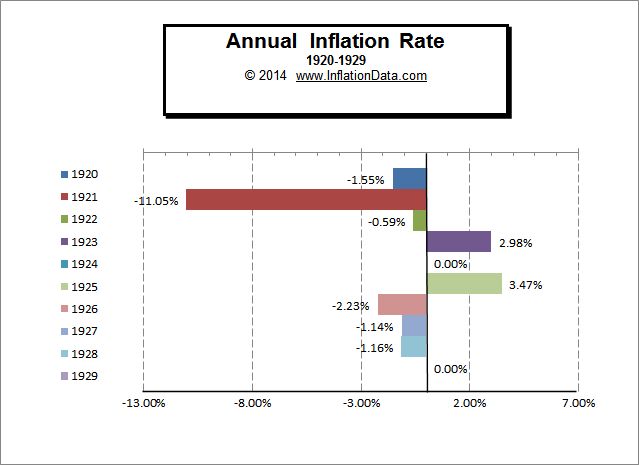
Using this data, the average inflation rate in the 1920s using the CPI data was .38%, basically the lowest ever outside of the the deflation of the Great Depression. https://inflationdata.com/articles/...inflation-cpi-consumer-price-index-1920-1929/

I like Austrian economists a lot. But the data is devastating to the Austrian depression narrative. What is the response to what I posted?

It is true the Federal Reserve caused the Depression but it was because the Federal Reserve raised interest rates to 6 percent when the inflation rate was zero to burst the stock bubble. Just like I think you would agree a hugely negative real rate is bad (like now), why is having a huge positive real rate good? As gold flowed into the country instead of expanding money as the gold standard would dictate, the Federal Reserve purposefully collapsed the money supply by a third.

Both inflation and deflation are bad policy outcomes. Deflation in the early 30s wasn't some beautiful corrective process caused by letting the market work. It was a purposeful choice by monetary central planners that should be thought of the same way as choosing inflation as a policy.
 
Last edited:
1920-1929.jpg


Does this look like a decade of decadent Federal Reserve monetary excess or frankly a near ideal Austrian policy of some years being negative and some positive?
 
1920-1929.jpg


Does this look like a decade of decadent Federal Reserve monetary excess or frankly a near ideal Austrian policy of some years being negative and some positive?

The original assertion in this thread of discussion was that deflationary collapse is not a real concern and that is incorrect -- a business which has $1M debt and is legally obligated to service that debt will collapse under the weight of it if its revenues, measured in the monetary unit of the debt (dollars), suddenly decline in absolute terms, even if the ratio of its revenues and outlays remains fixed throughout. A deflationary collapse is a debt-magnifier and so any major deflationary event will cause a swathe of bankruptcies. Whether businesses should be carrying such large debt loads (and the role that the constant expansion of credit plays in encouraging reckless commercial debts) is a separate question.

However.

In respect to the Fed's monetary recklessness, they have almost constantly expanded the money supply since the day it was created in 1913:

tHliZYn.png


This figure shows the nominal inflation-rate based on the official stats which are always the most flattering picture of the history of inflation.

While Mises could no more "time the market" than anyone else could, he did indeed predict a coming, massive inflationary collapse in the decades leading up to the 1929 crash. And while a lot of hay is made of the aftermath of the 1929 stock-market crash, the forgotten depression of 1920 is much more illustrative of the dangers of inflation.

In the absence of a central bank, there will still be a business cycle. Humans are not immune to "animal spirits" -- hypes, manias, FUD, etc. are all a part of the market. No Austrian economist claims that, but for the Fed, there would be no business cycle. The primary problem with the Fed is that it amplifies the business cycle, so that the bubbles blow much larger, and burst much harder, than they otherwise would. People are going to get sucked into bad investments with or without the Fed. But with cheap, expansionary credit many more people will get sucked in, and the extent of the monetary losses will be much greater than they otherwise would be.

The 2008 housing collapse, for example, is textbook Austrian economics. Yes, the Austrians were blaring the warning horns the entire time as we went into the housing bubble. Can an Austrian economist tell you "when" a bubble will burst, or exactly how the wreckage will get strewn in the aftermath? Don't be ridiculous, Austrian economics is not a crystal ball. It just explains cause-and-effect. If you light the fuse to an explosive charge, there will be a detonation and whatever that charge is attached to will be obliterated. You don't have to have a crystal ball to understand cause-and-effect. And understanding cause-and-effect, by itself, will not tell you how long the fuse is or where all the debris is going to land afterwards. But it will tell you a detonation is coming.

More instructive than the navel-gazing over "predicting" crashes, collapses, depressions, and the like, is understanding all the mechanisms by which the Fed has learned to conceal the real effects of inflation over the past century. Prior to 2008, real estate was considered an inflation hedge... the reason the American dream prescribed the 30-year mortgage as an enforced savings plan for the typical American household was supposed to be something along the lines that your retirement portfolio might evaporate in an unforeseen stock market crisis but your house won't just evaporate into thin air. So it's instructive to see how inflation is always chasing the inflation-hedge and that's the fundamental structure of the inflationary monster. Each successive bubble occurs in the former inflation shelters, the very thing that people ran into for cover against inflation. The entire economy has been restructured, top-to-bottom, to accommodate and conceal the real costs of inflation.

And not only has the economy itself been restructured, but our very culture has been corrupted. Stealing is a crime, and counterfeiting the money of the nation is corruption and an inherently criminal activity, no matter what is written in legislation. In Peter Thiel's recent keynote at the Bitcoin Miami Conference, he explained that we're supposed to believe that financial management is this highly complex art that only those who have been educated in the mysteries of modern finance can even begin to comprehend. In reality, saving up for the future is dead simple if you have honest money... anybody can do it. And that's one reason that the financialists and Wall Street types are so fond of non-sound money, because sound money is so simple that any Tom, Dick or Harry can do it, but non-sound money requires constant, harried flight from the inflation monster, leaping from one hedge into the next and the next. We have normalized the crime of counterfeiting the nation's money in order to accommodate every kind of swindler, shyster, hustler, con-artist and scammer known to man. In the end, truly honest work is guaranteed to be the least financially rewarding form of endeavor. Running a (legal) scam will always pay better.

tl;dr: No, the 1929 stock market collapse and the Fed's uncharacteristically restrained behavior in the period prior do not disprove the Austrian theory of the business cycle. The oft-forgotten 1920 stock market collapse, however, clearly shows the pattern of expansionary money and the resultant bubble burst it causes, as explained by Austrian theory.

The missing element from mainstream economics is the time-structure of production. Reference for lurkers who would like to understand the Austrian business cycle in more depth:

 
Last edited:
In respect to the Fed's monetary recklessness, they have almost constantly expanded the money supply since the day it was created in 1913

The chart you link shows the money supply almost flat in the 1920s which is the only topic mentioned. The 1920s were not a decade of monetary excess. It was a decade of restraint and should represent a monetary ideal for Austrian economics.
 
The chart you link shows the money supply almost flat in the 1920s which is the only topic mentioned. The 1920s were not a decade of monetary excess. It was a decade of restraint and should represent a monetary ideal for Austrian economics.

Well, printing money is never "restraint" or a "monetary ideal" and, yes, the Fed was printing money throughout the 1920s. The official stats are not reliable and always present the most flattering possible picture of the Fed's activity. The CPI is problematic and the picture it paints does not tell you, by itself, the rate of monetary or credit expansion. If you look at the stock market charts for the 1920's, you can see that the stock prices were moving up at an exponential pace and money invested in Wall Street could not simultaneously be spent on Main Street (driving up CPI). I haven't dug into the M* stats (and not going to, because I have other more important things to do) but the Fed has, obviously, been the primary culprit in all US market crashes, collapses, depressions, etc. since the day it was created. Its purpose is to be the central bank, that is, to yank the economy's chain this way or that way. If the chain slips, that doesn't tell you they weren't pulling on it, it just means that it slipped. You would like to zoom in on a few well-selected stats in a narrow band of the Fed's history, rather than having a broad discussion about central banking and the general history of the Fed because the former is an argument that can be fine-tuned to achieve some kind of "technical victory" (in your mind), while the latter is a dead ringer that makes obvious the role of the central bank in destroying the economy not merely through the bursting of inflationary bubbles, but through a systematic corruption of the entire structure of the economy.

"Lenin is said to have declared that the best way to destroy the Capitalistic System was to debauch the currency. . . Lenin was certainly right. There is no subtler, no surer means of overturning the existing basis of society than to debauch the currency. The process engages all the hidden forces of economic law on the side of destruction, and does it in a manner which not one man in a million can diagnose." -- John Maynard Keynes
 
Well, printing money is never "restraint" or a "monetary ideal"


The money supply should grow with the economy which is what would happen in a free market and what happened under the gold standard from 1870-1913. Between 1880 and 1900 the money supply grew by 80%. No Federal Reserve.

For example, between 1880 and 1900, the monetary base in Italy actually shrank by 4.8%. However, the monetary base in the U.S. grew by 81% over those same years
https://www.forbes.com/sites/nathan...-the-myth-about-money-growth/?sh=1716f94b6c09


but the Fed has, obviously, been the primary culprit in all US market crashes

There wasn't a Federal Reserve until 1913. There were constant crashes without a central bank. Booms and busts are part of human nature and will happen whether a central bank exists or not. Bubbles are part of human nature and human nature doesn't change.
 
The money supply should grow with the economy which is what would happen in a free market and what happened under the gold standard from 1870-1913. Between 1880 and 1900 the money supply grew by 80%. No Federal Reserve.

Yes, I understand that mining and minting exist and are markets like any other. Austrians call it the market for money production.

There wasn't a Federal Reserve until 1913. There were constant crashes without a central bank. Booms and busts are part of human nature and will happen whether a central bank exists or not. Bubbles are part of human nature and human nature doesn't change.

Nice try, but I qualified "since it was created." And yes, there were booms, bubbles, crashes, etc. prior to 1913. The central bank only made things worse by amplifying the very thing its job is supposedly to stop: instability. The market solution to manias is bankruptcy and liquidation. Yes, that good old-fashioned "bitter end liquidation" is the perennial solution to youthful animal spirits. And while a spoonful of sugar might make the medicine go down, the Fed waves its magic wand and imports a container ship load of sugar every few months with open market operations. Wall Street's infernal army of ants and roaches, of course, are always onsite to make quick work of all that magic infinity-cash.
 
Nice try, but I qualified "since it was created."

Yes, that good old-fashioned "bitter end liquidation" is the perennial solution to youthful animal spirits.

1. 1920s stock bubble. Not caused by Fed. See stats above

2. Forcing bitter end liquidation though deflationary monetary policy is central planning. If you think the Fed causing inflation is bad, you should think the Fed causing deflation through purposeful monetary contraction is bad. /thread
 
1. 1920s stock bubble. Not caused by Fed. See stats above

You're confusing the run-up to the 1929 crash with the 1920 depression itself which was, indeed, caused by the Fed's rampant inflation in the years prior. Just look at the historical graph yourself.

2. Forcing bitter end liquidation though deflationary monetary policy is central planning.

Correct. Therefore, to avoid central planning in the market for money, the correct solution is to free that market so money producers may freely compete. Obviously, a central monopolist with the power to print money out of thin air makes any such market practically impossible, even if it is not overtly prohibited (which, in most places, it is, just to be safe).

When the law is justly applied to bankruptcy of deposit banks, the result is bitter-end liquidation, no different than it would be when a business goes bust in any other market. Depositors are pro rata stakeholders in the final liquidation. There are some complexities but they are not insurmountable. And if our regulators really are so thick-skulled that they literally can't comprehend how to liquidate bankrupt banks, then we could fall back to Islamic/Eastern banking which even the rock-headed morons in Congress can understand. It protects depositors, prevents runaway speculation based on credit-expansion and it is just. And contrary to Western banking bullshit propaganda, it's thoroughly modern.

Or Congress can wake the hell up and figure out how to write just laws. Their choice.

If you think the Fed causing inflation is bad, you should think the Fed causing deflation through purposeful monetary contraction is bad. /thread

Both are bad, and the Fed should not be able to do either, that is, the Fed should not have a money printing press and neither should anybody else. Even a young child can understand this, so there's really nothing for Congress and the banking lobby to be "confused" about.

So far, the Fed and its global "banking" syndicate has managed to evade existential disruption to its affairs. The longer this continues, the more sudden its collapse will be. The Fed is like a malignant tumor that has threaded its tentacles into the nerves between the heart and brain. Any attempt at directly cutting it out would surely kill the patient (the common man). That didn't happen by accident. But that doesn't mean there is no solution to the problem. For those criminals who are perpetuating this corruption, voluntarily stopping is their least bad option. But when they have removed all other options, the matter will be brought to a final head, Rev. 18:10.
 
Last edited:
Back
Top