Madison320
Member
- Joined
- Jan 11, 2012
- Messages
- 6,130
Canada to ban foreigners from buying homes as prices soar
I'm wondering when that is going to happen here. You know China is going to be trying to get rid of its dollars.

Canada to ban foreigners from buying homes as prices soar
I'm wondering when that is going to happen here. You know China is going to be trying to get rid of its dollars.


For those who might still harbor some shred of doubt that any of this is fully intentional and deliberate:
(The overweening hubris implicit in economic scientism is what allows all these arrogant and presumptuous jackasses to imagine that they are clever and masterful enough to ride the tiger.)
The whole idea of a deflationary spiral is idiotic, it's never actually happened in real life.
1930s. Was the singular cause of the first part of Great Depression. Debt is priced in nominal dollars. If nominal incomes drop across the board, debt gets harder to service which means bankruptcies. The bankruptcy process is slow. It took years to sort out delinquent housing payments after 08 housing crisis which meant you had lots of dormant inventory. Companies can take years to sort bankruptcy out. New investment within bankrupt companies stop which means a further drop in nominal GDP and more bankruptcies. It also means lower future growth from less investment. Unions and employees don't like wage cuts which makes wages sticky. As a consequence companies lay off workers instead of cutting wages which causes unemployment to rise and more bankruptcies as laid off workers can't service debt.
Tl;dr. A deflationary spiral is a nominal GDP spiral. A big drop in nominal GDP can cause pain with no gain. The goal isn't deflation or inflation. It is stable monetary policy a stable growth in nominal GDP.
Falling prices didn't cause the great depression, the great depression caused falling prices. And the great depression was caused by the federal reserve keeping rates artificially low during the "roaring twenties".
It's not a coincidence that we had the great depression 16 years after the federal reserve was created.
I agree that once the federal reserve induced bubble popped, falling prices were a problem, but they weren't the initial cause. The most important thing is that the cure was not for government to try to prop up prices. That was the worst thing they could do.
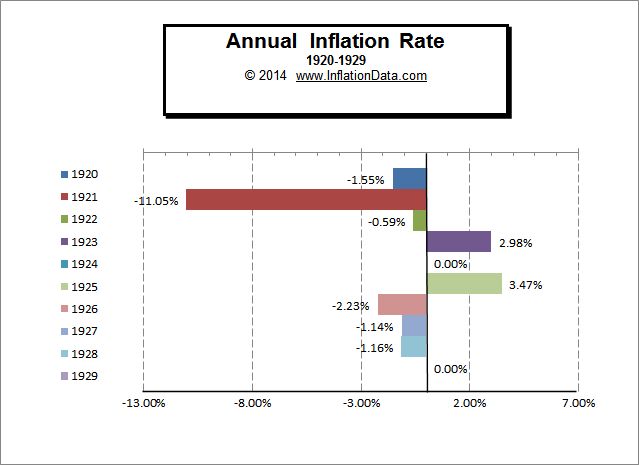

Does this look like a decade of decadent Federal Reserve monetary excess or frankly a near ideal Austrian policy of some years being negative and some positive?

In respect to the Fed's monetary recklessness, they have almost constantly expanded the money supply since the day it was created in 1913
The chart you link shows the money supply almost flat in the 1920s which is the only topic mentioned. The 1920s were not a decade of monetary excess. It was a decade of restraint and should represent a monetary ideal for Austrian economics.
"Lenin is said to have declared that the best way to destroy the Capitalistic System was to debauch the currency. . . Lenin was certainly right. There is no subtler, no surer means of overturning the existing basis of society than to debauch the currency. The process engages all the hidden forces of economic law on the side of destruction, and does it in a manner which not one man in a million can diagnose." -- John Maynard Keynes
Well, printing money is never "restraint" or a "monetary ideal"
https://www.forbes.com/sites/nathan...-the-myth-about-money-growth/?sh=1716f94b6c09For example, between 1880 and 1900, the monetary base in Italy actually shrank by 4.8%. However, the monetary base in the U.S. grew by 81% over those same years
but the Fed has, obviously, been the primary culprit in all US market crashes
The money supply should grow with the economy which is what would happen in a free market and what happened under the gold standard from 1870-1913. Between 1880 and 1900 the money supply grew by 80%. No Federal Reserve.
There wasn't a Federal Reserve until 1913. There were constant crashes without a central bank. Booms and busts are part of human nature and will happen whether a central bank exists or not. Bubbles are part of human nature and human nature doesn't change.
Nice try, but I qualified "since it was created."
Yes, that good old-fashioned "bitter end liquidation" is the perennial solution to youthful animal spirits.
1. 1920s stock bubble. Not caused by Fed. See stats above
2. Forcing bitter end liquidation though deflationary monetary policy is central planning.
If you think the Fed causing inflation is bad, you should think the Fed causing deflation through purposeful monetary contraction is bad. /thread


