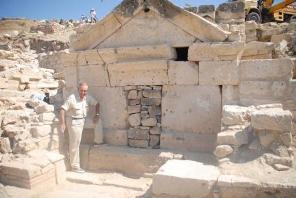
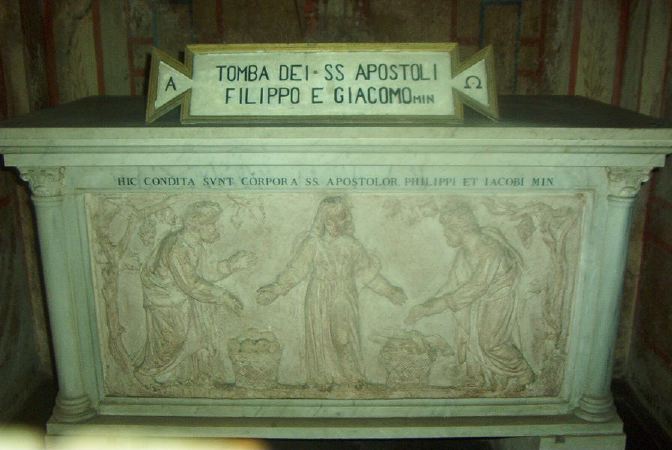
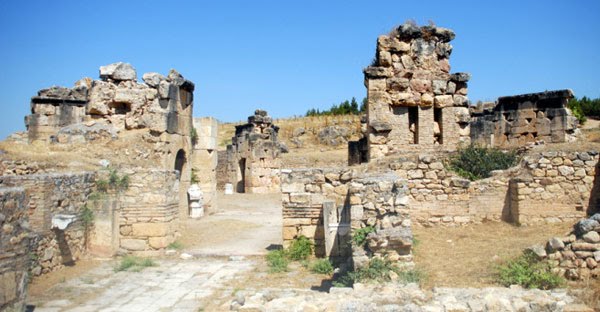
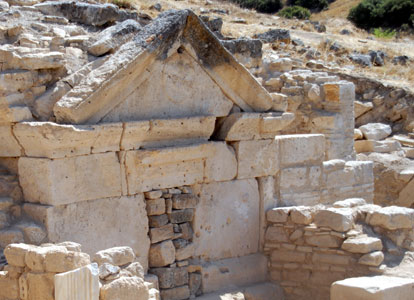
St. Philip’s Martyrium at Hierapolis draws thousands over the centuries
By Francesco D’Andria
The apostle Philip was hung on a tree upside down with irons in his heels and ankles in Hierapolis in Asia Minor.
One of the 12 apostles, according to all four Gospels, Philip was born in Bethsaida on the northern shore of the Sea of Galilee (John 1:44, 12:21). His later career, after the Resurrection, is recounted in the apocryphal Acts of Philip.
Philip was dispatched with his sister Mariamne and Bartholomew, another apostle with whom he is often paired, to preach in Greece, Syria and Asia Minor. In Phrygia in western Asia Minor, the threesome came to Ophiorhyme; that is, “Serpent’s Town,” so-called because the inhabitants worshiped serpents and a viper called Echidna. Images of the viper and serpents filled the town, including the serpent temple with its statue of Echidna. The preaching of Philip and his colleagues, however, brought many of the townspeople to Jesus.
When Nicanora, wife of the pagan proconsul, fell ill with various diseases, especially to her eyes, she too became a Christian under Philip’s influence. On one occasion Philip spoke to her in Hebrew, and she cried out, “I am a Hebrew and a daughter of the Hebrews; speak to me in the language of my fathers. For, having heard the preaching of my fathers, I was straightway cured of the disease and the troubles that encompassed me.”
Philip led a prayer for Nicanora:
Thou who bringest the dead to life, Christ Jesus the Lord, who has freed us through baptism from the slavery of death, completely deliver also this woman from the error, the enemy; make her alive in Thy life and perfect her in Thy perfection, in order that she may be found in the country of her fathers in freedom, having a portion in Thy goodness, O Lord Jesus.
This sent her husband, the proconsul and a worshiper of the snakes, into a fury. The text says he “raged like an unbroken horse.” He threatened her and called the Christians magicians. She urged “the tyrant” to convert: “Flee from the wicked dragon and his lusts; throw from thee the works and the dart of the man-slaying serpent,” she counseled her husband. If he would convert and “live in chastity and self-restraint, and in fear of the true God,” she would continue to live with him all her life; “only cleanse thyself from the idols and from all their filth.”
The proconsul again went into a rage. He would like nothing better, he said, than to see her “committing fornication with these foreign magicians.” He had Philip, Bartholomew and Mariamne beaten and scourged with thongs of raw hide and then dragged through the streets and, finally, brought to the serpent temple. Many of the townspeople who had converted to Christianity were brought with them. There they prayed and, according to the Acts of Philip, the pagan temple shook to its foundations.
The proconsul then had Philip, Bartholomew and Mariamne stripped and searched for the source of their “enchantments,” their magical powers that appeared to threaten the serpent temple. Mariamne they displayed naked so the people could “see her indecency, that she travels about with these magicians, and no doubt commits adultery with them.”
Philip and Bartholomew he ordered “hanged head downwards” with nails and iron hooks in their heels and ankles.
At the announcement of their punishment, Philip and Bartholomew smiled for “their punishments were prizes and crowns.” As for Mariamne, a cloud of fire enveloped her so that the crowd could not look at her nakedness.
In answer to Philip’s cry while hanging upside-down on the tree, an abyss suddenly opened and swallowed the proconsul and the viper temple where he was sitting, as well as the viper priests and 7,000 men, plus women and children. They promptly called to God from the depths of the earth, because “we now see the judgments of those who have not confessed to the Crucified One. Behold the cross illumines us. O Jesus Christ, manifest Thyself to us.” A voice replied, “I shall be merciful to you.” And all were restored.