Mises Wire
Vincent Cook
05/27/2025
Incorrigible truth-teller
Dr. Ron Paul recently pointed out that
cutting military spending would make for a big and beautiful bill; certainly a bit more beautiful than the
One Bloated Brobdingnagian Bill (falsely labeled the “One Big Beautiful Bill”) that House Republicans—with the notable exceptions of
Thomas Massie and Warren Davidson—actually voted for. Paul astutely observed that cutting the Pentagon would be much more popular with voters than the widely-touted cuts to Medicaid and food stamps, which (
as Davidson pointed out) amount to fake deficit-reduction anyways since these cuts only apply to later fiscal years and would be easily repudiated by future Congresses. Such illusory cuts aren’t likely to survive anyways once the “One Bill to Rule Them All” is taken up by the Senate.
Contrary to Dr. Paul’s prescription,
President Trump asked for a $119.3 billion
increase in military spending for FY2026, including a costly space-based missile defense system, additional pork for Naval shipbuilders and other defense industries, and an arms and munitions build-up directed against China. Not to be outdone in making the bill uglier, the
House Armed Services Committee jacked up the military spending increase to $150 billion. Unfortunately, Republicans are not heeding Dr. Paul’s advice to give up costly, counterproductive overseas crusades; a foreign policy which would generate a peace dividend by focusing the military on just defending American territory (as advocated by the original pre-World War II
America First movement) while encouraging friendly foreign powers to build up their own strategic defense capabilities on their own dime.
Trump’s xenophobic and
mercantilist ideology works against curbing the Pentagon despite Trump’s
personal ambition to be acknowledged as a peace-maker. It would take principled, rights-respecting policies—not just Trump’s negotiating skill and instinctive disdain for sanctimonious globalists—to pull it off. Trump enthusiastically arming a genocidal ally that is
deliberately starving thousands of children and
reducing extensive urban centers to rubble in the hope of acquiring ethnically-cleansed real estate that Trump envisions will be transformed into an
utterly bizarre beach resort, while also
threatening to bomb Iran and thus risking a
catastrophic thermonuclear blunder, is neither Nobel Prize-worthy nor a formula for reducing the Pentagon’s spending.
The few Republicans who still aspire to pose as budget hawks must feel like they are victims of the Stockholm syndrome as they are blackmailed into voting for a debt limit increase and overall spending increases with the threat that tax rates will go up if they don’t, followed by their President supporting a primary challenger against them.
Republicans are hostage to their own fiscal rhetoric of the past 45 years, still championing President Ronald Reagan’s “
voodoo economics” in spite of the fact that no Republican President since Eisenhower has managed to balance a budget. The basic reason why Republican politicians won’t break with their
long-discredited “supply-side” rhetoric about magically growing revenues via income tax rate cuts, and won’t break with Trump’s more recent falsehoods about
DOGE generating a trillion dollar cut by pretending to chainsaw the federal bureaucracy or
tariffs revenues replacing income tax revenues, is that genuine spending cuts that are substantial enough to actually balance the budget would be wildly unpopular. Unless they can keep fooling the conservatives in their base with talk about voodoo economics and make-believe cuts, Republican politicians simply can’t sustain their pretense of being fiscally responsible.
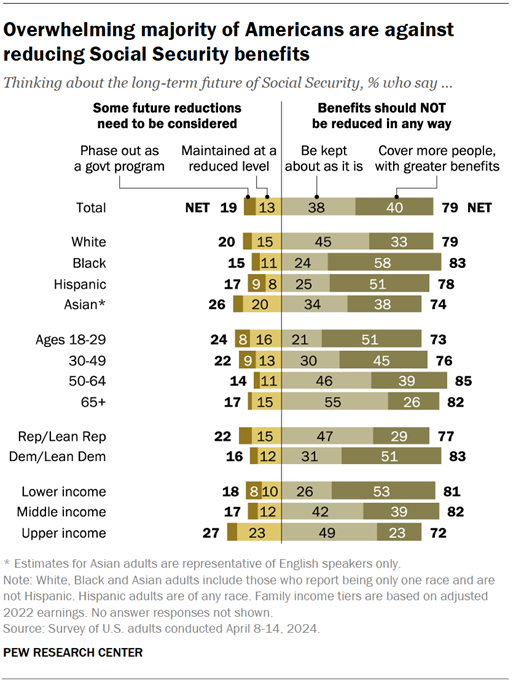
What has changed profoundly since the Eisenhower administration is that President Lyndon Johnson greatly expanded promises of government-guaranteed economic security beyond President Franklin Roosevelt’s original Social Security program, particularly with the enactment of Medicare and Medicaid in 1965. That was followed by President Richard Nixon cutting the dollar off from its last gold backing in 1971, freeing the Federal Reserve to purchase Treasury securities in whatever quantity needed to finance the resulting deficits. The combined malevolence of FDR, LBJ, and Nixon has put the relentless growth of the welfare state on autopilot over the past half century, seducing voters with the hope of having all their future needs taken care of by the federal government instead of them taking personal responsibility for their own well-being. Recent polling data show why modern Republican politicians don’t dare tackle entitlements like Social Security:
Figure 1—American attitudes regarding Social Security benefits
Source: Pew Research Center
This overwhelming support for entitlements makes it politically expedient for Republican politicians to keep spouting “supply-side” drivel instead of frankly confessing to voters that massive deficits divert private savings away from productive investments, killing growth and deindustrializing America just as surely as higher taxes would. Likewise, it would be political suicide to admit that central bank suppression of interest rates and open-ended promises of economic security deter working-age individuals from engaging in thrift in the first place, further crippling capital formation by keeping labor and resource inputs tied up in maximizing present consumption. Telling the truth about such things risks turning even fiercely loyal Republican voters against them.
The truth about the supply-side is that our ability to manufacture and supply anything has been vanishing because entitlement programs have increasingly turned America into a nation of profligate spendthrifts. Thrift deterrence has caused America’s
personal saving rate to decline precipitously over the past fifty years, which—together with massive deficits—has caused America’s
net savings to vanish over the past sixty years, so that
net investment for growing the stock of capital goods has been steadily crowded out by increasing entitlement spending. Of course, no voter wants to hear that the benefits promised are deindustrializing the country. It is far easier to lie and tell voters that trade with the Chinese is to blame.
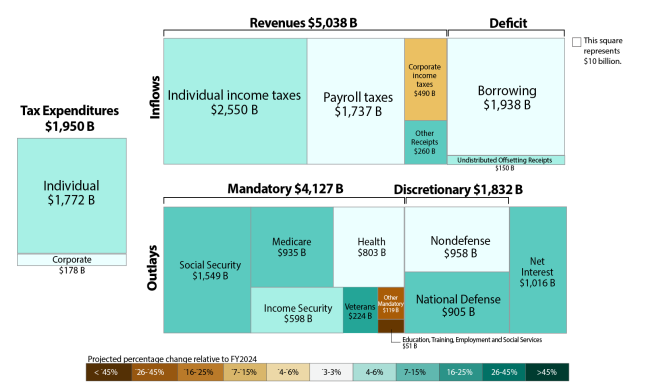
The traditional fiscal debates between Democrats and Republicans over things like income tax rates and the levels of various categories of discretionary spending have simply become irrelevant in light of how much transfer payments have swelled up to absolutely dominate all federal spending. This displacement of discretionary spending by mandatory spending can be visualized by examining the ugly details of the projected budget for the current 2025 fiscal year:
Figure 2—Projected FY2025 Federal Budget
Source: Congressional Research Service
The transfer payment spending mandated by FDR and LBJ’s welfare state legislation plus the interest payments mandated by the Constitution’s 14th Amendment add up to $5,143 billion of spending, compared to total tax revenues of $5,038 billion. Even if Congress eliminated literally
all discretionary spending, including all military spending, it still could not balance the budget. With genuine cuts to mandatory spending ruled out, balancing the federal budget without confiscatory tax increases becomes a mathematical impossibility.
The One Bloated Brobdingnagian Bill passed by the House is a stark confession by Republicans that they are the party of FDR and LBJ, not a party that cares about reducing the size and power of the welfare-warfare state. Consistent with the symptoms of the Stockholm syndrome, the party’s conservative hostages have come to identify with their
shamelessly corrupt captors to such an extent that they willfully evade the fact that their leader is victimizing them by
embracing statist economic policies and by
openly scorning the Constitution and
the rule of law. Republicans seem to be helpless to object to anything the President says or does. Congress hasn’t passed a
formal enabling act to hand its powers over to the President yet, but—apart from a handful of dissidents—Republican representatives and senators have scarcely exhibited much political will of their own lately.
The political risk to Republicans in all this is that as the malfunctioning American economy sinks into chaos, the ascendant socialist wing of the Democratic Party will be quick to fix the blame on Republicans and ride a tide of public anger back into power. The One Bloated Brobdingnagian Bill is also a confession of the Republican Party’s present moral, intellectual, and financial bankruptcy, reflecting its unilateral ideological disarmament in the face of its overtly collectivist enemies and its inability to implement sound fiscal and monetary policies to reverse America’s industrial decline and to save the dollar from a hyperinflationary collapse. Trump will not be able to hold onto power with lies, lawlessness, and corruption indefinitely, and his feckless party won’t be able to cope with the backlash against his dysfunctional regime once the public discerns the true nature of
the Emperor’s New Clothes.
President Trump's so-called “One Big, Beautiful Bill” is more of the same: big and bloated. It adds billions to the federal deficit and does nothing to deal

mises.org