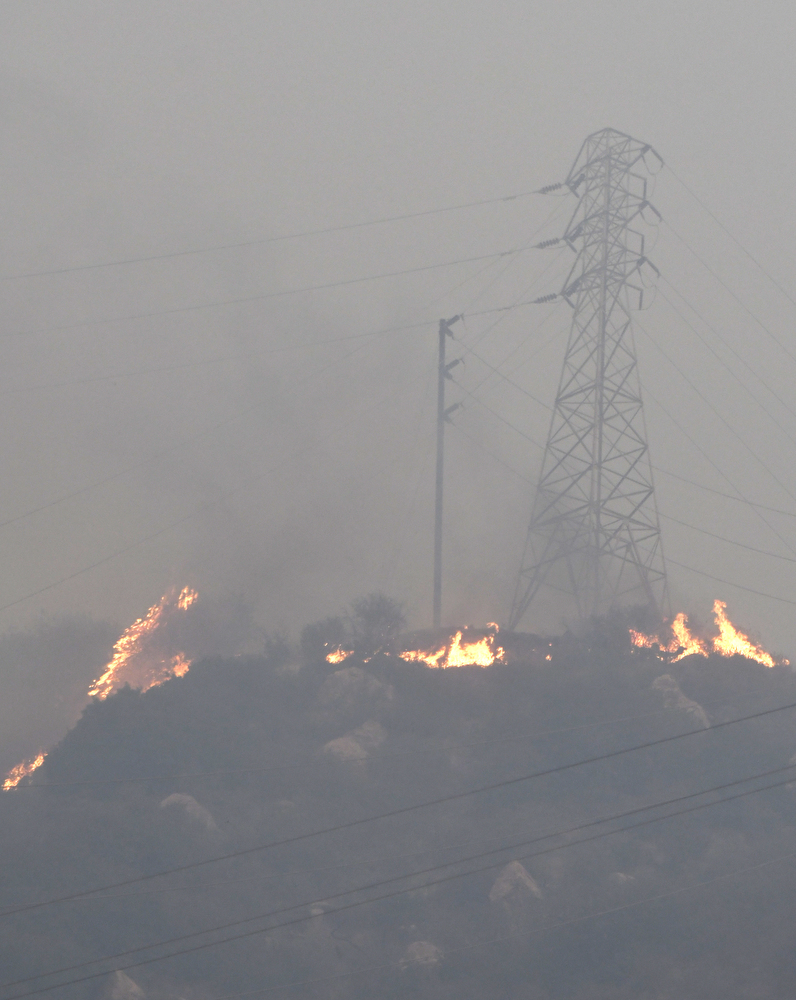
NASA Photos: California Fires Seen From Space, $9 billion in insured losses

Most likely it was "act of God" as there have been various such incidences, considering below recent news , hopefully possible causes are being checekd out.

Cal Fire continues to probe cause of deadly wildfires despite arson arrest


  • Sonoma County Sheriff Robert Giordano said an arson suspect was seen "walking away from a small fire."
  • The 29-year-old suspect allegedly had "a fire extinguisher and a lighter with him," the sheriff said.
  • Despite the arson arrest, Cal Fire said Tuesday afternoon it continues to investigate the cause of each of the wildfires in Northern California.
  • The wildfires have claimed more than 41 lives, and many more people remain listed as missing.

Jeff Daniels | @JeffDanielsca
Published 5:36 PM ET Tue, 17 Oct 2017
https://www.cnbc.com/2017/10/17/cal-...on-arrest.html


60,000 flee massive fires raging across Haifa; arson suspected

Buildings consumed in several locations; 11 neighborhoods cleared; 100 treated for minor injuries; other fires across country; Greece, Russia, Cyprus, Turkey send help; police chief: some suspects in custody

By TOI staff 24 November 2016


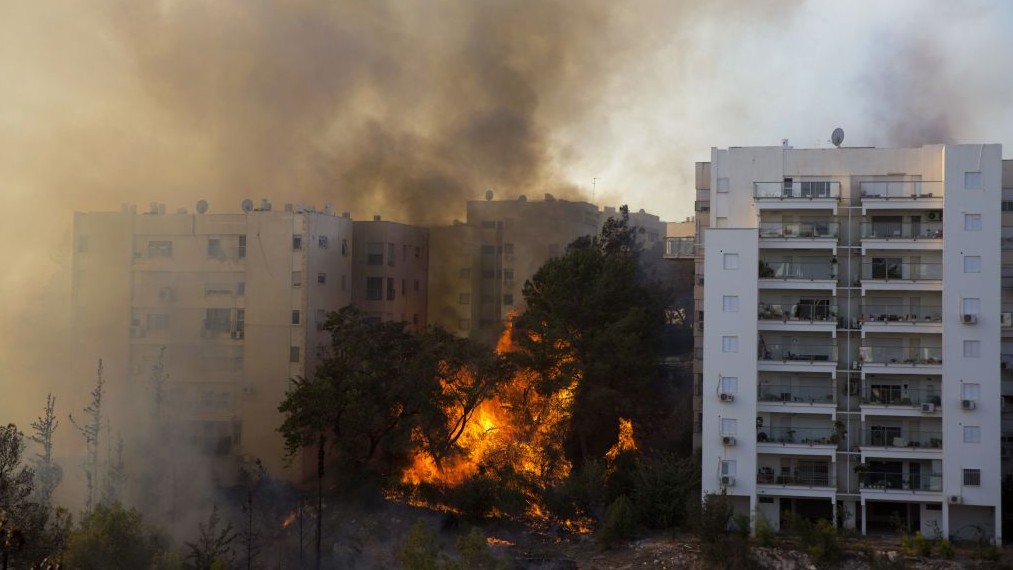
A picture taken on November 24, 2016 shows a bushfire raging in the northern Israeli port city of Haifa. Hundreds of Israelis fled their homes on the outskirts of the country's third city Haifa with others trapped inside as firefighters struggled to control raging bushfires, officials said. (AFP PHOTO / Jack GUEZ)

Some sixty thousand people were evacuated from their homes in Haifa Thursday as a wave of wildfires threatened the bay metropolis, bolstered by high winds and dry conditions that have contributed to a spate of blazes across the country this week.
 
ybTvcN


"Come on Rihanna take your panties of for me"
 
So this fire is still raging on, fifth largest fire on record and may very well go up in the list.. I've been having to wear a mask outside due to all the smoke.

But here's a funny government failure:

With a rush to pick crops before they wilted under the ash, owners nevertheless dispatched their workers, masks or no masks. Complaints started flooding into Cal/OSHA, but the state agency had closed its regional headquarters in Van Nuys and its Oxnard satellite office soon after the fire began. Recordings told callers they could fax a complaint form that would be received the following week. But under mounting pressure from Ventura residents, and state legislators Monique Limón and Hannah-Beth Jackson, Cal/OSHA reopened its Oxnard office on Friday and started deploying staff into the fields.


https://www.independent.com/news/2017/dec/11/ventura-farm-workers-spanish-speakers-left-out-tho/
 
https://www.independent.com/news/2017/dec/21/russia-rescue-thomas-fire/

Be200-on-the-step_t958.jpg


Russia to the Rescue in Thomas Fire?


Why the Federal Government Shot Down Plans to Bring Russian Supertankers to Town​

Thursday, December 21, 2017


At 4 a.m. on Friday, December 8, as the Thomas Fire bore down on Ventura and four other wildfires ripped through the state, David Baskett, a Santa Maria Public Airport District director, got a call from a Russian Federation official offering the services of his country’s giant firefighting airplanes to augment Cal Fire’s busy fleet of helicopters and tankers. Minister of Trade and Industry Denis Manturov had also sent a letter to Governor Jerry Brown’s office and, the Russian official said, opened lines of communication with FEMA, the U.S. Federal Emergency Management Agency.

“We in Russia are worrying about [the] situation with the extensive forest fires occurring in California,” Manturov wrote in his letter to Brown, a copy of which Baskett provided to the Independent. “To fight such disasters in Russia we use the Be-200 [amphibious] aircraft manufactured by Taganrog-based Beriev Aircraft Company. These aircraft proved to be effective for fighting fires of various complexity worldwide, and in terms of flight/technical performance, the Be-200 aircraft has no equivalents in the world.”

The offer didn’t come completely out of the blue. Baskett, who also operates the private aviation consulting firm International Emergency Services, has worked for the better part of a decade to bring the water-scooping Russian Be-200s to the Santa Maria Public Airport, a Central Coast base for firefighting aircraft. Similar proposals have been made over the years, Baskett said, but this one came with a greater sense of urgency as the Thomas Fire was actively consuming hundreds of homes and quickly growing to become the second-largest fire in modern California history.

“The Santa Maria Airport is fully operational and able to accept anything the Forest Service or Cal Fire wants to bring in, as long as the aircraft meets the category of aircraft we are designed for,” Chris Hastert, Santa Maria Public Airport general manager, told the Santa Maria Times, who first reported on Russia’s offer. “The Be-200 definitely falls within our design category.”

Believing FEMA was on board with the idea and speaking directly with the Russian Federation’s Ministry for Civil Defense, Emergencies and Elimination of Consequences of Natural Disasters (EMERCOM), Baskett started the ball rolling on the logistics. He contacted Cal Fire chiefs, booked rooms for the Russian pilots at the Santa Maria Radisson, and expected arrivals as soon as the following week. But a cease-and-desist email from a FEMA attorney threw cold water on his plans.

“I have received numerous emails forwarded to me where you have contacted Cal Fire officials claiming that FEMA has accepted offers of assistance from EMERCOM,” J.P. Henderson wrote to Baskett. “I have verified with our HQ International Affairs office that these claims are false. No offer has been made to FEMA.” Henderson threatened to sic federal authorities on Baskett if he didn’t stop publicly discussing the matter.

“I stand by what I said,” Baskett told the Independent this week. He said he’s tried repeatedly to confirm FEMA had in fact received a formal offer from EMERCOM by contacting the FEMA official who’d reportedly been in touch with the Russians, Deputy Director of International Affairs Andrew Slaten. Baskett said he’s received no response from Slaten.

Speaking on behalf of Cal Fire and Governor Brown’s office, Janet Upton said the state currently doesn’t have a need for additional emergency aircraft. “We have a fleet of over 90 aerial firefighting aircraft at our disposal in Southern California, including the DC-10 and 747,” she said. “We don’t have any aircraft orders being unfilled.” Even if there were a need for Be-200s, Upton went on, Russian officials must make their offer through the proper official channels. “They have been advised on what the process is,” she said. A FEMA spokesperson said that process involves the agency’s International Affairs Office.

Baskett acknowledged that right now — as the Thomas Fire continues to burn dangerously close to Santa Barbara and Ventura homes — might not be the most opportune time to coordinate a complicated emergency aid relationship with a foreign government at diplomatic odds with the United States. Nevertheless, he said, the offer should be seriously considered, as Be-200s could save property and lives during the next wildfire.

The planes, which carry more water than any of their U.S.counterparts, have been deployed around the globe, including in Israel, Spain, France, and Indonesia. They’re a backbone of Russia’s firefighting force, which routinely battles massive wildfires, like those in 2010 that burned 740,000 acres, killing 54 and causing $15 billion in damages. Baskett laughed at suggestions from others that his Russian connections are conspiratorial. “Yes, I collude with Russia,” he said, “to bring better aircraft here.”

 
CFPI_Photos_from_Thomas_Fire_5_t958.jpg


https://www.independent.com/news/2017/dec/20/rise-privatized-firefighting/

Thomas Fire Reveals the Rise of Privatized Firefighting


With a Little Extra Cash, You Too Can Get Extra Fire Protection​

Wednesday, December 20, 2017


A man in a navy-blue jumpsuit stood on Highway 192 in Montecito next to what looked like a pool-repair truck. One of California’s largest wildfires raged just a few miles away. His long hair tucked behind a workman’s cap did not identify him as one of the 8,300 firefighters battling the 260,000-acre scorcher.

The man in the jumpsuit was not a pool-repair worker; he was in the protection business. He worked for a private firefighting company that was contracted to do “structure protection” for a house nearby, on Buena Vista Drive. It was Sunday, December 10, a week before the Thomas Fire ripped west near multimillion Montecito estates owned by Oprah Winfrey, Katy Perry, Rob Lowe, and Julia Louis-Dreyfus, among others.

The company, Mt. Adams Wildfire, based out of the Sacramento area, is just one of many private companies that have been spotted throughout Montecito to “wrap” expensive homes hidden by lush foliage. The workers coat buildings with white foam or bright pink retardant to douse embers that fly onto roofs or underneath the eaves. They trim back brush and clear debris. Their work is largely preventive rather than active firefighting. “We are not there when the fire is 200 feet away,” said Irene Rhodes, owner of Consumer Fire Products based in Goleta. “That’s how people get hurt.”

Private fire-protection companies are sent by high-end insurance companies, such as Chubb or AIG. Others are hired by individual homeowners. By one estimate, they pay $3,500 per day on top of a $5,000 retainer fee.

Historically, these private companies have been controversial. Private trucks are not tracked by incident commanders, and private employees do not necessarily operate by the same safety standards, public fire officials said privately. They could pose risks if employees were trapped in a danger zone or on blocked roadways being used by municipal fire trucks trying to get out.

Fire officials said private companies have gotten better at coordinating with public agencies in recent years. Still, a clear map of where they are and who they are does not exist.

“I wouldn’t know them if I saw them,” County Fire spokesperson Captain Dave Zaniboni said. “They just show up. They are just doing their own thing, and we don’t really know what that is. We don’t include them in the operational plan.”

Rudy Evenson, a spokesperson for the Thomas Fire Incident Command, said four private companies ​— ​AIG Red Zone, Wildfire Defense Systems, Capstone, and Firestorm ​— ​are working on the wildfire. Though it is not required, these companies sent personnel to check in at the Incident Command headquarters. But there are no definite figures for the number of engines and employees they have in the area.“I don’t have any information about where they were,” he said, adding, “What they do on private property is up to them.”

Some private companies send liaisons to the daily incident briefings. Rhodes said they tune in their radios to the same channels and check in with the fire’s incident commanders. “It’s different on every fire,” she said.

While some companies have given the private industry a bad name, cooperation and acceptance by the public agencies has grown, several in the fire profession suggested.
One of Rhodes’s products, the Foamsafe FireMaster System, is installed in advance and automatically dispenses a white biodegradable foam on houses when it detects fire a half mile away. Some companies use a red retardant that can harm paint, pets, or plants.

Rhodes said she has 65,000 clients in the 12 western states. In the Thomas Fire, the company has protected about 50 homes, ranches, and businesses. Many houses were on Park Lane, Toro Canyon, East Camino Cielo, and other areas that hugged the fire’s perimeter. As of press time, they were all still standing, she said.
One client, homeowner Carol Kommerstad-Reiche, said during the Tea Fire she was frantically trying to pack up her $11 million Woodley Road home by herself. The service gave her peace of mind.

Consumer Fire Products hasn’t lost a home in 18 years, Rhodes claimed. “I woke up this morning and thought today might be the day,” she said last Saturday, December 16, when deafening 65-mile-an-hour winds rushed the fire west, blackening 20 Montecito homes. (More than 1,300 were deemed threatened.)

Last Saturday, when thick smoke and ash cast a hellish pall over the Santa Barbara coast, some Montecito homeowners who did not have private engines parked in their driveway grew frantic. They called their insurance agents to complain, and others hired structure protection services themselves.

Homeowners are easily spooked when wildfires break out, particularly when they see flames and smoke from backfires set to control the main blaze. “People get very frightened and are very emotional,” said Fran O’Brien, division president of Chubb Personal Risk Services. “They call up and ask, ‘Why isn’t the engine at my house?’”

O’Brien said Chubb agents explained to clients that they surveyed hundreds of houses threatened by the Thomas Fire and prioritized them based on “intel on the ground.” They have 11 engines, each with two employees in them, working the fire, she said.

One Toro Canyon homeowner, Cheryl Giefer, heard about Chubb’s fire-protection services from her neighbors. When the fire first crossed the Santa Barbara County line, her husband called their insurance provider, Allstate, to see if they offered similar services. Shortly after they were evacuated, she received text messages and iPhone photos from private firefighters who showed up to her property. “House is okay now but the fire is at the back on the hill coming down,” the message read.

Other companies send email updates. “We will continue to patrol your property throughout the day and night, staying on high alert for fire threat and taking any mitigation actions available,” read one update from Consumer Fire Products.

David Torgerson of Wildfire Defense Systems said there has been a steady increase in the company’s insurer wildfire programs. He said they provide supplemental support “without replacing any of the public wildfire responders.” We are not “first responders,” he said, adding that the company has maintained a 100 percent safety record on all of the 450 wildfires they have been dispatched to in the last 10 years.

Mt. Adams Wildfire, it turns out, is one of the many private companies the U.S. Forest Service contracts with for extra support. “It saves money,” owner Don Holter said. The private firefighters are not unionized ​— ​“No overtime, no retirement,” he said.

Like many essential public-safety services ​— ​private prisons and private neighborhood security firms ​— ​protecting homes from fire is becoming more privatized. One top fire official working the Thomas Fire asserted that public firefighters “treat everyone the same.” But for $3,500 a day, you can get special treatment.

 
Last edited:
https://www.independent.com/news/2017/dec/21/thomas-fire-and-rise-massive-wildfires/

The Thomas Fire and the Rise of Massive Wildfires

Thomas Fire Is Just Latest Megafire, Which Spark Renewed Interest in Prescribed Burns​

Thursday, December 21, 2017


Leave it to Andy Caldwell to play skunk at the garden party.

Last Tuesday morning, as county supervisors were getting an update on the Thomas Fire, California’s latest and soon-to-be-largest megafire, the mood was somber and grim. Anyone wearing a firefighter’s uniform was drenched in gratitude. The absence of finger-pointing was total.

Then Caldwell, conservative watchdog in chief for the Coalition of Labor Agriculture & Business (COLAB), took to the podium. “This is on you,” he blasted, blaming the supervisors and environmental activists for the damage wrought by the Thomas Fire. “These are not just wind-driven fires ​— ​they are policy-driven fires.”

What happened to prescribed burns, he wanted to know, that could keep such fires in check? “The guilty parties (activists, bureaucrats, and politicians) should be prosecuted for negligent homicide,” he charged in a subsequent written statement.

Caldwell’s organization in fact emerged from the ashes of 1990’s catastrophic Painted Cave Fire, when hundreds of burned-out homeowners found their efforts to rebuild stymied by overwhelmed bureaucrats they saw as hostile, indifferent, and incompetent. Caldwell, who is simultaneously confrontational, bombastic, and congenial, is a taste many in political life have made a point not to acquire. But the question he raised about prescribed burns is gaining new currency in the wake of the Thomas Fire and other fire-zillas, which are hitting California with increased frequency and devastation.


“There’s definitely more interest from citizens, local governments, and county boards of supervisors,” said Nic Elmquist, a fuels specialist with the Los Padres National Forest. He added that the U.S. Forest Service’s new chief, Tony Tooke, enthusiastically supported prescribed burns in the southeastern United States and is expressing keen interest in reviving the practice out west.

Prescribed burning is a decidedly old-school practice designed to keep wildfires from running amok while also protecting reservoirs and dams from the massive siltation and sedimentation that follows. It’s done by creating a patchwork of squares ​— ​a few thousand acres each ​— ​throughout heavily vegetated terrain by burning the brush. This doesn’t stop fires from breaking out, but it slows their rate of growth and acceleration.


The last major burn conducted in the Los Padres torched 35,000 acres between Santa Maria and Cuyama in 2012. But the practice’s heyday had long passed by then, done in by the logistical challenges involved in pulling one off, not to mention the high costs, environmental opposition, and legal nightmares that ensue when the occasional controlled burn gets off its leash.

This renewed interest comes at a time when climate change is rewriting the meteorological rule books before our eyes. With temperatures climbing and rainfall on the wane, the number of megafires ​— ​which are classified as anything 100,000 acres or more ​— ​is spiking nationwide.

“Fires are starting later in the season than before; they’re bigger than before, faster than before, hotter than before, more destructive, and more expensive,” said Michael Kodas, director of environmental journalism at the University of Colorado and author of Megafire. In 1995, there was usually one megafire a year in the United States, but in the past decade, California alone has had one a year. In 2017, megafires claimed nearly 8.8 million acres of land throughout the United States. That’s another record.

With snowpack melting sooner and summers lasting longer, California’s fire season has grown by 50 days a year since 1980. Nationally, 84 percent of all wildfires are started by humans. In California, where development in the urban-wilderness interface is especially acute, that number is 90-95 percent. Until the Thomas Fire broke out, 12 of California’s top 20 largest wildfires took place after 2000. Of those, six have struck since 2010.

Pushing this trend, Kodas said, is not just climate change, but what he called the United States’ “zero-tolerance” approach to wildfires, leading to a policy and practice of all-out suppression. That’s served only to increase the fuel load of the national forests, Kodas stated. “We need an attitude change.”

On the question of prescribed burns, there’s no shortage of attitude. Kodas, for example, believes they can be effective if done at the right time of year. But everyone sees “right” differently. For wildfire control, it’s better to burn chaparral ​— ​the dominant life force in our backcountry ​— ​in the spring when it’s cool, moist, and easier to control. But environmentalists contend chaparral is less likely to reseed successfully if the burning takes place in the spring rather than later in the year. This failure to reseed, they argue, makes chaparral more vulnerable to competition from exotic, non-native grasses, which, they point out, are quicker to ignite and flashier to burn once on fire.

In Santa Barbara, old-time ranching families are familiar with controlled burns. Caldwell said the county fire department used to deploy a napalm thrower to initiate its burns. Santa Barbara City Councilmember Bendy White, who was involved in several burns 30 years ago, recalled working with one rancher who mounted a flamethrower on the back of his jeep. “It was a hoot,” White said.

Environmentalists have opposed prescribed burns in court, hiring the Environmental Defense Center to block efforts to cut six-foot-wide fuel breaks along portions of the Gaviota Coast. Not only do such burns destroy native chaparral, they argue, but they fail to provide the protection people so desperately want. For example, the Thomas Fire hopscotched over three prescribed-burn areas in Ventura County, said Rick Halsey, director of the California Chaparral Institute, before heading west to Santa Barbara.

“Prescribed burns don’t stop wind-driven fires,” said Halsey. “What’s destroying homes and killing people are fires driven by wind and heat.” Protection against that, he argued, can best be achieved by creating defensible space around new or existing structures, building ​— ​or retrofitting ​— ​with fire-retardant materials, and installing outdoor sprinkler systems.

That’s an arguable point, as is everything relating to prescribed burns. According to the Forest Service’s fuel expert Elmquist, the Thomas Fire ran out of steam after it bumped into the area burned out 10 years before by the Zaca Fire and other areas burned out more recently by the Tea and Jesusita fires. By corralling the Thomas Fire into these spaces with newer, lighter fuels, firefighters successfully took much of the heat steam off.

But prescribed burns aren’t easy to pull off. Under the Forest Service’s criteria, a prescribed-burn plan has no fewer than 21 separate elements that have to be satisfied. “A lot of people aren’t as comfortable with them as they used to be,” Elmquist said. “A lot of agencies have to be involved.”

And sometimes prescribed burns get out of control, which is inevitable and tends to result in relatively minor burns of 150 or so extra acres. But no one can forget the Cerro Grande Fire of 2000 that started out as a controlled burn in the town of Los Alamos, New Mexico. After burning down more than 400 homes, gobbling up nearly 48,000 acres, and encroaching onto the Los Alamos National Laboratory, the Cerro Grande remains one of the most expensive fires in U.S. history, even by today’s inflated standards.

If current trends continue, the number, size, and intensity of megafires will explode. A recent Harvard study indicates the acreage consumed by megafires could well double by the year 2050. Maybe by then there will be greater agreement on strategies for limiting the size and damage inflicted by such fires. Or maybe not.

“We need a smarter plan,” Kodas said. “We know we’re never going to eradicate tornadoes. It’s not going to happen. Well, we’re never going to eradicate wildfires either.”

 
Riding Along with Chief Pat McElroy, Surveying the Thomas Fire Damage

Retiring City of Santa Barbara Fire Chief Takes Us for a Ride​

Thursday, December 21, 2017


That mantra was manifest Monday morning, with unscathed homes riding the ridges, their existence marvels of modern ingenuity and poor planning combined. Whether such homes belong on such remote, vulnerable terrain remains a debate for another day. But so long as they offer spectacular, $20 million views ​— ​in fact, Thomas Fire officials appraised the South Coast’s residential real estate value at $46 billion ​— ​that’s probably a conversation that will never happen

https://www.independent.com/news/2017/dec/21/riding-along-chief-pat-mcelroy-surveys-thomas-fire/


That dude is a such a commie..


But not as much as this guy:

[FONT=&quot]DavyBrown [/FONT][FONT=&quot] 2 hours ago[/FONT][FONT=&quot]We really DO need a big public debate about whether "such homes belong on such remote, vulnerable terrain..." [and if they're defensible], but Nick's dystopian cynicism and worship of the wealthy rings true: "that’s probably a conversation that will never happen." <—SB Co. Supes — can't hear you doing your jobs?!!


[/FONT]


Last edited:
[h=1]Montecito Mudslide Death Toll Climbs to 16[/h]
Two Dozen More Still Missing; Hundreds Trapped in Romero Canyon
https://www.independent.com/news/2018/jan/09/montecito-mudslide-death-toll-climbs-16/


[h=1]Two-Year-Old Girl Rescued by Montecito Family[/h]
[h=5]Tuesday, January 9, 2018[/h] By Kelsey Brugger

At about 4 a.m. on Tuesday, Montecito resident Berkeley “Augie” Johnson heard the faint sound of a child crying. It was pitch black. A 10-foot wall of rocky, muddy water had barreled down Olive Mill Road for nearly an hour. Johnson and a team of firefighters who had arrived spread out through the street to search for anyone trapped in the sludge. They waded through the debris, grabbing anything they could hold on to — branches, metal poles, roots, and boards. Several minutes later, a firefighter reached several feet down and pulled out a 2-year-old girl who looked like a “muddy doll.” Another firefighter cleared her airway. She was transported to the hospital. The girl suffered an injury to her hip, Johnson later learned, but she is expected to be fine. “I don’t know how that baby survived,”
 
Candlelight Vigil Remembers Those Lost to the Flood

Officials Hold Update on Search for Survivors​

Sunday, January 14, 2018


A somber, candlelit vigil to remember the victims of the mudflow that inundated Montecito on January 9 took place at the Santa Barbara Courthouse just a few minutes after search officials concluded a meeting to brief the media on the job of finding survivors. Most of them drove from Earl Warren Showgrounds to the Courthouse Sunken Gardens, which was full to overflowing. At one point during the vigil, Congressmember Salud Carbajal enjoined the mourners to look around and observe that all the community was present, and Supervisor Das Williams, who took Carbajal’s place in Montecito’s 1st District, reminded everyone that not only the rich lived there.
 
21 dead, 2 still missing.. they figure they may have been carried out to sea.
 
Back
Top