liberty2897
Member
- Joined
- Jun 10, 2011
- Messages
- 1,147
As far back as I can remember, I've thought the Voyager spacecraft are right up there with the moon landings when it comes to Engineering / Scientific achievements. As someone who spends most of their time developing technology to collect data over "long-range" RF links, I can't help but think of how amazing it is that these crafts launched in 1977 with a once-in-a-lifetime, time-limited opportunity to explore the entire solar system successfully. Long ago setting records for longest-range human-created telemetry, highest-velocity human spacecraft, Imaging from the edge of our solar-system with Earth in the view. 36 Years of Plutonium-238 power supply and still going. Pretty much as cool as technology gets in my opinion.
http://www.theguardian.com/science/2013/aug/17/voyager-leaves-solar-system-nasa
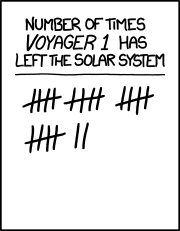
Scientists split over whether Nasa probe has finally left the solar system after 36 years

On a mission: Voyager pictured in 1979. Photograph: Time & Life Pictures/ Getty
http://www.theguardian.com/science/2013/aug/17/voyager-leaves-solar-system-nasa
Scientists split over whether Nasa probe has finally left the solar system after 36 years
On a mission: Voyager pictured in 1979. Photograph: Time & Life Pictures/ Getty
Edward Helmore
The Observer, Saturday 17 August 2013 12.10 EDT
It's 36 years since Voyager 1 was dispatched in 1977 on a mission to send back images of Jupiter's turbulent atmosphere and volcanic eruptions on one of its moons, Io. Then it was due to travel on to Saturn to examine that planet's intricate system of rings and moons. But after travelling more than 11bn miles, where is Voyager now? No one, it seems, knows for sure.
Nasa scientists including Edward Stone, the father of the programme at Nasa's Jet Propulsion Laboratory in Pasadena, say Voyager 1 has yet to pass beyond the reach of our sun's radiation. But a controversial study published last week in the Astrophysical Journal claims Nasa scientists misinterpreted magnetic field data and the satellite passed beyond the boundary known as the heliosheath a year ago. Put another way, Voyager 1 has left the solar system.
According to Marc Swisdak, an astrophysics researcher at the University of Maryland and lead author of the study, Voyager 1 made that giant leap on 27 July 2012, when it recorded a permanent drop in heliosphere-produced particles and an increase in galactic cosmic rays from outside the solar system.
"Our three lines of data are consistent with Voyager being outside the solar system," Swisdak told the Observer last week. "There's a class of particles generated within the solar system and we're not seeing them any more. Then there's the question of the magnetic field. You can get outside the solar system without seeing too much of a shift in the data." As Voyager clears the distortion, he says, the magnetic data will begin to conform.
"This is the first opportunity to take actual direct measurements of the particles and the magnetic fields," said Swisdak. "Instead of a indirect, complicated chains of arguments, we can say what's actually out there – and that's something rare in astronomy. Voyager is allowing us to see what's really out there."
Nasa has yet to confirm the finding. Scientists at the California Institute of Technology, led by Stone, believe the craft is travelling through a mysterious region at the edge of the heliosphere. They have said they will know Voyager has left the solar system when magnetic fields emanate from the long arms of our galaxy, not the sun.
But after running 100,000 processor hours of computer simulations on a Berkeley supercomputer called Hopper, Swisdak's team claim Nasa is failing to account for "magnetic reconnection" – when opposing magnetic field lines come together, snap and form new connections. They hypothesise that the magnetic fields of the sun and of interstellar space join in "magnetic islands" that make the border uneven.
Their study echoes claims made earlier this year – and dismissed by Nasa – in the journal of the American Geophysical Union that Voyager had travelled outside the solar system. This time Nasa has taken a more measured approach. "The Voyager 1 spacecraft is exploring a region no spacecraft has ever been to before," said Stone. "We will continue to look for any further developments over the coming months and years as Voyager explores an uncharted frontier."
Conceived of to take advantage of a rare alignment of Jupiter, Saturn, Uranus and Neptune that occurs once every 175 years, Nasa's original programme was designed for a "Grand Tour" of the solar system by harnessing the gravity of one planet to swing to the next. The mission's two probes, Voyagers 1 and 2, used satellites designed to last just five years. Yet they sail on, at 55,000km/h, their cameras shut down and using only essential instruments to ration power from their plutonium batteries that are expected to last until around 2020.
Scientists have estimated that in 40,000 years each spacecraft will be in the neighbourhood of other stars and about two light years from the sun.
Famously, each carries a phonograph record – a 12-inch gold-plated copper disc – containing 115 images and a variety of natural sounds and spoken greetings from Earth in 55 languages, along with messages from the then US president, Jimmy Carter, and UN secretary general Kurt Waldheim.
Leaving the solar system, Stone told Scientific American, will be "a milestone in human activity".
Both Voyagers will likely outlive Earth, he added: when, billions of years from now, the sun swells into a red giant, the Voyagers, albeit without power, will continue on course for the unknown.
Swisdak says: "Nothing comes close to Voyager in terms of interplanetary missions. They wanted to look at Jupiter and Saturn. Then, using a little wizardry, they got Voyager 2 to go by Uranus and Neptune. But nobody ever dreamed we'd get a look at interstellar space."