Elon Musk buys Twitter for $44 billion

Sorta wondering when Elon Musk, DARPA deepstate front-man, lover of massive government subsidies and Agenda 2030 carbon credits, became a hero to right-wing conservatives? Just because he may be involved in taking Twitter private and tweets a few words about free speech?

Seems scripted by the usual "If we tell the right that the left hates this person, the right will reflexively embrace this person" propaganda operations. It's a bit too obvious of a tactic used these days to get the right to embrace people as standard-bearers that they should not embrace. I guess it still works though since few actually look into the backgrounds of people like Musk.

elone-musk-conspiracy2.jpg
 
Sorta wondering when Elon Musk, DARPA deepstate front-man, lover of massive government subsidies and Agenda 2030 carbon credits, became a hero to right-wing conservatives? Just because he may be involved in taking Twitter private and tweets a few words about free speech?

Seems scripted by the usual "If we tell the right that the left hates this person, the right will reflexively embrace this person" propaganda operations. It's a bit too obvious of a tactic used these days to get the right to embrace people as standard-bearers that they should not embrace. I guess it still works though since few actually look into the backgrounds of people like Musk.

*yawn* Yeah, yeah, yeah, we get it, already. Elon Musk is "controlled opposition" - and the rest of us are just a bunch of blind fools and idiotic suckers being hopelessly and haplessly manipulated by the omni-competent and all-encompassing script-masters because we happen to like something about a rich and influential guy who otherwise has some self-interested opinions and policy positions we disagree with.

Sorry, but I'm gonna need an exhaustive analysis of the numerological significance of the number of "likes" received for tweets that were posted by Elon Musk on certain augural dates before I am entirely convinced of his utter and irredeemable perfidiousness.
 
...
But until now, Musk’s criticisms do not appear to have been personal or targeted at individual Twitter employees. His responses to the tweets from Enjeti and online influencer Mike Cernovich also reveal the chaos — and potential harm — that can ensue when the incoming owner of a company amplifies criticism of workers there.
...

If I could ask Musk one question right now, I would ask how he will decide who to fire. It is a difficult question.

My recommendation would be to wipe out upper management entirely, anyone not doing real work. And eliminate any diversity or inclusion BS positions. Best to do it right up front.
 
*yawn* Yeah, yeah, yeah, we get it, already. Elon Musk is "controlled opposition" - and the rest of us are just a bunch of blind fools and idiotic suckers being hopelessly and haplessly manipulated by the omni-competent and all-encompassing script-masters because we happen to like something about a rich and influential guy who otherwise has some self-interested opinions and policy positions we disagree with.

Sorry, but I'm gonna need an exhaustive analysis of the numerological significance of the number of "likes" received for tweets that were posted by Elon Musk on certain augural dates before I am entirely convinced of his utter and irredeemable perfidiousness.

I notice you didn't refute anything I wrote, just personal ad hominem. You're above that. Or at least you used to be.
 
If I could ask Musk one question right now, I would ask how he will decide who to fire. It is a difficult question.

My recommendation would be to wipe out upper management entirely, anyone not doing real work. And eliminate any diversity or inclusion BS positions. Best to do it right up front.

Even if he makes a sincere and genuine attempt to institute significant changes, he will certainly be resisted and undermined from within.

Depending on how "hands on" he is willing to get, there may not be much he can do about it.

HR departments have far greater control over a company's "culture" than CEOs or owners do.
 
Even if he makes a sincere and genuine attempt to institute significant changes, he will certainly be resisted and undermined from within.

Depending on how "hands on" he is willing to get, there may not be much he can do about it.

HR departments have far greater control over a company's "culture" than CEOs or owners do.

My guess is that most "changes" will happen on a case by case basis, as people bring specific things to elon's attention... via twitter.
 
My guess is that most "changes" will happen on a case by case basis, as people bring specific things to elon's attention... via twitter.

At least until Elon gets swarmed with this stuff and figures out its unsustainable, then in a knee jerk reaction he fires entire executive staff
 
I notice you didn't refute anything I wrote, just personal ad hominem. You're above that. Or at least you used to be.

I didn't waste time trying to refute anything you wrote because what you wrote cannot be refuted.

As I noted earlier in this very thread, that is precisely the problem inherent in all "controlled opposition" narratives:

nfalsifiable accusations of "controlled opposition" are a flamethrower that can roast anyone it's pointed at.

If one wished to do so, one could make the case that Ron Paul is "controlled opposition". Hell, I wouldn't be at all surprised if someone had already done so. And then, of course, any person making such a case could in turn be accused of being "controlled opposition" - and so on and so forth. Rather than riding that endless merry-go-round, I would just break the cycle and say that if Ron Paul (or, yes, even Elon Musk) is "controlled opposition", then by God and sonny Jesus, we could do with more "controlled opposition" - a lot more.

And then there's the fact that even someone with ulterior motives for insincerely advocating genuinely libertarian ideals would nevertheless still be advocating genuinely libertarian ideals. It doesn't take a Clausewitz or a Sun Tzu to realize that that is not a particularly good strategy if one's objective is to suppress or thwart the expression of libertarian ideals. Quite the opposite - which is precisely why so many enemies of liberty are screeching so hysterically about Elon Musk right now (entirely regardless of whatever Musk's motives or purposes might actually be).


I could accuse you of being "controlled opposition" who is deliberately trying to undermine and disparage what appears to be a positive development in the "information wars" - and there is nothing you or anyone else could do to disprove or refute it that I could not in turn dismiss as just being more evidence of you being "controlled oppostion" (perhaps for no other reason than merely because you tried to disprove or refute it).

And then you could accuse me of being "controlled opposition" who is just trying to confuse the matter even further ... (and so on and so on ...)

Yeah, well, those are exactly the kinds of things that "controlled opposition" would say about Elon Musk.

(See how that works?)

Or maybe the things the controlled opposition would say the controlled opposition would say about him.

Or things the controlled opposition would say the controlled opposition would say the controlled opposition would say about him.

It's turtles controlled opposition all the way down ...

There are things for which Elon Musk can (and should) be reasonably criticized.

There are likewise things for which he can (and should) be reasonably praised.

Dismissing or sneering at the latter things in order to preserve or protect the former things as uncontroverted proof of "controlled oppostion" is just an elaborately unproductive exercise in confirmation bias. It is intellectually sterile - it explains everything, and in so doing, it explains nothing. It is the ultimate self-justifying black pill.
 
Last edited:
Of course he is. Don't be an idiot....again.

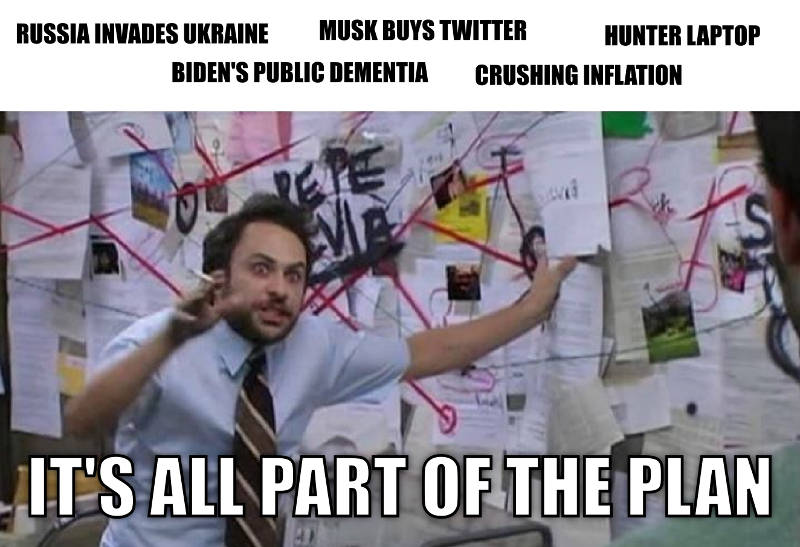
It's hilarious to me how the people who scoff at the 3,000-hyper-dimensional Trump/Qanon chess are the ones baiting 15-million-hyper-dimensional Elone Moosk chess.

its-all-part-of-the-plan.jpg
 
More whinging from The Washington Post:

***** SPOILER ALERT / TL;DR : It's just awful that the feds (and the Democrats in particular) aren't doing or can't do nearly enough to control & regulate speech. *****

Biden’s tech agenda gets a reality check as Elon Musk buys Twitter
Washington’s hands are largely tied as the world’s richest person acquires an influential social network, an impact of the regulatory void around social media companies
https://www.washingtonpost.com/technology/2022/04/27/tech-regulation-biden-musk
Cat Zakrzewski & Craig Timberg (27 April 2022)

The Biden administration arrived in Washington with an ambitious agenda for taming Big Tech, which it portrayed as concentrating too much power in the hands of a few billionaires — the moguls of a new, digital Gilded Age.

Elon Musk’s $44 billion deal to buy Twitter has put that critique into sharp relief, underscoring how badly Biden’s tech agenda has stalled in the 15 months since taking the White House.

The world’s richest person has bought one of its most influential social media platforms — and Washington’s hands are largely tied.

Musk, notorious for flouting regulators and running afoul of the Securities and Exchange Commission, will wield enormous discretion over thorny decisions about what content stays on and off the social network, and how the company handles the data privacy of its millions of users. By taking the company private, Musk will be subject to even less scrutiny than powerful executives of other publicly traded companies, such as Meta CEO Mark Zuckerberg.

Lawmakers now find themselves stymied, after failing for years to implement guardrails on social media companies that might force greater accountability of Musk. The deal does not present obvious antitrust conflicts, exposing the limits of Congress’s recent focus on regulating the largest tech platforms

“We’ve been asleep at the wheel,” said Rep. Ro Khanna, a Democrat who represents Silicon Valley and has advocated greater regulation of the tech industry. “It’s unsettling that a change in ownership can create that kind of change in public discourse.”

Activists, academics and lawmakers who once pinned their hopes on a more assertive federal government now are increasingly looking abroad — mainly to Europe — in the hopes that foreign regulators might have the clout to curb Silicon Valley’s worst abuses. European policymakers appeared eager to take up that mantle, responding with a warning for Musk.

“Be it cars or social media, any company operating in Europe needs to comply with our rules — regardless of their shareholding,” tweeted Thierry Breton, the European commissioner for the internal market. “Mr. Musk knows this well. He is familiar with European rules on automotive, and will quickly adapt to the Digital Services Act.”

The rhetoric across the Atlantic stood in contrast to the White House, where press secretary Jen Psaki declined to comment on the deal. She said that President Biden has “long been concerned about the power of large social media platforms.”

Musk has sought to portray himself as a “free speech” absolutist, saying in a Tuesday tweet that he is against “censorship that goes far beyond the law.”

“If people want less free speech, they will ask government to pass laws to that effect,” he wrote.

But despite the majority of Americans supporting greater regulation of tech companies, Washington has not passed comprehensive legislation on the tech industry in decades.

The Biden administration and Democrats promised an unprecedented regulatory assault on Silicon Valley when they regained power in Washington in 2021. Motivated by the role they said Facebook, Twitter and other social networks played in spreading falsehoods during the 2020 election and inflaming extremism, they proposed changes to an Internet liability law known as Section 230, privacy protections and new competition rules. Biden named prominent tech industry critics to key antitrust enforcement roles. Following revelations from Facebook whistleblower Frances Haugen later last year, they expanded their vision — promising children’s safety legislation and greater transparency around the black box algorithms that power major tech platforms.

Yet as the midterm elections approach, many Democrats are fearful their party will lose control of the House and possibly the Senate — closing their window to pass significant tech legislation.

The party’s ambitions have collided with the realities of governing in a deeply polarized Washington. Lawmakers in the United States are more constrained than their European peers in regulating social media, because of First Amendment protections that limit government regulation of speech. Tech regulation has also taken a back seat to pressing policy dilemmas as the pandemic stretched into its third year, inflation rose and war broke out in Europe. And with a fragile majority broken only by Vice President Harris’s tiebreaking vote in the Senate, Democrats have struggled to achieve even basic tech policy goals — such as breaking the 2-to-2 deadlock at the Federal Trade Commission, the regulatory agency tasked with overseeing competition and privacy issues in Silicon Valley.

“I haven’t seen much of anything from the Biden administration,” said Katie Harbath, a former Facebook public policy director and CEO of consultancy Anchor Change. “Europe’s eating the United States’ lunch on this.”

The legislation that has the most momentum in the Senate are bills that would regulate app stores and prevent large tech platforms from boosting their own products and services over those of their rivals. But neither would apply to Twitter, which has a significantly smaller footprint than Facebook, Apple, Google or Amazon. (Amazon founder Jeff Bezos owns The Washington Post.)

“They’ve done nothing to date except talk about it,” said William E. Kovacic, a former Republican chair of the FTC. “If they want to effectuate basic change, they have to change the law.”

Musk will be required to report his purchase of Twitter to the FTC and the Justice Department, which could slow down the deal by requesting detailed information about the transaction, Kovacic said. But Kovacic said he didn’t see a competitive link to Musk’s other businesses, making it unlikely the agencies would block it.

Tech regulation is at times presented as a bipartisan policy issue, with Republicans and Democrats alike bashing the industry. But despite a flurry of bills and dozens of hearings, the parties are fundamentally at odds over how they believe social networks should be regulated, with Democrats pushing companies to address misinformation, while Republicans critique these limits.

This split-screen reality was on display in the fallout of the Musk deal. The same Republicans who had once criticized former Twitter CEO Jack Dorsey for wielding too much power over Twitter celebrated Musk taking the company into private hands, suggesting that it was a victory for “free speech.” Meanwhile, Democrats criticized the deal as a sign that billionaires have too much influence over the economy, calling for greater tech regulation and wealth taxes.

“Republicans are claiming Musk as their digital Paul Revere, that he’s going to save them and give them a voice again, and the Democrats are expressing concerns about that,” said Jeffrey Chester, the executive director of the digital rights advocacy group Center for Digital Democracy. “It reflected all the deep divisions that our country is enmeshed in.”

In the absence of legislation, lawmakers have largely used congressional hearings and their media megaphones to keep pressure on tech moguls, hauling in Zuckerberg, Dorsey, Bezos and Alphabet CEO Sundar Pichai. Khanna said Congress should have a hearing with Musk to press him on his plans for Twitter, especially how the company’s corporate governance would be structured.

Policy experts largely expect such a hearing with Musk, who is known for his brusque criticism of lawmakers, would devolve into a media frenzy. Musk has bashed Sen. Elizabeth Warren (D-Mass.) as “Sen. Karen” during a Twitter feud about tax policy, and vulgarly suggested that the profile picture of Sen. Ron Wyden (D-Ore.) looks like he just had an orgasm.

“I’m sure it will make great TV, but not good, substantive conversation,” said Evelyn Douek, a senior research fellow at the Knight First Amendment Institute at Columbia University.

Musk appeared to acknowledge the likelihood that he would be called to Capitol Hill, tweeting a smiling emoji in response to Box chief executive Aaron Levie, who tweeted that Musk would “like to be the only human that can be called to congress for up to 63 different topics.”

The challenge of regulating Silicon Valley is compounded because the most controversial developments around social media — such as the Musk deal or social networks kicking off Donald Trump — get the lion’s share of public attention. But areas where there is more consensus, such as passing privacy legislation or transparency requirements for tech platforms, don’t get as much traction.

“We get distracted by these shiny, fantastical, movie-like storylines, while the fundamental, boring systemic issues that need fixing just chug along,” Douek said. “It would be great if we could pick up some of the low-hanging fruit.”

Some policy experts say the challenges in regulating social media companies are indicative of the broader ineptitude in Washington, where Biden’s efforts to pass a signature social spending initiative have been stalled for more than a year.

“We are paralyzed in many, many ways right now,” said Ethan Zuckerman, an associate professor of public policy, information and communication at University of Massachusetts Amherst.
 
Elon Musk Conquers Twitter, and France
https://mtracey.substack.com/p/elon-musk-conquers-twitter-and-france
Michael Tracey (26 April 2022)

[...]

I’ll always maintain that the single thing which most enabled Donald Trump to win the Republican presidential nomination in 2016 was his mastery of Twitter, through which he completely dominated the media and bypassed the pundits, operatives, and “experts” who would otherwise exert outsized influence on the nominating process. Then of course Twitter became his primary communications mechanism during his presidency, before being seized from him in an act of unparalleled corporate usurpation and censorship.

And that doesn’t even begin to scratch the surface of Twitter’s wider cultural influence: all the time now, people get book and movie deals directly through Twitter. The stories one hears are crazy. I don’t know how you can have lived through the past 10 years with any cognizance of Twitter’s impact and still dismiss it as a silly distraction. If anything, you should be ever-more appreciative of its power!

That power, I would guess, is at least part of why Elon Musk paid the premium. Maybe he has other motives. But if you go by what he publicly states, his intention is to restore free speech as the platform’s paramount ethos, impose more transparency on its algorithmic inner-workings, and introduce some kind authentication process that gets rid of bots. I know — sounds horrifying!

All the media/activists who are so infuriated by this can’t seem to specify how exactly they foresee their Twitter user experience being changed under Musk’s ownership. Presumably, they’ll still be able to follow or not follow whomever they choose, block and mute at will, etc. So what’s the problem? Well, the problem should be obvious, and almost doesn’t even need articulating: they will no longer be able to coerce Twitter’s management to accede to their demands. Since roughly 2016, they’ve progressively shifted the platform away from what Jack Dorsey had once declared to be its mission — “Twitter stands for freedom of expression” — and instead gotten it to “stand for” whatever the most shrill activists and journalists wanted. Which was not “free expression” — but to wield their cultural and political leverage to mold Twitter policy in accordance with their own niche worldview.

This meant constant frenzied hectoring that Twitter moderators needed to more aggressively intervene on the platform to protect adults from “harmful” content. And it meant demanding that Twitter monitor/regulate speech more and more stringently, on the ground that doing so was necessary to fight some nefarious combination of Trump, Russia, and the scary right-wing white nationalist anti-vax whatever whatever “disinformation” network. To achieve their desired disciplinary measures, they concocted concepts of “harassment” that were never really about harassment per se, but whether the “harassment” victim in question checked the right cultural/political boxes.

Now, it seems, the presumption that they’ll be able to emotionally blackmail Twitter into guaranteed capitulation seems no longer operative. I’m personally most curious if Musk plans to continue allowing Twitter to be used as a vehicle of the US national security state to “counter” official enemies like Russia and China. That to me seems like the real test of his claimed commitment to maximalist “free speech” — and Musk does have a bunch of lucrative Pentagon contracts. So we’ll have to see. Either way, enjoy the meltdown.
 
This meant constant frenzied hectoring that Twitter moderators needed to more aggressively intervene on the platform to protect adults from “harmful” content. And it meant demanding that Twitter monitor/regulate speech more and more stringently, on the ground that doing so was necessary to fight some nefarious combination of Trump, Russia, and the scary right-wing white nationalist anti-vax whatever whatever “disinformation” network. To achieve their desired disciplinary measures, they concocted concepts of “harassment” that were never really about harassment per se, but whether the “harassment” victim in question checked the right cultural/political boxes.

And here is a perfect case in point:

In an article oozing with impotent butt-hurt, The Washington Post [...] characterizes Musk's statement in that tweet as being a "personal attack" that was "targeted" at Gadde, resulting in "racist" harassment of her. (As proof of this, they cite a single unidentified Twitter user who said Gadde would “go down in history as an appalling person". That's it. That's the sum total of the evidence they could muster to support their claim of "racist" harassment.)

Elon Musk on Tuesday used his powerful Twitter account to bolster right-wing users who sharply criticized two company executives, exposing them to the online masses who joined in the attacks.

It started with a tweet from political podcast host Saagar Enjeti, who was responding to a report by Politico that Twitter’s legal, policy and trust leader broke down in tears at a meeting with her staff this week.

“Vijaya Gadde, the top censorship advocate at Twitter who famously gaslit the world on Joe Rogan’s podcast and censored the Hunter Biden laptop story, is very upset about the @elonmusk takeover,” Enjeti tweeted.

Tesla CEO Musk,who acquired Twitter for $44 billion this week, replied, criticizing Gadde’s past actions. “Suspending the Twitter account of a major news organization for publishing a truthful story was obviously incredibly inappropriate,” he wrote.

[...]

Musk’s response Tuesday was the first time he targeted specific Twitter executives by using his nearly singular ability to call attention to topics that interest him. Supporters of Musk, a prolific and freewheeling tweeter with 86 million followers, tend to pile on with his viewpoints.

He has used the platform to criticize Twitter’s decisions in the past, particularly on topics related to free speech and the banning of accounts from individuals who violate Twitter rules. Gadde is the most senior executive responsible for those decisions.

[...]

Twitter users quickly piled onto the criticism of Gadde, including calling on Musk to fire her and using racist language to describe her. Gadde was born in India and immigrated to the United States as a child. One user said she would “go down in history as an appalling person.”

[...]
 
Even if he makes a sincere and genuine attempt to institute significant changes, he will certainly be resisted and undermined from within.

Depending on how "hands on" he is willing to get, there may not be much he can do about it.

HR departments have far greater control over a company's "culture" than CEOs or owners do.

My guess is that most "changes" will happen on a case by case basis, as people bring specific things to elon's attention... via twitter.

At least until Elon gets swarmed with this stuff and figures out its unsustainable, then in a knee jerk reaction he fires entire executive staff

One lesson that could have been learned from the Trump Administration is don't fu*k around. Don't try to figure out who to keep, who to get rid of, who to hire based upon recommendations from the same people who destroyed the organization. Clean house, all in one fell swoop. There will be much whining and gnashing of teeth. The tears will flow, leftist politicians will scream and threaten.

But all of that will happen upon each and every firing of an executive at Twitter anyway. Get it all over at once. Bring in new people you have past experience with and you trust.

I've never read Sun Tzu or anything like that, but I suppose this strategy already has a name.
 
I've already seen talk of getting Twitter barred from "app stores" (Google, Apple) and web services (Amazon).

Remember Parler?

https://twitter.com/naval/status/1518629257622163456
j4ZOu1S.png


And don't exclude the international level:

Activists, academics and lawmakers who once pinned their hopes on a more assertive federal government now are increasingly looking abroad — mainly to Europe — in the hopes that foreign regulators might have the clout to curb Silicon Valley’s worst abuses. European policymakers appeared eager to take up that mantle, responding with a warning for Musk.

“Be it cars or social media, any company operating in Europe needs to comply with our rules — regardless of their shareholding,” tweeted Thierry Breton, the European commissioner for the internal market. “Mr. Musk knows this well. He is familiar with European rules on automotive, and will quickly adapt to the Digital Services Act.”

[...]

The party’s ambitions have collided with the realities of governing in a deeply polarized Washington. Lawmakers in the United States are more constrained than their European peers in regulating social media, because of First Amendment protections that limit government regulation of speech. Tech regulation has also taken a back seat to pressing policy dilemmas as the pandemic stretched into its third year, inflation rose and war broke out in Europe. And with a fragile majority broken only by Vice President Harris’s tiebreaking vote in the Senate, Democrats have struggled to achieve even basic tech policy goals — such as breaking the 2-to-2 deadlock at the Federal Trade Commission, the regulatory agency tasked with overseeing competition and privacy issues in Silicon Valley.

“I haven’t seen much of anything from the Biden administration,” said Katie Harbath, a former Facebook public policy director and CEO of consultancy Anchor Change. “Europe’s eating the United States’ lunch on this.”

https://twitter.com/arstechnica/status/1519403221625802754
MTEdcC2.png
 
Twitter workers freaking out over Elon Musk in internal Slack messages
https://nypost.com/2022/04/27/twitter-workers-freak-out-over-elon-musk-in-internal-slack-messages/
Andy Ngô (27 April 2022)

Leaked internal communications by Twitter employees reveal woke employees are overtaken by despair and anger about Elon Musk’s month-long effort to acquire Twitter.

Musk announced he would purchase the company for $44 billion on Monday. The deal concludes a month-long saga that began with Musk first tweeting out polls and his thoughts about the decline of free speech on Twitter.

On the business communication platform Slack, some Twitter employees vented against the new owner, leaked messages reveal.

“Physically cringy watching Elon talk about free speech,” a site reliability engineer who identifies as a nonbinary transgender and plural person wrote.

“We’re all going through the five stages of grief in cycles and everyone’s nerves are frazzled,” wrote a senior staff software engineer who called Musk an “a**hole,” and tried to console his colleagues. “We’re all spinning our wheels, and coming up with worst case scenarios (Trump returns! No more moderation!). The fact is that [Musk] has not talked about what he’s planning on doing in any detail outside of broad sweeping statements that could be easily seen as hyperbolic showboating.”

A senior staff video engineer announced he would be quitting, “Not the place to say it perhaps, but I will not work for this company after the takeover.”

Following the back-and-forth among multiple employees angry about the news, some warned that their communications on Slack could be searched. The employees then moved their conversations onto their personal devices using the encrypted chat application Signal.

Twitter’s leadership appeared to predict an internal backlash and possible sabotage when it locked down the ability of its employees to make changes to the platform through Friday.

Leading up to Monday’s deal, Twitter employees had already been venting for weeks on Slack about Musk and defending the platform’s moderation enforcement.

A reliability engineering manager said Musk’s views on free speech “is cover for ‘I want to not be held accountable for saying or amplifying harmful things.’”

Another engineer wrote that “self-reported censorship is sometimes just horrible people f—king around and then find[ing] out.” A senior content strategist responded, “and it doesn’t happen often enough.”

That senior content strategist, who worked as a left-wing political operative outside of Twitter, led many of the conversations that were heavily critical of Musk.

“Sometimes I think it can’t be as bad as I’m imagining it’ll be. Then I see something like this and I’m all ‘nope it’ll be even worse,’ ” she wrote responding to a Musk tweet last week.

But not all employees kept their views within internal business chats. Some of the strongest comments against Musk were made publicly on employees’ Twitter accounts.

Addison Howenstine, a software engineer, tweeted: “You asked me why El*n M*sk buying 9.2% of Tw*tter and getting a board seat is bad and I’m explaining why this was clearly not his end goal and things will certainly get worse and potentially be dangerous for democracy and global affairs.”

Jay Holler, an engineering manager, broke down in multiple tweets earlier in the month when it was announced that Musk could take on a leadership role. “The problem with @elonmusk is that he has demonstrated a pattern of harmful behavior consistently that disproportionately impacts marginalized people, so maybe let’s not give him any more power than he already stole?” Holler later tweeted, “I’m radicalized now.”

Connor Campbell, a nonbinary front-end engineer, responded directly to Musk on Tuesday defending Twitter’s censorship of the Post for its reporting on Hunter Biden’s laptop shortly before the 2020 presidential election.

“Twitter had a policy about hacked documents. We applied this policy equally,” Campbell claimed. The contents of the laptop were not hacked, as The Washington Post and The Times both acknowledged. Former Twitter CEO Jack Dorsey said it was a “total mistake” at a congressional hearing last year.

Laura Gomez, who used to lead localization for Twitter, tweeted: “A M*sk-owned Twitter is one of the greatest threats to the 2022 and 2024 elections. We are f*cked if this happens.”

A M*sk-owned Twitter is one of the greatest threats to the 2022 and 2024 elections. We are f*cked if this happens. https://t.co/ozWltJ3IwG
— laura i. gómez (@laura) April 25, 2022

Separately on Slack, multiple Twitter employees disparaged this journalist repeatedly for posting screenshots of their colleagues’ publicly available tweets. They discussed ways they thought his tweets could be a violation of Twitter’s policies.

“How is this [Ngo] a–hole verified?” asked a senior staff software engineer. Multiple employees used insults to refer to this journalist before conceding that the tweets didn’t violate their rules. They suggested to one another to remove mentions of Twitter employment in their Twitter biographies.

Though many of the internal Slack comments were personally critical of Musk and his views, a few employees weren’t as outraged and some actively pushed back.

“I don’t know much about him, I don’t really care. I would just love free speech to be [the] highest priority. I don’t care who leads that. Especially for minorities like myself, I had no rights at all in my home country,” said a woman in the design department.

Another software engineer wrote, “I do think it’s obvious that our policies are biased (everyone has a bias) and I would personally like to see more balance. IDK if Musk is the right person to do that but the idea of someone who might be less biased towards the things we are already biased on is something that I like.”
 
Back
Top