Sowell: Minimum wage madness leads to rising unemployment

The minimum wage increase is not related to the cost of living increase (inflation). The Federal Reserve system is responsible. As I mentioned above:

You really need to sit back and think about this statement. While I agree the fed is most definitely the biggest problem of our money losing its value. You must understand that a minimum wage increase does cause inflation even though on a smaller scale than the fed. Business is not going to cut profits to pay a higher minimum wage, they are in business to make money, they will raise their prices to make up for the difference lost in higher payroll costs. Which in return causes you to get less for the money in your pocket. Inflation hurts those with the least amount of money the most, simply because money is worth less.
 
You really need to sit back and think about this statement.

You are right. I shouldn't have said "not related." I am against the minimum wage. Although printing a trillion or so extra dollars a year and wasting it, IMHO, is much worse.
 
Why are we even comparing the minimum wage with the fed? They are both bad. Why did this thread come to this vs that. Obviously the fed is worse but that doesnt diminish the minimum wage and its harmful effects.
 
  • Like
Reactions: PRB
I agree. The rocking deck chair would have a better view on the starboard side rather than the port side of the Titanic.
 
It's occurred to me I'm starting to behave in a troll like manner in this thread. Back to the min. wage debate. You have my apologies.

(I'm bowing as I exit the virtual door.)
 
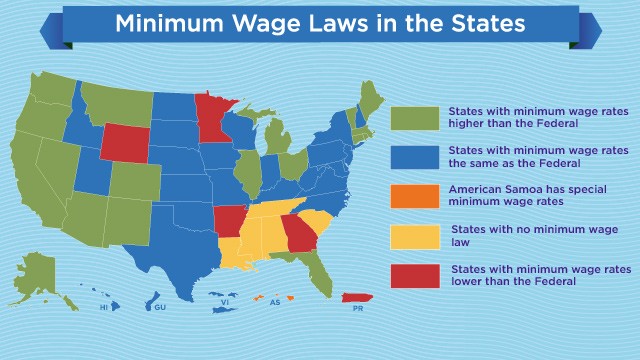
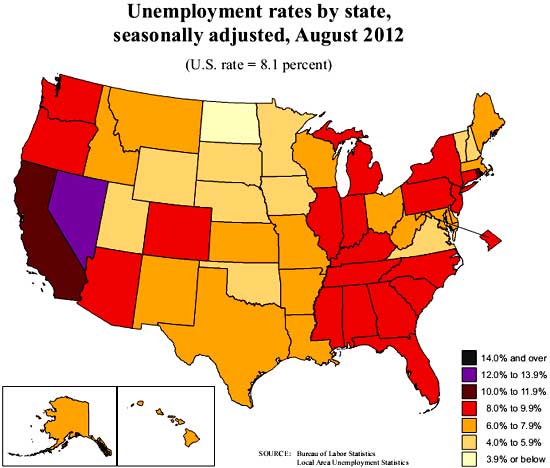
Perhaps we can look at something like this. First, a chart of states with highest/ lowest minimum wages.
minimum_wage_laws_states_map_wg.jpg

http://abcnews.go.com/Business/states-highest-lowest-minimum-wages/story?id=16330751

stateempmap812.jpg

http://www.economicpopulist.org/category/topic-meta-tags/state-unemployment-map

Seems pretty mixed- likely factors other than minimum wage effecting the unemployment picture in most states.
 
Last edited:
increase minimum wage.. increase sales tax.. increase taxes in general = fail sauce for businesses, especially small businesses.
 
It depends on how high the minimum wage is. I heard them talking about raising it to $10 an hour. That'll do some noticable damage.

That depends on which states have already a close to $10 an hour effective wage. But yes, if some states have a $5 minimum wage, such as GA or WY, they'll hurt greatly!
 
You really need to sit back and think about this statement. While I agree the fed is most definitely the biggest problem of our money losing its value. You must understand that a minimum wage increase does cause inflation even though on a smaller scale than the fed. Business is not going to cut profits to pay a higher minimum wage, they are in business to make money, they will raise their prices to make up for the difference lost in higher payroll costs. Which in return causes you to get less for the money in your pocket. Inflation hurts those with the least amount of money the most, simply because money is worth less.

One question I love asking liberals is this : putting aside whether minimum wage causes less employment. Just ask them "If more people can afford to live, will cost of living just remain the same so people can save extra money, have extra entertainment money and borrow less money forever?" Some actually will tell you "Yes, cost of living will not go up if you paid people more"
 
Perhaps we can look at something like this. First, a chart of states with highest/ lowest minimum wages.
minimum_wage_laws_states_map_wg.jpg

http://abcnews.go.com/Business/states-highest-lowest-minimum-wages/story?id=16330751

stateempmap812.jpg

http://www.economicpopulist.org/category/topic-meta-tags/state-unemployment-map

Seems pretty mixed- likely factors other than minimum wage effecting the unemployment picture in most states.

First...ceteris paribus.

Second "No minimum wage" simply means 7.25. Likewise "Lower than the federal" also means 7.25. The states really only have the power to raise the minimum wage not lower or get rid of it (Sadly) if they did places like Louisiana and Mississippi would have very low unemployment.

There was this pic going around with a pic of san francisco saying that it had the highest minimum wage in the country but lower unemployment than the national average. There minimum wage policy hurts primarily the poerer suburbs and satellite cities of san francisco, namely oakland. Most people who actually live in San Francisco are higher income earners and thus the minimum wage doesnt effect their employment. The poorer people who would work minimum wage jobs probably work outside city limits and commute in. Further you dont even have the look that far, if they look at teenager and young adult unemployment or those only with a high school degree or less the unemployment in San Francisco im sure would be above the national average in those categories.

Ideally we should have no minimum wage anywhere, but a good compromise and something that is more politically feasible would leave this up to the states.
 
Last edited:
According to BLS statistics, about 4.7% of hourly workers get paid the Federal Minimum wage or less and 59% of all workers are hourly. That would mean that the minimum wage effects about 2.8% of all workers.

http://www.bls.gov/cps/minwage2012.htm

In 2012, 75.3 million workers in the United States age 16 and over were paid at hourly rates, representing 59.0 percent of all wage and salary workers. 1 Among those paid by the hour, 1.6 million earned exactly the prevailing federal minimum wage of $7.25 per hour. About 2.0 million had wages below the federal minimum.2 Together, these 3.6 million workers with wages at or below the federal minimum made up 4.7 percent of all hourly paid workers. Tables 1 through 10 present data on a wide array of demographic and socioeconomic characteristics for hourly paid workers earning at or below the federal minimum wage
 
Looks like , left of the Ohio River Valley , Illinois , Nevada and California are suckiest, lol , imagine that.
 
According to BLS statistics, about 4.7% of hourly workers get paid the Federal Minimum wage or less and 59% of all workers are hourly. That would mean that the minimum wage effects about 2.8% of all workers.

http://www.bls.gov/cps/minwage2012.htm
I think you mean currently, only about 3% are paid minimum wage or lower, but if it were raised to $10, anybody paid $10 or less would be affected.
 
The higher you raise it the more workers it will effect. Further those are the people who got a job. That figure doesnt show the number of people who want to work but cant because their productivity is worth less than 7.25 per hour. (There probably not even counted in the government unemployment statistics unless they are actively looking for a job, which many im sure are not considering how comfortable welfare can be) A lot of the costs and unintended consequences of the minimum wage are hard to quantify. Like the amount of people who never got on the job experience thus improving their marketability in the labor force.
 
A friend of mine told me quite a while ago that the minimum wage should be eliminated. At the time I really didnt understand what he was proposing and thought it was a terrible idea. Once I thought about what he said and let it sink in for a while, I understood what he was talking about. Kind of adding to the point of what gwax23 said. What my buddy was trying to tell me is, without a minimum wage (and of coarse without government meddling as it is) business would boom in this country. Like gwax23 said many more people will be employable with a lower wage. Many are not worth the minimum wage now so they are not given a chance, but given a chance at a lower wage they could develop their skills.

With the influx of non-skilled labor jobs they would create a demand for skilled jobs (to build their machines or fix them etc etc) Wages would probably be higher than now for the hard workers and skilled personal as money wouldn't be wasted paying someone minimum wage that is not generating it back. Businesses will pay to keep a good, skilled hard worker on their team, the lack of minimum wage would not cut earnings for people that do their job and do it well (like they should). Workers should be paid what they are worth to the company, not paid what the government says.

The elimination of minimum wage would help bring back some work ethic to this country which has been lost with all of the government and union interference in business.
 
Explain Nevada for me, thanks.

I think Las Vegas at least was one of the hardest hit when the housing bubble burst. In fact, I wouldn't be surprised if there is not decent correlation between how hard a state was hit by the housing collapse and the 2012 unemployment rate.

Any takers?
 
Back
Top