Rand Paul to Obama: "Prioritize" Passage of Trans-Pacific Partnership

Oh, I see... Your problem with this is that you think we should strike independent deals with each nation?

Yes. So far I have not seen a multilateral trade agreement that turned out to be in our national best interest. NAFTA, WTO, GATT, the FTAA etc. Just like I don't trust the Federal government anymore, at this point I do not trust multilateral trade agreements in general.
 
Listen, I'm a free trader. I'd like every country in the world to promise to allow open trade with every other country. But that's not reality. There are still too many people who believe protectionism is a good thing.

I'm a free trader in principle as well; however: just as open borders are incompatible with a welfare state; I feel that free trade is incompatible with a global fiat currency.
 
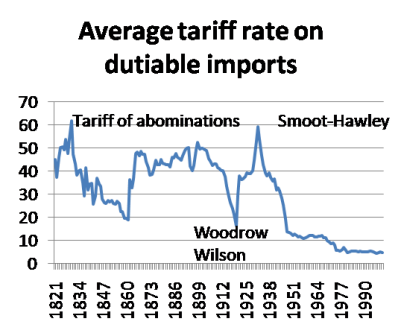
tariff_history.png
 

Wow! I know "correlation does not equal causation" but I would be interested in seeing the amount of internal taxes and regulations in the U.S. superimposed on this graph. I'm betting a negative correlation. (The lower the tariffs the higher the internal taxes and regulations.) And look at the dramatic drop in tariffs under Woodrow Wilson? We get the IRS, the Federal Reserve, the "League of Nations" and super low tariffs all under the same globalist president. Hmmmmm......
 
Someone had brought up the question of in-fighting among the elite in a pm recently and I thought that this was one of the most profound realizations that I've read relative to what we are seeing here when questioning why one particular high profile person opposes the thing as opposed to another. There is a tremendous amount of in-fighting among the elites at the moment as well as between neocon "thinkers" who reside in both political parties. That's important to acknowledge. I, for one, have shared a great deal of specific instances of this here on the boards and they've went mostly under the radar because it's something that we don't always place into perspective with particular issues where we kind of maintain a cookie cutter type debate with regard to them. Will try to dig some of them up.
 
Last edited:
Oh, I see... Your problem with this is that you think we should strike independent deals with each nation?

I have no issue with multi party deals.

My issue is jurisdiction.


Traditionally, a foreign corporation doing business in the US has two avenues to complain about violations of trade agreements:

1) Local, State, or Federal US courts (just like domestic companies)

2) Additionally, the foreign corporation could, in their home jurisdiction, petition for consular action or lobby for retaliatory economic action to be initiated against the US.


All of these new, supposed "free trade" deals open up a new door which overrides all previous "traditional" dispute settlement channels:

Supranational Investor-State Dispute Settlement
 
Last edited:
Cato discussion:

[video]http://www.cato.org/multimedia/events/tpa-tpp-ttip-you-when-will-we-enjoy-fruits-us-trade-agenda[/video]

Just some additional context.
 
No. My issue is jurisdiction.


Traditionally, a foreign corporation doing business in you US has two avenues to complain about violations of trade agreements:

1) Local, State, or Federal US courts (just like domestic companies)

2) The corporation could, in their home jurisdiction, petition for consular action or lobby for retaliatory economic action to be initiated against the US.
Ok, I understand your concern. Do you concede then, that a multi-lateral agreement would not be possible while ensuring this jurisdiction? So, in effect, you would be limiting the trade deals to bilateral deals at most.
 
Ok, I understand your concern. Do you concede then, that a multi-lateral agreement would not be possible while ensuring this jurisdiction? So, in effect, you would be limiting the trade deals to bilateral deals at most.

Trade deals between sovereign nations shoud be "symbolic", "in good faith", "offering friendship and peace"; not "binding" under "international law".


I have no problem with multilateral deals.


Similarly but off topic... plural marriage does just fine in Utah without authoritarian oversight.
 
Last edited:
Cato discussion:

[video]http://www.cato.org/multimedia/events/tpa-tpp-ttip-you-when-will-we-enjoy-fruits-us-trade-agenda[/video]

Just some additional context.

If you're concerned about "fast track authority", I'd recommend the 20 minute mark. But really, you should watch the whole boring thing.
 

Wow! I know "correlation does not equal causation" but I would be interested in seeing the amount of internal taxes and regulations in the U.S. superimposed on this graph. I'm betting a negative correlation. (The lower the tariffs the higher the internal taxes and regulations.) And look at the dramatic drop in tariffs under Woodrow Wilson? We get the IRS, the Federal Reserve, the "League of Nations" and super low tariffs all under the same globalist president. Hmmmmm......

IIRC, one of the biggest reasons for the significant decline in tariffs prior to the Wilson administration was a long-term (and ultimately successful) effort to woo the support of anti-tariff farmers and populists for (among other things) a system of internal taxation - including the federal income tax. Farmers & other such interests got significantly lower tariffs in exchange for their support for things like the income tax and greater federal control of the banking system. This culminated in the adoption of the Federal Reserve system and the federal income tax in 1913. Once they got what they wanted, the elites stabbed their erstwhile supporters in the back by jacking tariffs up again (note the sharp upward spike after 1913 ...).
 
Trade deals between sovereign nations shoud be "symbolic", "in good faith", "offering friendship and peace"; not "binding" under "international law".

Ok, I almost agree with this. I don't like international law. But this is something of a contract. It's international contract enforcement. To ensure countries do not violate the agreement that they entered into. Unless I'm missing it, TPP would not create any laws. I also agree that trade agreements should be in good faith. But that is not reality. In reality, there are contracts to which parties must agree. That being said, those contracts are only on tariff provisions to which the governments must abide. The traders themselves have signed no such contract - they can manage their prices as they see fit.

Governments don't trade - people do. But governments can secure deals that open the pathways.
 
A key element of sovereignty in a legalistic sense is that of exclusivity of jurisdiction. Specifically, the degree to which decisions made by a sovereign entity might be contradicted by another authority. Along these lines, the German sociologist Max Weber proposed that

sovereignty is a community's monopoly on the legitimate use of force;

and thus any group claiming the same right must either be brought under the yoke of the sovereign, proven illegitimate, or otherwise contested and defeated for sovereignty to be genuine.

http://en.wikipedia.org/wiki/Sovereignty
 
Wow! I know "correlation does not equal causation" but I would be interested in seeing the amount of internal taxes and regulations in the U.S. superimposed on this graph. I'm betting a negative correlation. (The lower the tariffs the higher the internal taxes and regulations.) And look at the dramatic drop in tariffs under Woodrow Wilson? We get the IRS, the Federal Reserve, the "League of Nations" and super low tariffs all under the same globalist president. Hmmmmm......

And where's the Constitutionality in any of it? This is just another transfer of power to some foreign institution. Internationally managed trade benefits special interests. This is just an extension of NAFTA.
 
Probably going to get a better idea of support for or against this thing through foreign media. Asia Times is a good one. The BRICS Post, India Today. Some others...

If nothing else, you'll get a better read on the terms of controversy that we just won't ever hear or read from western legacy media.
 
http://www.hightowerlowdown.org/node/3402#.VGJ5qYUrDCc
This thing is a supersized and nuclearized NAFTA,


the 1994 trade scam rammed through Congress by Bill Clinton, Wall Street's Robert Rubin, and the entire corporate establishment. They promised that the "glories of globalization" would shower prosperity across our land. They lied. Corporations got the gold. We got the shaft--thousands of factories closed, millions of middle-class jobs went south, and the economies of hundreds of towns and cities (including Detroit) were hollowed out. (Most Mexicans got the NAFTA shafta, too. US grain traders like ADM dumped corn into Mexico, wiping out millions of peasant farmers' livelihoods, and thousands of local businesses were crushed when Walmart invaded with its Chinese-made wares.)


Twenty years later, the corporate gang that stuck us with NAFTA is back, hoping to fool us with an even more destructive multinational deal. (This calls for another immortal quote from George W: "Fool me once, shame on--shame on you. Fool me--you can't get fooled again." Well, you know what he meant).


This time we really must pay attention, because TPP is not just another trade deal. First, it is massive and open-ended. It would hitch us immediately to 11 Pacific Rim nations (Australia, Brunei, Canada, Chile, Japan, Malaysia, Mexico, New Zealand, Peru, Singapore, and Vietnam), and its door would remain wide open to lure China, Indonesia, Russia, and other nations to come in. Second, note that many of those countries already have trade agreements with the US. Hence,

THIS AMAZING FACT:
TPP is a "trade deal" that mostly does not deal with trade. In fact, of the 29 chapters in this document, only five cover traditional trade matters!


The other two dozen chapters amount to a devilish "partnership" for corporate protectionism. They create sweeping new "rights" and escape hatches to protect multinational corporations from accountability to our governments... and to us. Here are a few of TPP's provisos that would make our daily lives riskier, poorer, and less free:


Food safety.

Any of our government's food safety regulations (on pesticide levels, bacterial contamination, fecal exposure, toxic additives, GMOs, non-edible fillers, etc.) that are stricter than "international standards," as most are, could be ruled as "illegal trade barriers." Then our government would have to revise our consumer protections to comply with the weaker global standards. Also, our government could no longer ban meat imports that don't meet our safe-to-eat laws, as long as the exporting nation simply claims that its inspection system is "equivalent" to ours. In addition, food labeling laws we rely on (organic, country-of-origin, animal-welfare approved, GMO-free, etc.) would also be subject to challenge as trade barriers.


Fracking.

Our Department of Energy would lose its authority to regulate exports of natural gas to any TPP nation. This would create an explosion of the destructive fracking process across our land, for both foreign and US corporations could export fracked gas from America to member nations without any DOE review of the environmental and economic impacts on local communities--or on our national interests. It also means that most of the gas produced by this violently polluting process will not go to us, but to foreign users, which will raise our consumer prices and cut manufacturing growth.


Jobs. US corporations would get special foreign-investor protections to limit the cost and risk of relocating their factories to low-wage nations that sign onto this agreement. For example, an American corporation thinking about moving a factory would know it is guaranteed a sweetheart deal if it exports to a TPP nation like Vietnam. The corporation could skirt Vietnam's laws and demand compensation at an international tribunal for any government policy or action (such as a hike in the minimum wage) that undermined its "expected" profits.These guarantees would be strong incentives for corporate chieftains to export even more of our middle-class jobs.


Drug prices.

Big Pharma would be given more years of monopoly pricing on each of their patents and be empowered to block distribution of cheaper generic drugs. Besides artificially keeping everyone's prices high, this would be a death sentence to many people suffering from cancer, HIV/AIDS, tuberculosis, and other treatable diseases in impoverished lands. The deal would also restrict the rights of our government to negotiate with drug giants to get lower consumer prices with bulk purchases, as Medicare and Medicaid do in the US.


Banksters.

Wall Street and the financial giants in other TPP countries would make out like bandits: The deal explicitly prohibits transaction taxes (such as the proposed Robin Hood Tax here) that would shut down super-rich speculators who have repeatedly triggered financial crises and economic crashes around the world; it restricts "firewall" reforms that separate consumer banking from risky investment banking (thus prohibiting Congress from reinstating the much needed Glass-Steagall firewall in our country); it could roll back reforms that governments adopted to fix the extreme bank-deregulation regimen that caused Wall Street's 2007 crash; and it provides a backdoor escape from national rules that would limit the size of "too-big-to-fail" behemoths. These extreme provisions would be enforceable by the banks themselves--TPP empowers them to force governments either to repeal reform laws or to compensate banks with taxpayer money for "losses" they say are caused by reforms.


Internet freedom.

Thanks to public rebellion, corporations hoping to lock up and monopolize the internet failed in Congress last year to pass their repressive "Stop Online Piracy Act." However, they've slipped SOPA's most pernicious provisions into TPP. Corporate-created content, for example, would be given copyright protection for a stunning 120 years! The deal would also transform internet service providers into a private, Big Brother police force, empowered to monitor our "user activity," arbitrarily take down our content, and cut off our access to the internet. To top that off, consumers could be assessed mandatory fines for non-commercial, small-scale copying--like sending your mom a recipe you got off of a paid site.


Public services.

TPP rules would limit how governments regulate such public services as utilities, transportation, and education, including restricting policies meant to ensure broad or universal access to those essential needs. One especially insidious rule says that member countries must open their service sectors to private competitors, which would allow the corporate provider to cherry pick the profitable customers and sink the public service. Also, corporations from any TPP nation must be allowed to bid on contracts to provide public services in the US on the same terms as American corporations.

Well, you might think, we'll still have our courts to redress corporate misuse of TPP's provisions. Uh... no. One of the deal's chapters creates a monstrous monkey wrench called the "Investor-State Dispute Resolution" system. In this private, supra-legal "court," corporations are empowered to sue TPP governments over environmental, health, consumer, zoning, or any other public policies that the corporations claim are either undermining their TPP "rights" or diminishing--get this--their


"expected future profits."

These "tribunalists" are not accountable to any electorate, and their decisions are final--there's no appeal to a real court. If a corporation wins a case,


taxpayers


of the government being sued lose, for they must pony up cash to compensate the corporation for its "loss" of profit.
 
Last edited:
Owch. Good post, presence. That's a nice easy one to pass around. I haven't spent as much time as I'd like with regard to the issues of fracking. The old we should drill in every possible conceivable place gag, I found to be alarming just because this is a position based solely upon misguided economic policy abroad and we, of course, see what is happening as nations come into agreement of gas supplies and how they'll move those to each other. We're seeing private property owners here in the states with gag orders forced upon them who were at the receiving end of eminent domain and this should not be abused to take private property from owners who did not consent to fracking on their property which is being done to benefit private developers. And, of course, we would do well to pay attention to the phenomenon in places around the world. The Ukraine is a great example of this.

Here are a couple of discussions with regard to the fracking thing here on the forums. Although there are way better ones that I recall around here some place.

Lifelong ‘frack gag’: Two Pennsylvania children banned from discussing fracking
Frack us! : Documentary
Measure P (Bans Fracking/High Intensity/Cyclic Steam Injection Drilling in Santa Barbara County)
Biden Promotes U.S. as Fracking Missionary Force
The Multi-National Corporate Interests in Urkaine.. same old criminals

Family awarded $3 million in first US fracking trial


Really, there is just a boat load of threads that could be bumped for this but I'm not fiddling with it. If there are reasons to bump those then maybe then. Most people understand what is happening with the fracking thing. Well...I guess.
 
Last edited:
IIRC, one of the biggest reasons for the significant decline in tariffs prior to the Wilson administration was a long-term (and ultimately successful) effort to woo the support of anti-tariff farmers and populists for (among other things) a system of internal taxation - including the federal income tax.

That is my understanding as well.
 
Back
Top