NASA validates impossible drive. 'New' Emdrive could get us to Mars in two weeks!

torchbearer

Lizard King
Joined
May 26, 2007
Messages
38,926
http://theness.com/neurologicablog/index.php/nasa-tests-em-drive/
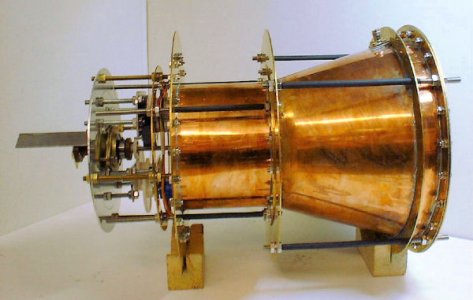
emdrive_2.jpg


I’m skeptical. I know, you’re shocked. When you recover,take a look at this article about NASA “validating” an allegedly impossible drive.The bottom line is that I just don’t believe it. I could be wrong. I hope I’m wrong. I don’t necessarily think the results of NASA’s test are untrue, just that I don’t think they have “validated” that the propellantless drive is what proponents say it is.
My reaction is identical to the claim made in 2011 that a team of researchers found that neutrinos travel faster than light. I didn’t believe those results either. The researchers were very careful, they rigorously reviewed every aspect of their experiment, and only announced the results when they were confident they ruled out all error. The physics community didn’t believe it, but they did their due diligence. After further analysis, it was found that the results were an error – an artifact introduced in the experimental setup. Initial skepticism was vindicated.
The claims made for a machine that can provide thrust without propellant is as unlikely and at variance with the laws of physics as neutrinos traveling faster than light or free energy machines. Sure, it’s always possible that our understanding of the universe is incomplete in a way that allows for one of these phenomena to be true, but our current understanding calls for extreme initial skepticism. Such a stance has a very good history to support it.
At the same time, I wouldn’t invest a dime of my own money in a company claiming to have invented a free energy machine, and I don’t think our taxes should fund such research either. It’s worse than playing the lottery.
Producing thrust without propellant is similar. It seems to violate the conservation of momentum. Conservation laws in physics are among the most reliable and solid of the laws of the universe that we have discovered. Scientists should not idly speculate about violating them.
The idea here is to create a drive that converts energy into thrust without the need for accelerate propellant in the opposite direction. This would transform space travel, and make things like hovercars a reality. Perhaps the biggest limitation of space travel is that you have to carry around your fuel and propellant with you. This means you have to accelerate the fuel and propellant also, and the fuel for accelerating that fuel, etc. Most of the energy spent in getting to orbit is lifting the fuel you need to get into orbit.
For most rockets used today, the fuel is the propellant. There are drives, however, that generate energy to accelerate a separate propellant, such as an ion drive. There are also designs that do not need propellant, such as solar sails or using a laser to push a spaceship. Ram drives are designed to scoop up their propellant as they go (from the thin hydrogen gas in space). Many of these are theoretical technologies or provide very little thrust.
Imagine, however, if we had a device that could turn energy directly into thrust without the need for propellant, by exploiting some exotic feature of physics. That is what some people claim they have developed.
NASA has recently tested one design and published the results in a paper entitled: Anomalous Thrust Production from an RF Test Device Measured on a Low-Thrust Torsion Pendulum. In the paper they do not speculate about the physics involved, just test the drive. They found: “Approximately 30-50 micro-Newtons of thrust were recorded from an electric propulsion test article consisting primarily of a radio frequency (RF) resonant cavity excited at approximately 935 megahertz.”
They are correct to term this “anomalous thrust,” which just means they don’t know where it is coming from. They are not concluding it is propellantless thrust or that that their test confirms the speculation of proponents. I also find it highly significant that that anomalous thrust is teeny tiny – 30-50 micro-Newtons. One Newton is the amount of force required to give a 1-kg mass an acceleration of 1 m/s/s. So this thrust is 30-50 millionths of a Newton.
It is hard to draw any firm conclusions from such tiny anomalies. The fact that the force is so small means that even very subtle errors in the experimental setup, or unknown factors affecting the measurement, could be sufficient to explain the results. You can’t simply extrapolate from such small effects and assume they will scale up. That is the perpetual mistake of perpetual motion machine claimants – they find tiny anomalies and naively believe they will scale up.
The other possibility is that the anomalous thrust is genuine and is produced by some subtle physical effect, so subtle that this is all you are going to get and it won’t scale up. There may not be more thrust to be had.
Proponents argue that even a tiny thrust is useful in space and over years can provide a significant cumulative acceleration. This, of course, would also provide the ultimate test. If engineers can build a ship using this form of thrust and actually use it to accelerate a probe, that would be impressive evidence. This is similar to my challenge to free energy gurus – call me when you are running your home, or even a large motor, off your device (actually doing work, without any “supplemental” energy source).
For now my attitude toward the NASA test of this alleged propellantless drive is the same as it was toward the faster-than-light neutrinos. I think it is far more likely that this will turn out to be some experimental artifact than a truly new phenomenon. This will need careful independent replication, enough to get the physics community excited, before I will get excited too.
I do sincerely hope that I am wrong. I want my flying car just as much as the next guy.
 
http://www.wired.co.uk/news/archive/2014-07/31/nasa-validates-impossible-space-drive

Nasa is a major player in space science, so when a team from the agency this week presents evidence that "impossible" microwave thrusters seem to work, something strange is definitely going on. Either the results are completely wrong, or Nasa has confirmed a major breakthrough in space propulsion.

British scientist Roger Shawyer has been trying to interest people in his EmDrive for some years through his company SPR Ltd. Shawyer claims the EmDrive converts electric power into thrust, without the need for any propellant by bouncing microwaves around in a closed container. He has built a number of demonstration systems, but critics reject his relativity-based theory and insist that, according to the law of conservation of momentum, it cannot work.


According to good scientific practice, an independent third party needed to replicate Shawyer's results. As Wired.co.uk reported, this happened last year when a Chinese team built its own EmDrive and confirmed that it produced 720 mN (about 72 grams) of thrust, enough for a practical satellite thruster. Such a thruster could be powered by solar electricity, eliminating the need for the supply of propellant that occupies up to half the launch mass of many satellites. The Chinese work attracted little attention; it seems that nobody in the West believed in it.


DON'T MISS
10 questions about Nasa's 'impossible' space drive answered10 questions about Nasa's 'impossible' space drive answered
However, a US scientist, Guido Fetta, has built his own propellant-less microwave thruster, and managed to persuade Nasa to test it out. The test results were presented on July 30 at the 50th Joint Propulsion Conference in Cleveland, Ohio. Astonishingly enough, they are positive.


The Nasa team based at the Johnson Space Centre gave its paper the title "Anomalous Thrust Production from an RF [radio frequency] Test Device Measured on a Low-Thrust Torsion Pendulum". The five researchers spent six days setting up test equipment followed by two days of experiments with various configurations. These tests included using a "null drive" similar to the live version but modified so it would not work, and using a device which would produce the same load on the apparatus to establish whether the effect might be produced by some effect unrelated to the actual drive. They also turned the drive around the other way to check whether that had any effect.


DON'T MISS
EmDrive: China's radical new space driveEmDrive: China's radical new space drive
Back in the 90s, Nasa tested what was claimed to be an antigravity device based on spinning superconducting discs. That was reported to give good test results, until researchers realised that interference from the device was affecting their measuring instruments. They have probably learned a lot since then.


The torsion balance they used to test the thrust was sensitive enough to detect a thrust of less than ten micronewtons, but the drive actually produced 30 to 50 micronewtons -- less than a thousandth of the Chinese results, but emphatically a positive result, in spite of the law of conservation of momentum:


"Test results indicate that the RF resonant cavity thruster design, which is unique as an electric propulsion device, is producing a force that is not attributable to any classical electromagnetic phenomenon and therefore is potentially demonstrating an interaction with the quantum vacuum virtual plasma."


This last line implies that the drive may work by pushing against the ghostly cloud of particles and anti-particles that are constantly popping into being and disappearing again in empty space. But the Nasa team has avoided trying to explain its results in favour of simply reporting what it found: "This paper will not address the physics of the quantum vacuum plasma thruster, but instead will describe the test integration, test operations, and the results obtained from the test campaign."


The drive's inventor, Guido Fetta calls it the "Cannae Drive", which he explains as a reference to the Battle of Cannae in which Hannibal decisively defeated a much stronger Roman army: you're at your best when you are in a tight corner. However, it's hard not to suspect that Star Trek's Engineer Scott -- "I cannae change the laws of physics" -- might also be an influence. (It was formerly known as the Q-Drive.)


Fetta also presented a paper at AIAA on his drive, "Numerical and Experimental Results for a Novel Propulsion Technology Requiring no On-Board Propellant". His underlying theory is very different to that of the EmDrive, but like Shawyer he has spent years trying to persuade sceptics simply to look at it. He seems to have succeeded at last.


Shawyer himself, who sent test examples of the EmDrive to the US in 2009, sees the similarity between the two.


"From what I understand of the Nasa and Cannae work -- their RF thruster actually operates along similar lines to EmDrive, except that the asymmetric force derives from a reduced reflection coefficient at one end plate," he says. He believes the design accounts for the Cannae Drive's comparatively low thrust: "Of course this degrades the Q and hence the specific thrust that can be obtained."


Fetta is working on a number of projects which he is not able to discuss at present, and Nasa's PR team was not able to get any comments from the research team. However, it's fair to assume that the results will be picked over very closely indeed, like CERN's anomalous faster-than-light neutrinos. The neutrino issue was cleared up fairly quickly, but given that this appears to be at least the third independent propellant-less thruster to work in tests, the anomalous thrust may prove much harder to explain away.


A working microwave thruster would radically cut the cost of satellites and space stations and extend their working life, drive deep-space missions, and take astronauts to Mars in weeks rather than months. In hindsight, it may turn out to be another great British invention that someone else turned into a success.
 
http://mashable.com/2014/08/02/emdrive-mars-momentum/

The Emdrive appears to have found a loophole. It is, in some sense, creating an unbalanced equation of momentum.The engine's inventor, Roger Shawyer, and his company, SPR Ltd., have been working on thisfor more than a decade with little fanfare. Shawyer's science had been roundly criticized, although no one seemed to be able to prove that it didn't work.
Slowly, the scientific community has come around. Last year, Chinese scientists replicated it. Now, NASA has done it, too, with the help of U.S. scientist Guido Fetta, who has built his own thruster similar to the Emdrive. A new paper on an eight-day test completed in August 2013 describes the dynamic as "a force that is not attributable to any classical electromagnetic phenomenon, and therefore is potentially demonstrating an interaction with the quantum vacuum virtual plasma." More tests are planned.
Potential applications of the technology vary, from replacing propellant thrusters on satellites, thereby reducing the cost and difficulty of operating, to providing sustainable thrust on deep space missions, resulting in a trip to Mars taking just "weeks rather than months," according toWired.
 
As Squiggy from the Laverne and Shirley Show once said, "I'll see it when I believe it" or something like that.
 
Engage-Luc-Picard-1024x682.gif
 
As Squiggy from the Laverne and Shirley Show once said, "I'll see it when I believe it" or something like that.


In the video I posted, I believe they show the demonstration of the emdrive providing thrust.
NASA had the same thought as you 12 years ago when this device was invented.
The Chinese demonstrated it worked, then NASA decided to take a look at it.
 
In the video I posted, I believe they show the demonstration of the emdrive providing thrust.
NASA had the same thought as you 12 years ago when this device was invented.
The Chinese demonstrated it worked, then NASA decided to take a look at it.

Could be sid that this technology has been under development for decades. :)

I'm of the opinion that what we are seeing is a controlled release of the technology in a time when suppression simply isn't necessary given the fact that the proliferation and tracking issues that were a stumbling block in years past seems to be fading given the expansion of surveillance capability. What I mean by that is that gone are the days when one would be concerned so much with the potential weaponization capabilities for these technologies since monitoring and tracking the technologies have evolved so much. It's interesting timing given what we see in that front at the moment with monitoring of economies and financial clearing but that's another glass of water.
 
Could be sid that this technology has been under development for decades. :)

I'm of the opinion that what we are seeing is a controlled release of the technology in a time when suppression simply isn't necessary given the fact that the proliferation and tracking issues that were a stumbling block in years past seems to be fading given the expansion of surveillance capability. What I mean by that is that gone are the days when one would be concerned so much with the potential weaponization capabilities for these technologies since monitoring and tracking the technologies have evolved so much. It's interesting timing given what we see in that front at the moment with monitoring of economies and financial clearing but that's another glass of water.


This could be similar to the space race with russia.
And yeah, it could have been in development for decades... and since China release the numbers on their experiment publically... we are now hearing about our Emdrive development.
 
This could be similar to the space race with russia.

What we have at the moment is a world wide space race. Are we paying attention to these mergers between a long list of countries with regard to their space programs that is happening at the moment? We should be. Especially the BRICS nations. Of course, it's not directly relative to what we are seeing here with the drip effect regarding various technologies but we're in the ballpark. As it is, the alliances that we are seeing in these space programs are under the guise of "cyber-security and are effectively being established as a means for international finance clearing infrastructure removed from the dollar. Again, no longer will the country who rules the seas and ports enjoy reserve currency status. This is done digitally/electronically now. As in space. So whomever rules that infrastructure will most likely be the beneficiaries of reserve currency status. Whichever currency that may ultimately be that these countries choose to work with.

Of course, this goes back to what I had mentioned in the previous posting in this thread regarding the tracking situation. I don't know. Reminds me of the old gag about a place for everything and everything in it's place. I'd imagine that we're going to see a lot of news with regard to technologies coming out. And there has been.
 
Last edited:
According to Ray Kurzweil we will experience 20,000 years of tech progress this century, by the last century rate of tech progress.

Perhaps, if WW3 has the same effect on tech development that WW2 did. But I do not hold out great hope for that outcome.
 
Perhaps, if WW3 has the same effect on tech development that WW2 did. But I do not hold out great hope for that outcome.

The Law of Accelerating Returns


March 7, 2001 by Ray Kurzweil

.An analysis of the history of technology shows that technological change is exponential, contrary to the common-sense “intuitive linear” view. So we won’t experience 100 years of progress in the 21st century — it will be more like 20,000 years of progress (at today’s rate). The “returns,” such as chip speed and cost-effectiveness, also increase exponentially. There’s even exponential growth in the rate of exponential growth. Within a few decades, machine intelligence will surpass human intelligence, leading to The Singularity — technological change so rapid and profound it represents a rupture in the fabric of human history. The implications include the merger of biological and nonbiological intelligence, immortal software-based humans, and ultra-high levels of intelligence that expand outward in the universe at the speed of light.
http://www.kurzweilai.net/the-law-of-accelerating-returns
 
Perhaps, if WW3 has the same effect on tech development that WW2 did. But I do not hold out great hope for that outcome.

That's a myth, actually, Ray Kurzweil plotted progress on a chart from the 1800's on up to the modern day, and war didn't have any effect at all on the rate at all. I don't have a link to the youtube vid, as watched it long ago, but I had thought WWII caused an increase as well, but it didn't.
 
As far as the drive goes, I absolutely hope it is real. That drive wouldn't necessarily open the galaxy to us, but it would at least get us trucking around the solar system, which we will need to do, if we don't want humanity to enter an age of "restriction", as in controlled birth rates, controlled consumption, etc.... The resources in the solar system could keep us going strong for 100's more years, with no authoritarian restrictions required. Of course even if the drive is 100% real, it will still take decades to start colonizing, and perfecting off-earth living systems, but at least your children or grandchildren won't be doomed.
 
As far as the drive goes, I absolutely hope it is real. That drive wouldn't necessarily open the galaxy to us, but it would at least get us trucking around the solar system, which we will need to do, if we don't want humanity to enter an age of "restriction", as in controlled birth rates, controlled consumption, etc.... The resources in the solar system could keep us going strong for 100's more years, with no authoritarian restrictions required. Of course even if the drive is 100% real, it will still take decades to start colonizing, and perfecting off-earth living systems, but at least your children or grandchildren won't be doomed.


I could see resorts on the moon as a driving factor for off-world habitat technology.
The cost of space flight would be reduce by a factor of 130 immediately.. and drops as the tech improves.
imagine a $2000 dollar round trip ticket to the moon. spend a week gazing at the earth. maybe suit up and take a stroll on the surface.
 
Back
Top