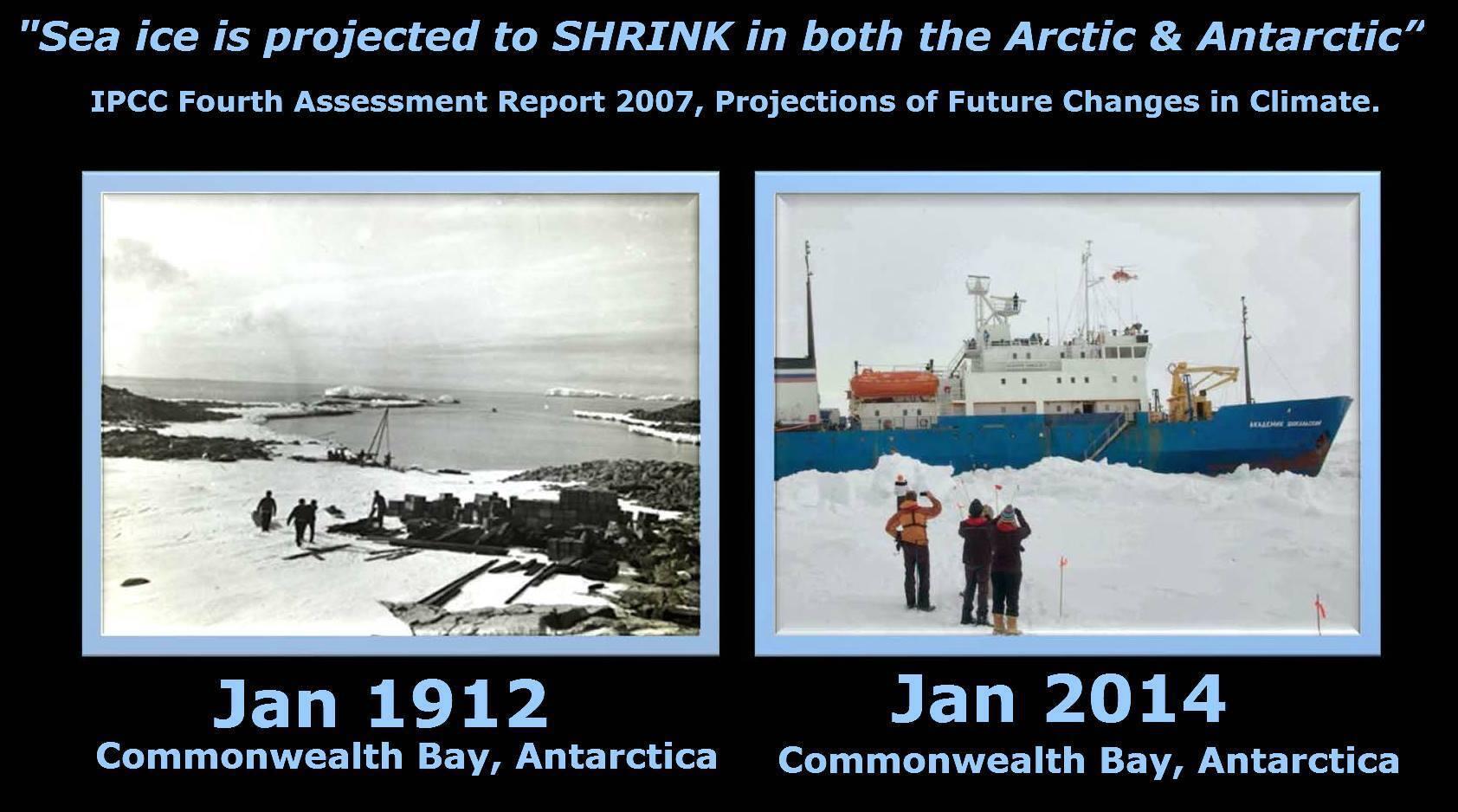
MSM Glosses Over Irony of Global Warming Scientists Trapped in Antarctic Ice

It gets better. The crew requested the help of a well-known global warming skeptic:

WUWT and WeatherBell help KUSI-TV with a weather forecasting request from ice-trapped ship in Antarctica Akademik Shokalskiy
http://wattsupwiththat.com/2013/12/...apped-ship-in-antarctica-akademik-shokalskiy/

Today, while shopping at lunchtime for some last minute year end supplies, I got one of the strangest cell-phone calls ever. It was from my friend John Coleman, the founder of the Weather Channel and Chief meteorologist at KUSI-TV in San Diego. He was calling via cell phone from his car, and he was on his way into the TV station early.

He started off by saying, “Anthony, we have a really strange situation here”.

Then to my surprise, he relayed a conversation he had just had; a person on the Akademik Shokalskiy had reached out, because they didn’t have adequate weather data on-board. At first, I thought John was pulling my leg, but then as he gave more details, I realized he was serious.
[...]
The message was that they needed better weather information on the ship than they had, specifically about wind and how it might affect the breakup of sea ice. John asked me to gather everything I had on the area and send it, and also to help him contact Joe D’Aleo of WeatherBell Analytics, because somehow John’s cellphone had gotten stuck into some sort of “private caller” mode and Joe wasn’t answering his phone due to how the incoming call looked.

My first thought was that no matter how much we’ve been criticizing the expedition for its silliness, that if such a request had reached all the way from Antarctica to me, I’d do everything I could to help.

[...] As I drove, I started thinking about the situation with the ship there. They had wind compressing the ice into shore, with the Akademik Shokalskiy in the middle, and the wind wasn’t changing. They needed a wind shift in order to ease the pressure on the ice but they had no idea when that might happen. It was a waiting game, and as we know, the longer a ship remains trapped in sea ice, the greater its chances of having a hull breach due to the pressure.
[...]
In a couple of minutes John Coleman was back on the phone to me, he wanted my assessment of the maps. I had looked at what was happening and saw what I thought might be an opening in 7-8 days based on the forecast graphics from WeatherBell, where the winds would shift to offshore in the area where Akademik Shokalskiy was stuck. Like we discussed in the WUWT post yesterday Polynyas are very important for marine life and cooling the oceans I had hoped that a coastal polyna might open up near the ship. We also discussed the possibility of a low pressure system passing nearby that might help break up the ice. I didn’t express much hope for that.

The problem is that they are in a catch-22 now, they need strong offshore winds to help blow the sea ice out to open water, but at the same time they need calm or light winds for a safe helicopter rescue.
[...]
Despite the irony and folly of the situation, I’m sure readers will join me in the hope that everyone makes it off the ship safely, whether it is by helicopter or by the ship being freed from the ice.
 
So, it's the Chinese who are the ones to rescue the liberal loons frozen in the Antarctica.

Marxist media just so happens to minimize or ignore the stuck global warming kooks. Let's not forget Big Barry's global Circus tent and Washington DC profiteering prostitutes, which get involved in everything around the globe so long as as long as it's profitable to someone inside the DC beltway, yet Washington sits back because of bad publicity(lol), all because their plans for taking more with their scam game of carbon taxes. So, that's your clown cart of Washington DC and the idiots stuck in ice of the global warming planet entertainment of the week.


Needs some frozen lyrics to the Love Boat theme...

http://www.ft.com/intl/cms/s/0/04276fd8-69ca-11e3-aba3-00144feabdc0.html
January 3, 2014 4:42 pm A cruise that will cost the climate campaign dear

6346bc8a-0950-11e1-8e86-00144feabdc0.img
By Christopher Caldwell
The rescue of passengers from a Russian ship is a setback for those who warn of global warming
063f4898-0ba6-4ab7-ab77-60597f0fd257.img


When a Chinese helicopter rescued 52 passengers from a Russian climate-science cruise ship trapped in ice off Antarctica, it was a skilfully managed end to an ordeal that had begun on Christmas Eve. It was also a debacle for climate change activists. The 233-foot Akademik Shokalskiy, a Russian meteorological ship leased by the Australian tour outfit Aurora Expeditions, had been on a mission called the “Spirit of Mawson”. It aimed to replicate part of a gruelling voyage the explorer Douglas Mawson had made in 1912. The ship carried 22 scientists looking to perform various experiments, led by Chris Turney, a professor of climate change at the University of New South Wales. They were joined by 26 tourists paying for the adventure, along with journalists for The Guardian, BBC and The Sydney Morning Herald.
Amid the worldwide relief that the passengers are now en route to Tasmania on the Australian supply ship Aurora Australis, another note is audible. Many websites where readers normally take climate change for granted have been inundated by posts from gloating disbelievers. The Australian group belittled the winter that nearly killed them and got a comeuppance, say the detractors. Such posts appear on the many YouTube videos uploaded by passengers (“For all your self-aggrandising bluster, you will go down in history as Turney’s turkeys . . . You are an international laughing stock”), on the Spirit of Mawson Twitter feed (“If the #spiritofmawson has taught us anything it’s the low level of intellect among those who have ‘settled’ the science”) and even on the New York Times’s Dot Earth blog, where the writer Andrew Revkin notes that the incident has “energised climate change contrarians”.

Of course, a scientific dispute cannot be settled by one near-tragedy on the high seas and a week’s worth of online invective. But the episode is a setback for those making the case for what used to be called global warming – probably the largest such setback since emails stolen from the University of East Anglia in 2009 cast doubt on the scientific neutrality of several climate researchers.
A beset ship is like a skint bank, and we can draw certain parallels to the financial crisis of 2008. The voyage of the Akademik Shokalskiy mixed public and private purposes, and all such enterprises nowadays invite scepticism. Those who stood to reap the benefits of the voyage were able, when things went sour, to pass on many of the costs.
These were of three kinds. The first was a cost in danger. Precipitation and wind complicated rescue plans in the week between Christmas and New Year’s day. Andrew Luck-Baker of the BBC called his own 15-minute rescue flight a “white-knuckle ride” – but the Chinese helicopter had to cover the distance between the Russian vessel and the rescue vessel eight times over the course of four hours. The second is a cost in money. The Xue Long, the Chinese icebreaker that sought to free the stricken vessel, became stranded itself, and will now lie idle until the weather changes. Twenty-two Russian crewmen will remain aboard the Akademik until help arrives weeks from now. French personnel and equipment were involved, too. The final cost is to science. The Aurora Australis had to delay offloading supplies to other, more purely scientific projects along the Antarctic coast in order to respond to the emergency call.
That is why the generally sympathetic Revkin found “vexing” the “devil-may-care” attitude of the ship’s passengers, who videotaped their raucous and self-referential New Year’s eve singalong. Nerves could be an explanation for that, but there was something unseemly in press reports of crew members dragging sleds with the passengers’ luggage to the helicopters. This looked like pampering. It made Mr Turney’s tweet of thanks to his rescuers – “for all their hard work” – sound less like the acknowledgment of an unrepayable debt to someone who has saved your life, and more like something you would say when tipping a barmaid.
How to keep well-meaning but overconfident people from imposing on others when they fail is a familiar problem. In his healthcare reform, Barack Obama sought to solve it (for better or for worse) with the “individual mandate”, which requires people to buy health insurance even if they are certain nothing could ever go wrong with them. The state of New Hampshire has a controversial “negligent hiker law”, which bills lost hikers for the cost of their own rescue, should they require one. In the world’s deadliest waters, that approach would be neither charitable nor fair. But that does not make it reasonable, in any walk of life, to confer the rewards of risk on people who need never heed the costs.
 
Last edited:
Look at these fools:

Worst-case climate scenario looking more likely
Thursday 02 Jan 2014
http://www.3news.co.nz/Worst-case-c...kely/tabid/1160/articleID/327000/Default.aspx

New research released today suggests rises in global temperatures rises by the end of the century will be at the warmer end of predictions.

According to the study, published in scientific journal Nature, shows that as temperatures rise, fewer clouds will form, meaning less sunlight will be reflected back into space.

So far it's been difficult to model the effect of cloud cover on climate change, and scientists say this study breaks new ground.

"First by identifying what is controlling the cloud changes, and second by strongly discounting the lowest estimates of future global warming in favour of the higher and more damaging estimates," says Prof Steven Sherwood of the University of New South Wales, who led the study.

"[Four degrees Celsius] would likely be catastrophic rather than simply dangerous," he told the Guardian. "For example, it would make life difficult, if not impossible, in much of the tropics, and would guarantee the eventual melting of the Greenland ice sheet and some of the Antarctic ice sheet."

If that happened sea levels could rise by several metres, flooding low-lying coastal land where hundreds of millions of people live and work.

By including the effects of cloud cover, Prof Sherwood says scientists are able to "halve" the uncertainty around what the ultimate temperature increase will be by the year 2100.

"Climate sceptics like to criticise climate models for getting things wrong, and we are the first to admit they are not perfect," he says. "But what we are finding is that the mistakes are being made by the models which predict less warming, not those that predict more."

He says the apparent pause in warming since 1998 is "almost certainly temporary", as most of the heat is being sucked up by the ocean, and most of the rise is occurring in the polar regions, where accurate temperature data has been scarce.

"Rises in global average temperatures of [at least 4degC] will have profound impacts on the world and the economies of many countries if we don't urgently start to curb our emissions," Prof Sherwood told the Guardian.
 
Anybody else see the irony in using an "icebreaker" ship to go detect whether the ice is breaking up?
 
Back
Top