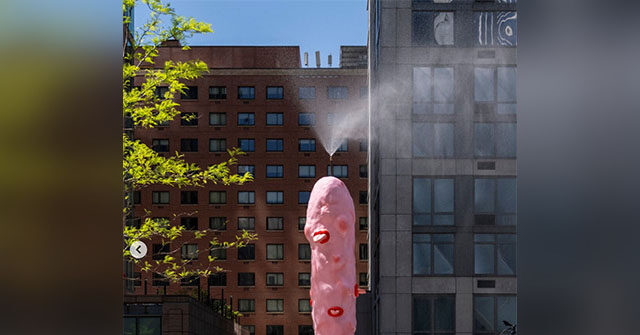
Modern "art"

F90S2BMXIAAtz-i.jpeg


Good movie, but The Third Man is better.
 
Last edited:
How it started:
 
https://x.com/Culture_Crit/status/1838658871919001693
to: https://x.com/Culture_Crit/status/1838659170289008946
{Culture Critic @Culture_Crit | 24 September 2024}

This 500-year-old portrait may seem ordinary, but it's one of the most mysterious in history.

There's so much detail that you can read every musical note on this small page.

But look closer — an unsettling secret is hiding in plain sight...

mKDELMa.jpeg

The more you study Hans Holbein's "The Ambassadors," the more you realize why it's one of history's most analyzed paintings.

It's so detailed you can feel every thread in this rug...

7Fs2tNP.jpeg

Or see each individual page of this book — and even work out which arithmetic text it is (by German astronomer Peter Apian).

But why bother rendering every object so meticulously?

kLE9Ng4.jpeg

Well, the painting depicts French diplomat, Jean de Dinteville (left) and bishop, Georges de Selve (right).

But they are not the real focus. What's more interesting are the objects between them...

WZhh11J.jpeg

On the top shelf are measuring devices to do with the celestial realm: a celestial globe, sundial, torquetum.

Below are objects of the earthly realm: a globe, musical instruments, and notation.

6qgA7Ft.png

They're all symbols of human understanding, and fields that these men have mastered.

All their earthly accomplishments are on display: the globe even shows the position of Jean's château in Polisy.

EwoOUVB.jpeg

But we've still only scratched the surface. Holbein's cleverness goes far deeper.

Look very closely and you'll notice the lute has a single broken string — a symbol of some kind of fracture...

mJmyWsq.jpeg

Next to the lute, a book of hymns by none other than Martin Luther.

This painting was made when the Protestant Reformation was in motion, at which it makes a subtle prod. But the theological hints don't end there...

AvEFGSN.jpeg

Look at the celestial globe and you'll begin to realize not a single detail is accidental.

It shows the sky on April 11, 1533 — Good Friday. Precisely 1,500 years after the death of Christ...

jqwZBxb.jpeg

So, what ties all this together?

You probably noticed that strange blur in the foreground. It's an anamorphic image...

JxTlJkv.jpeg

View it from the correct angle, and it becomes a human skull.

What is Holbein suggesting?

Mpe3q5O.jpeg

With all the earthly knowledge and possessions these men have collected, what does it all mean in the end? What will the division of the Reformers achieve?

Eventually, death comes for us all — and their transient lives mean nothing...

GacAQ2g.jpeg

Or don't they?

Notice the painting is 207 x 209.5 cm. Very nearly, but not quite, a perfect square — why?

wMZLYbw.jpeg

What if you draw a perfect square, starting on the right side of the painting?

Only one thing is left outside the square, and outside our earthly understanding...

H2nEQqh.jpeg

A small, half-obscured crucifix, tucked behind the curtain.

That this lies outside the square, an ancient symbol of Earth, is no accident...

7QMlrvq.jpeg

For all our ability to conquer the globe, or measure the position of the stars and planets...

True meaning is found not in earthly pursuits, but in spiritual ones.

A3E5jCJ.jpeg

Holbein renders earthly reality in such detail that we can't believe it's only brushwork.

But we can't even see the skull at first — just as we struggle to comprehend the transience of life.

g62JvMM.jpeg

Even more hidden is a truth that's harder still to comprehend.

The eternal truth.

oxfKjtR.jpeg

There's simply too much detail to cover in one thread.

Even the floor is significant — Holbein borrowed the mosaic floor of Westminster Abbey, itself a diagram of the cosmic order...

vziN9zb.jpeg


kmdZQvx.png

How it's going:
 
Composition II in Red, Blue, and Yellow - Piet Mondrain (1930)
bJSv4wP.png


Orange, Red, Yellow - Mark Rothko (1961)
G4Fh7k8.jpeg


Comedian - Maurizio Cattelan (2019)
9MXCz0o.jpeg

 
How it started:
 
https://x.com/Culture_Crit/status/1838658871919001693
to: https://x.com/Culture_Crit/status/1838659170289008946
{Culture Critic @Culture_Crit | 24 September 2024}

This 500-year-old portrait may seem ordinary, but it's one of the most mysterious in history.

There's so much detail that you can read every musical note on this small page.

But look closer — an unsettling secret is hiding in plain sight...

mKDELMa.jpeg

The more you study Hans Holbein's "The Ambassadors," the more you realize why it's one of history's most analyzed paintings.

It's so detailed you can feel every thread in this rug...

7Fs2tNP.jpeg

Or see each individual page of this book — and even work out which arithmetic text it is (by German astronomer Peter Apian).

But why bother rendering every object so meticulously?

kLE9Ng4.jpeg

Well, the painting depicts French diplomat, Jean de Dinteville (left) and bishop, Georges de Selve (right).

But they are not the real focus. What's more interesting are the objects between them...

WZhh11J.jpeg

On the top shelf are measuring devices to do with the celestial realm: a celestial globe, sundial, torquetum.

Below are objects of the earthly realm: a globe, musical instruments, and notation.

6qgA7Ft.png

They're all symbols of human understanding, and fields that these men have mastered.

All their earthly accomplishments are on display: the globe even shows the position of Jean's château in Polisy.

EwoOUVB.jpeg

But we've still only scratched the surface. Holbein's cleverness goes far deeper.

Look very closely and you'll notice the lute has a single broken string — a symbol of some kind of fracture...

mJmyWsq.jpeg

Next to the lute, a book of hymns by none other than Martin Luther.

This painting was made when the Protestant Reformation was in motion, at which it makes a subtle prod. But the theological hints don't end there...

AvEFGSN.jpeg

Look at the celestial globe and you'll begin to realize not a single detail is accidental.

It shows the sky on April 11, 1533 — Good Friday. Precisely 1,500 years after the death of Christ...

jqwZBxb.jpeg

So, what ties all this together?

You probably noticed that strange blur in the foreground. It's an anamorphic image...

JxTlJkv.jpeg

View it from the correct angle, and it becomes a human skull.

What is Holbein suggesting?

Mpe3q5O.jpeg

With all the earthly knowledge and possessions these men have collected, what does it all mean in the end? What will the division of the Reformers achieve?

Eventually, death comes for us all — and their transient lives mean nothing...

GacAQ2g.jpeg

Or don't they?

Notice the painting is 207 x 209.5 cm. Very nearly, but not quite, a perfect square — why?

wMZLYbw.jpeg

What if you draw a perfect square, starting on the right side of the painting?

Only one thing is left outside the square, and outside our earthly understanding...

H2nEQqh.jpeg

A small, half-obscured crucifix, tucked behind the curtain.

That this lies outside the square, an ancient symbol of Earth, is no accident...

7QMlrvq.jpeg

For all our ability to conquer the globe, or measure the position of the stars and planets...

True meaning is found not in earthly pursuits, but in spiritual ones.

A3E5jCJ.jpeg

Holbein renders earthly reality in such detail that we can't believe it's only brushwork.

But we can't even see the skull at first — just as we struggle to comprehend the transience of life.

g62JvMM.jpeg

Even more hidden is a truth that's harder still to comprehend.

The eternal truth.

oxfKjtR.jpeg

There's simply too much detail to cover in one thread.

Even the floor is significant — Holbein borrowed the mosaic floor of Westminster Abbey, itself a diagram of the cosmic order...

vziN9zb.jpeg


kmdZQvx.png

How it's going:
 
Composition II in Red, Blue, and Yellow - Piet Mondrain (1930)
bJSv4wP.png


Orange, Red, Yellow - Mark Rothko (1961)
G4Fh7k8.jpeg


Comedian - Maurizio Cattelan (2019)
9MXCz0o.jpeg


To be fair, Mondrain's style did have a point, and has been influential on art. Rothko is pretty abstract, but there's still something there in some of his work. I'm OK with abstraction. Where I think we lost track of the narrative is absurdism and anti-art. The point of art is, obviously, to be artistic, to make something that people actually want to look at because it's beautiful or genuinely interesting. I might not like your style, and I might not understand the point your work is trying to make, but at least have a style and some kind of objective or purpose to your art, particularly in respect to the intended viewer/audience. Slicing up a human-shaped, skin-color-frosted velvet cake is not "art", it's disturbing, performative, group psychopathy. Installing a common toilet in an art display is not a work of art... it's just an insult to the viewers. Taping a banana to a wall is not deep, it's "I'm 14 and this is deep". I can even track with a certain amount of absurdism, where it is leaning toward the satirical or comical, but self-eating absurdism is pointless. If everything is absurd, what's the point of being absurd? Why should it matter that everything is absurd, if it is absurd? If you were trapped in a lucid dream, what would be the point of protesting it? It's a dream, who cares.
 
Marxism.

I hate to inject politics into such a question, but I did not do it, our enemies did.

Art, literature, music, architecture...there is not a single endeavor that the Marxists have left untouched.

It is ugly, vapid, profane and distasteful for a reason, to make you, and your fellow citizens hate yourself and the culture which created this trash.

So when the time came, which is now, nobody would lift a finger to defend it.
RIP Chris.

 
Back
Top