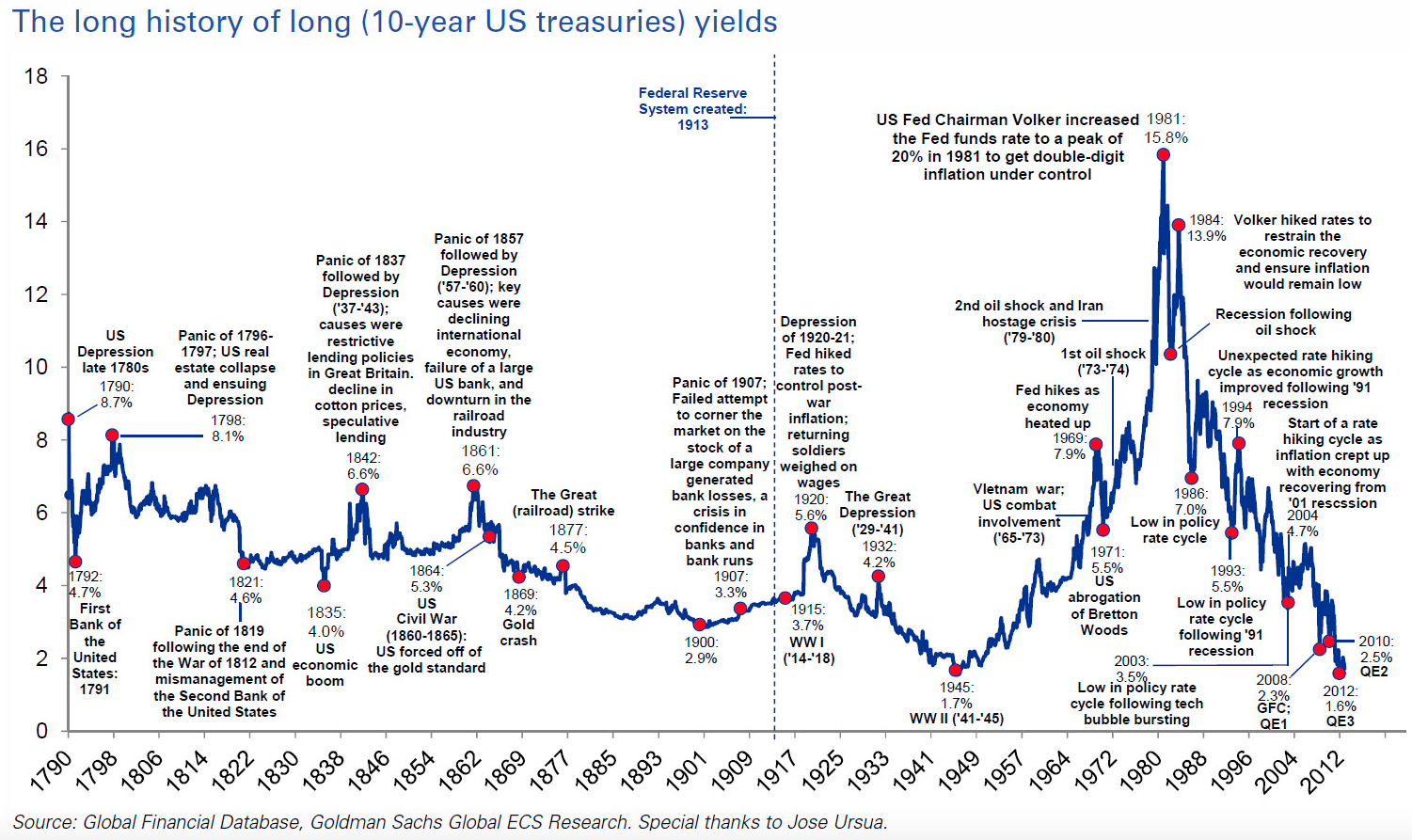
Would you consider having a metal standard "sound money"? How did interest rates behave when we were on such a standard?
Were prices more stable?
We can always count on Zippy to deflect, conflate and confuse the issue.
Dude. I was talking about the rate of interest banks and finance companies charge on loans, and you post a chart of the various rates of interest T bills have paid over time. What has that got to do with anything? Surely you're not going to tell us that the rate banks charge for interest on loans is tied by statute to the rate of interest paid to the holders of bonds.
As for the second graph, I wondered if you were going to post that old standby again. As I have mentioned, oh, about the last thousand times you posted that chart, it does a nice job of demonstrating the problem with fiat currency. Yes, the value of sound money fluctuates. But it fluctuates both directions. It goes both up and down. And in the end, it generally winds up about where it started. A person is born, and learns the value of a dollar. At the end of his life, perhaps a century later, he still knows the value of a dollar because it has evened out, and is about the same. This is demonstrated by the left hand portion of the chart, where we see both blue and green. But after the creation of the Federal Reserve in 1913, and more particularly after Nixon completely decoupled the currency from gold in 1971, where does the green go? Simple. The green evaporates, just like the value of your greenbacks evaporates. The people who print the money always print enough to ensure the value of the money goes down, because they like making money the old fashioned way--printing it--and always print as much as they can get away with printing.
So, as always, that particular chart proves my point. It isn't the fluctuations that steal all your savings and turn your middle class salary into starvation wages. All that bad stuff happens when all the fluctuations go the same way, and the dollar never, ever recovers the value it lost.
Setting aside that you don't know me, you don't know my motivations and, well, that's a pretty crappy thing to say. What would lead you to this conclusion?
We know hard-earned savings have disappeared. And we know nobody can get a raise out of his or her boss every time the value of their salary drops (a daily occurrence). We know this has turned into a type of corporate welfare disguised as citizen welfare--corporations that used to have to pay a living wage to attract labor can now get labor for less than a living wage, as their employees stand in line and jump through government hoops for SNAP benefits and Section 8.
Agreed
And how did we get here? Devaluation of the fiat currency.
Dam, we were doing so well

Going to disagree.
You didn't give me a lot to critique, So I'll respond briefly in hopes that you will expand on how you believe devaluation has lead to the situation as you understand it.
I'd say that debt fears have led to decreases in spending that disproportionately affect the middle and lower classes. Lowering demand relative to potential supply. As we see in this chart below, US capacity utilization has declined steadily:
The middle class has been disappearing, and the working poor have been working themselves into abject poverty, since 1973 or so. Have decreases in investment and spending been the rule that whole time? Hardly. The 1980s and 1990s were spending and investment sprees. So, your theory holds no water.
What has been constant in those four and a half decades is dollar devaluation. And what's more, you have admitted repeatedly that the value of the dollar has a real impact on the wealth of wage earning workers.
No of course not. However, I know that inflation is fairly steady whatever it is so I'm sure to ask for enough money to support my lifestyle. If I feel that my job isn't giving raises to keep pace with inflation, I look for another job.
As far as the money I earn, that's fairly simple. I don't save my money in dollars. Somone Mentioned Treasury Inflation Protected Securities. I split my retirement accounts between safe and highly aggressive assets. I earned 16% last year on my aggressive assets and about 3.8% on my safe investments. Whatever inflation is, I'm certain I beat it.
Bully for you. Will you admit that not everyone is? Do burger flippers have a right to expect that if they do their hot, sweaty job sixty hours a week, they should be able to put a roof over their heads and feed themselves? Well, they could forty-five years ago, and they cannot today. What has happened in the meantime? Hard to tell, with the government--and people like Zippy--cooking up meaningless numbers for us, but the minimum wage has certainly not sextupled the way the price of an entry-level new car has.
Is there no way to ensure stability in wages? Well, if an employer had to go to his employees and ask them to take a cut in pay in the event the dollar fluctuated up in value, that might help. As it is, you may have skills sufficiently in demand that you can get a raise whenever you feel the cost of living has left you behind, but that makes you a minority, not the majority.
So, what skin is it off your nose if burger flippers starve? Since you seem not to believe in taxes, you must not think Section Eight and Food Stamps come out of your paycheck, so the burger places can continue to pay the people who do the work for them less than a living wage and it does you no harm. That makes it so easy to say you shouldn't be expected to negotiate with the bank for a lower interest rate on your loans, and should have the guilty pleasure of repaying that loan with dollars which are worth less than the ones you borrowed...
Why would you want the currency to increase in value?
Let's see if I can give an intuitive example and you tell me where you think I'm wrong.
First, in this hypothetical, let's establish an average salary of $20k (40hr work week)
Let's say $20k also happens to be the average price of a new car (giving us some idea of the value of $20k).
Now let's imagine that you buy a new car and agree to pay for it over 5 years at $333 dollars per month.
Now let's imagine that the year after you buy it, the value of the dollar rises by 25% (extreme I know, but it helps make the effect easier to see).
Is that a good thing?
At first glance, it might seem that way as each dollar you earn is worth 25% more. But why should your employer pay you 25% more? If the value of the dollar were to increase, wouldn't your employer be justified in cutting your pay by the same amount? After all, you wouldn't be earning less in real terms, you'd still be able to buy the same car for the same amount of work.
Your pay is cut by 25% and you now make $15k, still enough to buy the same brand new car (as the cost of the car declined as dollars increased in value), but there's a problem. You paid $20k for the car a year earlier, but now you earn 25% less. Even though your dollars are worth more, you make fewer of them. Your loan of $20k worked out to $333 per month which was 19% of your monthly salary, but now you only make $15k but the loan amount does not adjust, so now your payment is 26% of your salary. You lose and the bank wins. Of course, if you had any idea that dollars would increase in value over the short term, you wouldn't make such a purchase as that would entail too much risk. This would result in decreased demand for items financed with debt and decreased demand results in increased unemployment.
Economics is a visceral subject around here because some of us know and care about burger flippers, and hate to see them bust their asses all day, only to go online and beg the government for enough benefits to live in the evening. There's no pride of self-sufficiency in it, though some of us are old enough to remember when a burger flipper could enjoy that luxury. And there's certainly no future in it, especially with Social Security threatening to collapse. What has McDonald's stockholders done that they deserve this kind of corporate welfare, or that they deserve to profit on the very destruction of the people who work for the money the stockholders pocket?
You say I don't know you. I say you, like millions of others, know not what you do to people. So the question then becomes, do you want your study of economics to remain a dry, amusing study of a game with anonymous winners and losers you can laugh at, or would you like to see the real results of this casino gambling that all of us are forced to play? Because people are getting screwed, and I still maintain that the Incredible Shrinking Dollar is the dildo which is screwing people.
Do you want to pave yourself a road to hell with your good intentions?
This republic does not need more people blathering about economics. This republic needs more people of conscience discussing economics in a clear-eyed, responsible, compassionate manner. You have the brains to rise to that challenge. Do you have the sense of responsibility, the compassion, and the clear eyes?
No, they didn't teach you that in college. They taught you that fiat is necessary to prevent recessions which happen anyway, or soften the effect of recessions that run deeper and last longer than they ever did during the run of the gold standard. So, how long are you going to keep believing the tripe they fed you?
Serious question, dude.