
You are using an out of date browser. It may not display this or other websites correctly.
You should upgrade or use an alternative browser.
You should upgrade or use an alternative browser.
Economic Storm Clouds Gather, but Ending the Fed Provides Hope
- Thread starter DamianTV
- Start date

VIDEODROME
Member
- Joined
- Sep 16, 2007
- Messages
- 5,407
Sure, but the real question we're dealing with is what gives the nation's currency value if it's created by fiat.
Let me answer the question via an example. Let's say I'm having a yard sale next weekend. If I create my own dollars with a pen, paper, and scissors and announce to my neighbors that the only way they can purchase things at my sale they have to purchase them with the dollars I create. If I have things that people want to buy, where does that value in the dollar I create come from?
Supply/ Demand=Value
That is, the supply of the things I have, divided by the demand for those things, equals the value of the dollars I create. It makes no difference that my dollars, the paper that I scrawl specific denominations on is worthless, what matters is if they can be redeemed for things of real value.
Thier value is extrinsic rather than intrinsic, but it does not change the fact that they have value. Of course, my neighbors could sell me things of value they own in order to earn my dollars, or they can do work for me (mow my lawn?) and after I have taken goods and services (G&S) the whole lot of my stuff can catch on fire making supply=zero and all the dollars I created worthless. So extrinsic money has some risk attached to it.
One more example. Where do promises come from? Do they come from a bucket of promises? Do you have to get promises back before you can make more?
Promises are made from thin air and can be spent just like currency. The fact they come from nothing does not make them worthless, it just induces risk. So if you trade something to me of real value today and I return to you, an IOU, that IOU is a promise. A promise to whoever holds the IOU (let's say its to mow 1/3 of an acre of lawn).
Does the fact that the IOU is made of paper and ink make it worthless? No, only if the supply of the service goes unfulfilled.
The interesting part and something I'm sure to bring up later is, what is the value of the IOU to the person who created it? In other words, when I get the IOU back after providing the services in question, do I now have something of value I didn't have before?
What do you think?
Respectfully,
E4E1
Hmm.... Does this make sense?
“Money talks” because money is a metaphor, a transfer, and a bridge. Like words and language, money is a storehouse of communally achieved work, skill, and experience. Money, however, is also a specialist technology like writing; and as writing intensifies the visual aspect of speech and order, and as the clock visually separates time from space, so money separates work from the other social functions. Even today money is a language for translating the work of the farmer into the work of the barber, doctor, engineer, or plumber. As a vast social metaphor, bridge, or translator, money—like writing—speeds up exchange and tightens the bonds of interdependence in any community. It gives great spatial expansion and control to political organizations, just as writing does, or the calendar.
Understanding Media - Marshall Mcluhan

NorthCarolinaLiberty
Member
- Joined
- Oct 11, 2010
- Messages
- 12,674
He voted for Hillary before, and claims to have voted for Gary Johnson in the last election, lol.
The funny thing about his Gary Johnson post was that he also claimed that US senators Boxers and Feinstein aren't even in his district.* And this is the guy who lives in California. lol
*
Feinstein and Boxer aren't even in my district...
I voted Gary Johnson.

Danke
Top Rated Influencer
- Joined
- Nov 6, 2007
- Messages
- 44,644
The funny thing about his Gary Johnson post was that he also claimed that US senators Boxers and Feinstein aren't even in his district.* And this is the guy who lives in California. lol
*
Aren't U.S. Senators a State wide vote?
NorthCarolinaLiberty
Member
- Joined
- Oct 11, 2010
- Messages
- 12,674
Aren't U.S. Senators a State wide vote?
That's the funny thing. Zip would obviously know that.
It's even funnier when he's misspelled commons words lately: courier (currier), pursuit (persuit), and truly (truely).
Maybe he's not actually sloppy, but a master manipulator messing with our heads!
NorthCarolinaLiberty
Member
- Joined
- Oct 11, 2010
- Messages
- 12,674
If I create my own dollars...
OMG, you're a terrorist! Just like Bernard von NotHaus. He was convicted for making his own currency. Our great government that builds up all that fiat trust says that “Attempts to undermine the legitimate currency of this country are simply a unique form of domestic terrorism,...”

DamianTV
Member
- Joined
- Dec 7, 2007
- Messages
- 20,677
The purpose of the Gold Standard was to prevent the govt from just printing money. What we have today are almost worthless IOUs with no intrinsic value because our leaders do not want to be held accountable for their irresponsible spending, which destroys the value of any currency. One can not yet print Gold, but we sure as shit can print FRNs. And just take a look around at what that has gotten us.
For the record, there are only two countries that do not have Central Banks that play nice with the international banks. Iran, and North Korea. Who are we beating the war drums against? Hmmm... I wonder if there might be an agenda there...
For the record, there are only two countries that do not have Central Banks that play nice with the international banks. Iran, and North Korea. Who are we beating the war drums against? Hmmm... I wonder if there might be an agenda there...
Madison320
Member
- Joined
- Jan 11, 2012
- Messages
- 6,130
In 2000 I was pulling for Ralph Nader and I think I'm close to him politically, so Zippy's comments don't bother me that much. I liked Ron for a strong stance of anti-corruption or anti-cronyism as well as his foreign policy.
Maybe the only thing about Zippy I'm perplexed about is I don't think he really identifies what his ideology is or if he's just a contrarian. Did he even support a candidate last time?
Ralph Nader!!!! Did you know he's literally a communist? I still remember a few parts his platform under the Green Party. Nationalize the top 200 corporations. Min wage of $12 an hour. Max wage of $120 an hour (10 times the minimum). Government takeover of radio during all the peak daytime hours. Steeply progressive tax rate.
Madison320
Member
- Joined
- Jan 11, 2012
- Messages
- 6,130
Speaking of the Fed did anyone notice they had one of their members try to calm the markets this morning by saying no more hikes are needed? They're so predictable.
https://www.reuters.com/article/us-usa-fed-bullard/feds-bullard-repeats-view-that-interest-rate-is-close-to-neutral-idUSKCN1HB1YC
The markets liked it!
https://www.reuters.com/article/us-usa-fed-bullard/feds-bullard-repeats-view-that-interest-rate-is-close-to-neutral-idUSKCN1HB1YC
The markets liked it!
Last edited:

Swordsmyth
Member
- Joined
- Apr 14, 2016
- Messages
- 74,737


Zippyjuan
Banned
- Joined
- Feb 5, 2008
- Messages
- 49,008
Speaking of the Fed did anyone notice they had one of their members try to calm the markets this morning by saying no more hikes are needed? They're so predictable.
https://www.reuters.com/article/us-usa-fed-bullard/feds-bullard-repeats-view-that-interest-rate-is-close-to-neutral-idUSKCN1HB1YC
The markets liked it!
Bullard is a non- voting member so he has no say on policy. From the link:
Bullard, who does not have a vote on the Fed’s interest rate policy this year, has become critical of the central bank’s plans to continue to raise rates as it seeks to normalize short-term borrowing costs amid a strong economy.
The Fed has now raised rates six times since it began a tightening cycle in late 2015, with the pace of hikes having quickened to three rate rises last year.
The median forecast remains for another two rate hikes this year, but a growing number of policymakers foresee three being required to prevent the economy from overheating.
But Trump's tariff wars could cause the Fed to reduce their expected rate of growth for the US economy and raise their expected rate of inflation. Those could cause them to back off rate hikes.
econ4every1
Member
- Joined
- Apr 2, 2018
- Messages
- 136
Yes, they printed $300 million British pounds and laundered it in various ways into the British economy (though the initial plan was to drop them into the streets). $300 billion is about the equivalent of $12 billion today. At the time $300 million pounds was about 3% of the UK's GDP.
Let's see how it worked:
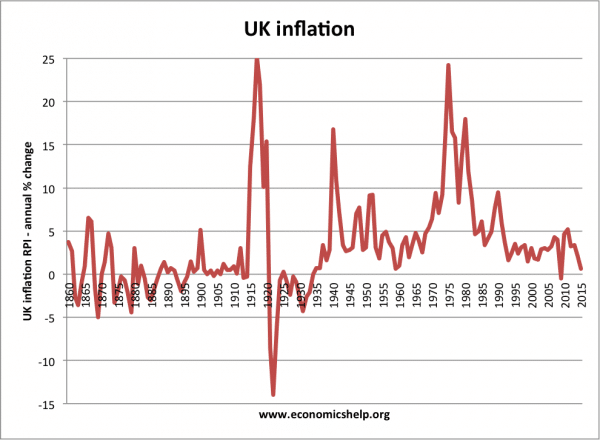
When looking at inflation in the US over the same time:

Doesn't look like it had any effect at all. The US and Britain experienced the same high rates of inflation during the war (to be expected).
As far as the Eagle logos....Really?
Oh, and BTW, none of the trillions of dollars created by the Fed entered the private sector economy. Ironically, what creating trillions of dollars did do was completely falsify the quantity of money theory (MV=PQ).
Last edited:
econ4every1
Member
- Joined
- Apr 2, 2018
- Messages
- 136
OMG, you're a terrorist! Just like Bernard von NotHaus. He was convicted for making his own currency. Our great government that builds up all that fiat trust says that “Attempts to undermine the legitimate currency of this country are simply a unique form of domestic terrorism,...”
You realize that he was charged because he created money that (and you can argue this point if you wish) closely resembled US money, $7 million dollars of it.
"Von NotHaus designed the Liberty Dollar currency in 1998 and the Liberty coins were marked with the dollar sign ($); the words dollar, USA, Liberty, Trust in God (instead of In God We Trust); and other features associated with legitimate U.S. coinage."
The lesson? Don't make money that resembles US legal tender (past or present).

econ4every1
Member
- Joined
- Apr 2, 2018
- Messages
- 136
Manipulation that is less than natural and less than market.
There is no "natural" market. Markets are a human construct they do not exist in "nature". I think what you mean to say is unregulated, which would be perfectly consistent with libertarian ideology. Using the word "natural, IMO, is just an appeal to nature fallacy. I admit this is a minor point...like who cares if you call it "natural" or "unregulated", right?
The reality that most people do not understand is that the economy has changed since 1974 and the economy as Austrian's understand it has also changed.
Case-in-point. Most Austrians believe that the US government/ Fed should let the interest rate move "naturally" according to market forces. What they don't realize is that if the government/ Fed did nothing all rates would drop to zero, permanently. It takes manipulation of Reserves (prior to 2008) and setting the rate on reserves (post-2008) to cause the interest rate to rise above zero.
Now you may not like either system, once you learn how it really works, you may still hate it, but I allege that most Austrians (in fairness I should say, most Austrians I've met) don't understand how interest rates are set, most believing they are determined by the market. Whenever you hear someone opining concern that future interest rate increases will drive interest paid as a percentage of federal debt to the largest portion of the Federal Budget, what they are really saying is "I have no idea how interest rates are set". Furthermore, they don't realize that interest rates paid on Federal debt are earned as income by people in the private sector and that money earned increases GDP....But I digress.
The risk you cite is a big reason why people here like gold. Paper has counterparty risk. Paper can be much more easily manipulated. Gold can't just be printed. It's finite. It's durable. Gold has some great chemical properties. It's timeless. People have naturally chosen gold; from ancient kings to your gold digger girlfriend.
Gold is a commodity like any other commodity. As far as manipulation...Of course, gold can be manipulated, or at least it's price can be manipulated. Any time you control the flow of information or enough gold, you can manipulate its price.
But here is the real difference in my opinion between gold and fiat.
Let's say there are two nations at war with each other. They have pummeled each other nearly to death and broken virtually all their toys (tanks, ships, etc). Spring is coming and both nations realize the other is vulnerable to a ground assault if they only had enough tanks they could with the war via a tank assault on their enemy. Fortunately, the labor and raw materials to make tanks exist, all each nation needs is money.
One nation, we'll call it Golderberg sets about mining new gold in order to come up with the money it needs to pay its workers to mine, process, and manufacture enough tanks for the assault.
The second nation, we'll call Fiatville, creates notes from thin air, declares them legal tender and pays its workers to mine, process, and manufacture enough tanks for the assault.
Golderberg loses, you know why? Because they had to do more work in order to reach the same result. You don't need gold to make tanks, but in Golderberg you need it to make money so you can make tanks.
The point is, Golderberg will always have to do more work and spend more resources (regarless of how they acquire their gold) than a nation that uses fiat ceteris paribus.
Using gold as a way to constrain politicians is self-limiting. For all the effort that goldbugs put into trying to convince people to use gold as currency, why not spend that time understanding how money works and how to use fiat efficiently and effectively? To create effective political constraints in place (how about removing the influence of money on politics???).
Before you answer, let me try to anticipate a possible reply.
"Fiat can't be used efficiently and effectively" - Ok...Why?
Respecfully,
E4E1
Last edited:
Krugminator2
Member
- Joined
- Aug 1, 2014
- Messages
- 4,568
Ironically, what creating trillions of dollars did do was completely falsify the quantity of money theory (MV=PQ).
That equation is most identified with Milton Friedman and Friedman would have supported printing infinite money. In fact, here is a quote from Milton talking about Japan in 1998.
Most of the proceeds will end up in commercial banks, adding to their reserves and enabling them to expand their liabilities by loans and open market purchases. But whether they do so or not, the money supply will increase.
There is no limit to the extent to which the Bank of Japan can increase the money supply if it wishes to do so.......
After a year or so, the economy will expand more rapidly; output will grow, and after another delay, inflation will increase moderately.
https://www.hoover.org/research/reviving-japan
econ4every1
Member
- Joined
- Apr 2, 2018
- Messages
- 136
Productivity has increased 1000 fold throughout the years since the creation of the Fed. But productive citizens can't just save for retirement, the dollar is constantly being devalued.
So let's say the dollar in 1913 was worth $1 and that today that same dollar is worth 98% less.
Does that matter? Well, if you earned $1 in 1913 and tried to spend it today, you'd lose 98% of it's purchasing power, so yeah it matters, but only if you are earning dollars and stuffing them under your mattress for 105 years.
But consider the fact that salaries over the same period (since 1913) have risen 6600%.
Now take that average rate of pay and multiply it by the rate the dollar has devalued and ....
6600% x 0.02= $1.32
So when the value of labor is factored in, people make more money, not less on each dollar. Any fool that earns money and stuffs it under their mattress for decades rather than converting that money into something that will maintain it's valued over time (like gold or any other commodity) deserves to lose it in my opinion.
Respectfully,
E4E1

acptulsa
Member
- Joined
- Jan 2, 2008
- Messages
- 77,201
Most of my disagreements about how Austrians see the economy is based mostly on changes to the money system since 1974 that Austrians fail to recognize or do not grasp the implications of.
And I say few people have a better understanding of what has become of our money--and what effect it has had on real people--than Austrians. We know hard-earned savings have disappeared. And we know nobody can get a raise out of his or her boss every time the value of their salary drops (a daily occurrence). We know this has turned into a type of corporate welfare disguised as citizen welfare--corporations that used to have to pay a living wage to attract labor can now get labor for less than a living wage, as their employees stand in line and jump through government hoops for SNAP benefits and Section 8.
And how did we get here? Devaluation of the fiat currency.
I think what the newcomer to this discussion has the most trouble understanding is the dollar is not a dollar--it's a nickel.
What do I mean? Well, my old man got out of the Army Air Corps after WWII and got himself a good job paying a dollar an hour. How is that a good job? Easy--it was 1946 and the dollar was still a dollar. As in, when he wanted a Pepsi he paid a nickel for it--now it costs a dollar. When he wanted to ride a bus, he put seven cents in the meter, or a nickel and a half--now it costs a buck and a half. When he wanted to sit down and have a cup of regular old coffee, he paid a dime, or two nickels--now it costs two bucks. When he put gas in the car (it was always cheap in Oklahoma), he paid 14.9 cents per gallon, or three nickles--now it costs three bucks. When he was hungry for lunch, he bought a deluxe double hamburger with all the trimmings for a silver quarter, or five nickles--now it costs five bucks. When he wanted to go to a movie, he paid thirty-five cents or seven nickles--now it costs seven bucks. And when he shopped for a new top of the line Dodge Custom with heater and radio and other options, it would set him back two grand, or forty thousand nickles--now it costs forty thousand dollars.
The Pepsi isn't any wetter, the gas doesn't burn any brighter, the double burger isn't any more filling, and the movie doesn't last any longer today (with no newsreel, serial and cartoon, it actually doesn't last as long). So, there's only one explanation. The dollar is no longer worth a dollar. The dollar is worth a nickel. Period.
Why do you think all the five and ten cent stores have been replaced with dollar stores?
So, you ducked the question earlier. How do you feel about repealing legal currency laws, and allowing people to use what they wish when they do their daily exchanges?
Economics is generally considered a dry mental exercise. I should warn you that around here, it can become downright visceral. How do you feel about making the rich richer and the poor poorer? Are you prone to argue as Zippy does, that working people are as well off as ever because of technical progress? Do you feel someone reduced to eating cat food is well off if they can get a color TV at a garage sale for next to nothing?
But consider the fact that salaries over the same period (since 1913) have risen 6600%.
Is that a "fact"? Has it happened across the board, or is this average we're comparing the middle of a much wider range than before? Is this salary that's up 6600% an average salary or a mean salary? Are the people affected by this stuff important? Do you answer, or skip, the hard questions?
Do you think this fiat currency has been managed the way it should have been, to benefit everyone? If not, where do you propose we find, as Jefferson called them, "angels in the form of men" to do the job right?
Last edited:
econ4every1
Member
- Joined
- Apr 2, 2018
- Messages
- 136
That equation is most identified with Milton Friedman and Friedman would have supported printing infinite money. In fact, here is a quote from Milton talking about Japan in 1998.
https://www.hoover.org/research/reviving-japan
Quite right, yes, that is a Monetarist theory, thank you for pointing that out.
Respectfully,
E4E1
NorthCarolinaLiberty
Member
- Joined
- Oct 11, 2010
- Messages
- 12,674
...he was charged because he created money that (and you can argue this point if you wish) closely resembled US money, $7 million dollars of it.
That's "domestic terrorism?"
"Von NotHaus designed the Liberty Dollar currency in 1998 and the Liberty coins were marked with the dollar sign ($); the words dollar, USA, Liberty, Trust in God (instead of In God We Trust); and other features associated with legitimate U.S. coinage."
Silly me; I didn't realize the US government has a monopoly on words "liberty," "trust," "God," and "dollar."
Krugminator2
Member
- Joined
- Aug 1, 2014
- Messages
- 4,568
Quite right, yes, that is a Monetarist theory, thank you for pointing that out.
Respectfully,
E4E1
You said it invalidated it which it clearly didn't. The most accurate descriptors of the economy over the last 9 years have been market monetarists.
Similar threads

- Replies
- 0
- Views
- 286


