When he was alive, I didn't see stories on - the Duke of Edinburgh - Prince Philip being a freemason, but now that he's kicked the bucket at the age of 99, freemasons "toast" this Greek as a "true English gentleman".
In 1952, Philip was initiated into Navy Lodge. The Navy Lodge's past members includes 4 monarchs – King Edward VII, King Edward VIII, King George VI and King George II of the Hellenes.
In 1953, Philip progressed to the second and third Degree of Freemasonry, before he was initiated into the United Grand Lodge of England (UGLE) later that year:
https://www.freemasonrytoday.com/ugle-sgc/ugle/prince-philip-a-true-english-gentleman
(
https://archive.is/odN66)
All Grand Masters of the United Grand Lodge of England from 1813 till present have also been Knights of the Garter.
Prince Augustus Frederick, Duke of Sussex (1773 to 1843, KG #603)
Thomas Dundas, 2nd Earl of Zetland (1795 to 1873, KG #763)
George Robinson, 3rd Earl de Grey (1827 to 1909, KG #760)
Albert Edward, Prince of Wales, later King Edward VII (1841 to 1910, KG #724)
Prince Arthur, Duke of Connaught and Strathearn (1850 to 1942, KG #753)
Prince George, Duke of Kent (1902 to 1942, KG #866)
Henry George Charles Lascelles, 6th Earl of Harewood (1882 to 1947, KG #864)
Edward William Spencer Cavendish, 10th Duke of Devonshire (1895 to 1950, KG #892)
Lawrence Roger Lumley, 11th Earl of Scarbrough (1896 to 1969, KG #905)
The United Grand Lodge of England (UGLE) is the governing body for Freemasonry in England, Wales and the Commonwealth of Nations. Together with the Grand Lodge of Scotland, and the Grand Lodge of Ireland, Masons refer to them as "the home Grand Lodges" or "the Home Constitutions".
This (first) Grand Lodge was officially founded on 24 June 1717, after George I became king of Great Britain in 1714. It was founded as the Grand Lodge of London and Westminster, later calling itself the Grand Lodge of England.
This united 4 existing Lodges: the Goose and Gridiron alehouse (now called Lodge of Antiquity No.2); the Crown alehouse in Parker’s Lane; the Apple Tree Tavern in Charles Street, Covent Garden (now Lodge of Fortitude and Old Cumberland No.12); and the Rummer and Grapes tavern in Channel Row, Westminster (now Royal Somerset House and Inverness Lodge No. IV).
Anthony Sayer was elected the first Grand Master:
https://www.thehistorypress.co.uk/articles/freemasonry-the-first-masonic-grand-lodge/
Freemasons' Hall in London is the headquarters of the United Grand Lodge of England and the Supreme Grand Chapter of Royal Arch Masons of England, and a meeting place for other Masonic Lodges in the London area.
It is located in Great Queen Street between Holborn and Covent Garden and has been a Masonic meeting place since 1775.
The current building was built between 1927 and 1933 in art deco style.
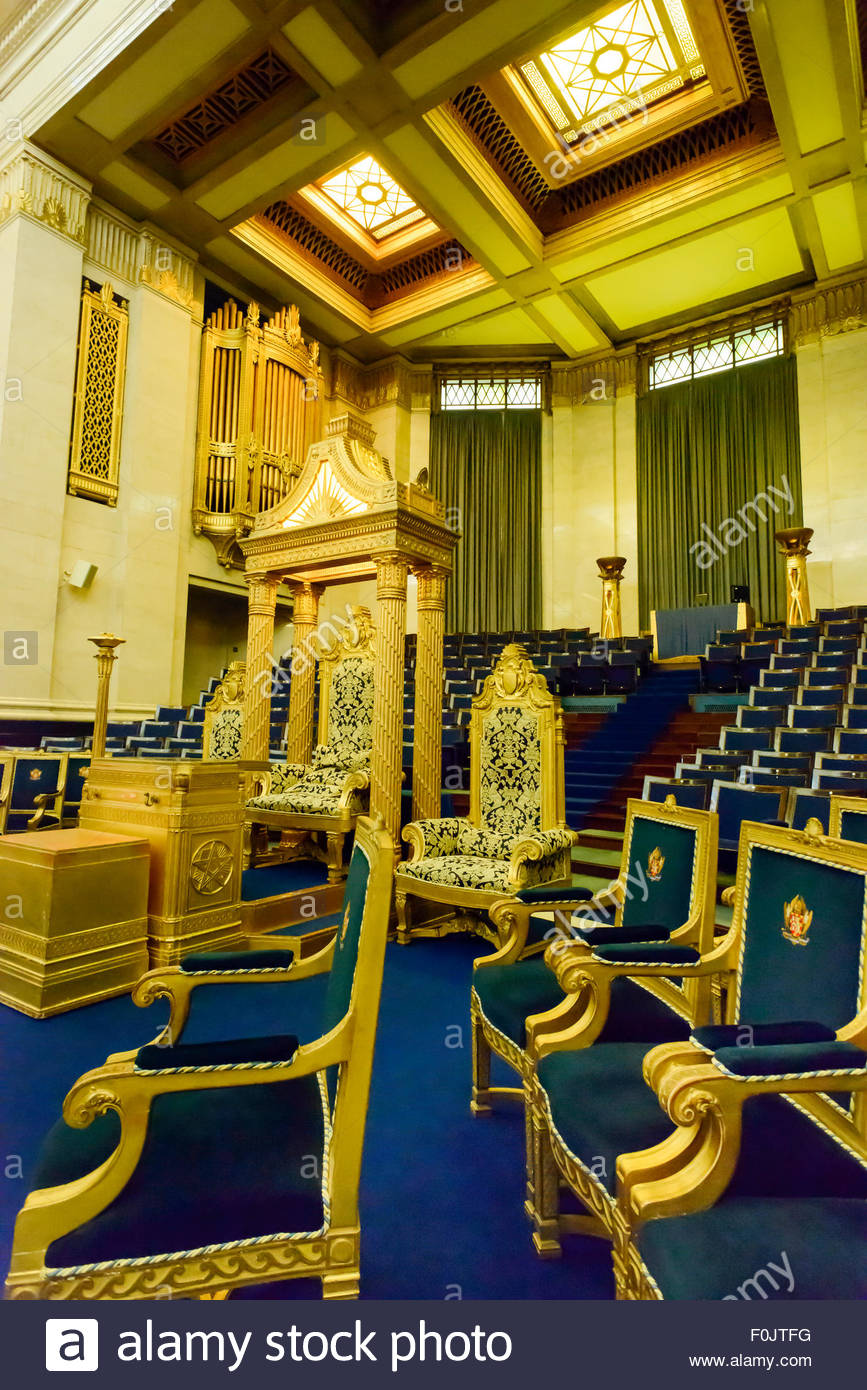
See the Grand Temple Room at the Freemasons' Hall, London.
The most important I see here is what looks like a temple inside the temple over the seat of honour (for the grandmaster of the lodge?), with the 4 pillars on the corners.
https://en.wikipedia.org/wiki/Freemasons'_Hall,_London
The Shrine at the Freemasons' Hall was designed by Walter Gilbert (1871-1946). It is in the form of a bronze casket resting on a boat amongst reeds; the boat symbolises a journey which has come to an end. It contains the Roll of Honour for the masonic dead of WW I.
The Roll of Honour is guarded by kneeling figures representing the 4 fighting services (the Royal Navy, Royal Marines, Army and Royal Flying Corps). On either side of the Shrine are the bronze Pillars of Light decorated with wheat (for resurrection), lotus (for the waters of life) and irises (for eternal life) with 4 panels of oak leaves at their base.
At the 4 corners of the Shrine stand pairs of winged Seraphim carrying golden trumpets and across the front are 4 gilded figures portraying Moses the Law Giver, Joshua the Warrior Priest, Solomon the Wise and St George (the patron saint of Britain and the Order of the Garter).
https://www.freemasonrytoday.com/fe...l-of-honour-and-the-shrine-in-freemasons-hall
The Grand Master of United Grand Lodge of England since 1967 is Prince Edward, Duke of Kent, who also became a Knight of the Garter in 1985.
See Prince Edward at a Masonic ceremony at Earls Court in London.
Edward became a freemason when he was initiated into Royal Alpha Lodge No. 16 on 16 December 1963:
https://en.wikipedia.org/wiki/Prince_Edward,_Duke_of_Kent
Edward's brother, Prince Michael of Kent, is the Grand Master of the Grand Lodge of Mark Master Masons, and Provincial Grand Master of the Provincial Grand Lodge of Middlesex (he's no KG though).
Prince Michael has received £320,000 in friendly bribes from the exiled Russian oligarch Boris Berezovsky through offshore companies:
https://en.wikipedia.org/wiki/Prince_Michael_of_Kent
Another KG, who was inducted in the United Grand Lodge of England, was the reportedly gay Prince Albert Victor:
https://en.wikipedia.org/wiki/Prince_Albert_Victor,_Duke_of_Clarence_and_Avondale
Thomas Pelham-Holles, 1st Duke of Newcastle (KG in 1718) was made a Master Mason at an Occasional Lodge Premier Grand Lodge of England in 1731:
https://en.wikipedia.org/wiki/Thomas_Pelham-Holles,_1st_Duke_of_Newcastle
Firestarter said:
Thomas Pelham-Holles, 1st Duke of Newcastle (KG in 1718) had rallied all the southern militias and regular forces against the Jacobites who withdrew to northern Scotland.
He was PM from 1757 to 1762.
In 1747, the Duke of Newcastle was involved in organising a coup to put Willem IV of Orange (KG in 1733) in power in the Netherlands, so he could continue the war with the French.
In 1734, the opium trafficking Stadhouder Willem IV (Willem Karel Hendrik Friso), after he married Princess Anna of England, was also initiated as a freemason in England.
After he moved to Friesland with his wife, Willem IV founded the first Dutch Masonic Lodge in Leeuwarden in 1734 (Antiqua Virtute et Fide). On 8 November 1734, he established another Masonic Lodge in The Hague, which included his cook Vincent la Chapelle and Douwe Sirtema van Grovestins.
In 1756, the Dutch lodges were united in "De Orde van Vrijmetselaren onder het Groot Oosten der Nederlanden".
On 25 maart 1734, the English entourage of Princess Anna founded a lodge in Amsterdam ("De la Paix" later called "La Bien Aimée").
(in Dutch):
https://nl.wikipedia.org/wiki/Willem_IV_van_Oranje-Nassau
https://www.deoudelandmerken.nl/Documenten/AO_boekje_-_2864.pdf