Dragon court

From Bertrand Russell to Rev. Moon

Another good story from Lyndon LaRouche. It’s an attempt to connect the dots from the British Coefficients club to the World Anti-Communist League of Rev. Moon.

Lord Bertrand Russell was a grandson of John Russell, 1st Earl Russell (1792-1878), who became a Knight of the Garter in 1862, was prime minister when Victoria was Queen of Britain and intimate with the notorious, longtime head of the Foreign Office, Lord Palmerston (also a KG).
Since the 17th century, the Russell family is one of the principal Whig dynasties in England and counts at least 10 Knights of the Garter.
John Russell, 1st Earl of Bedford, KG in 1539
Francis Russell, 2nd Earl of Bedford, KG in 1564
William Russell, 1st Duke of Bedford, KG in 1672
Wriothesley Russell, 2nd Duke of Bedford, KG in 1702

John Russell, 4th Duke of Bedford, KG in 1749
John Russell, 6th Duke of Bedford, KG in 1830
Francis Russell, 7th Duke of Bedford, KG in 1847
Francis Charles Hastings Russell, 9th Duke of Bedford, KG in 1880
Herbrand Arthur “Bertrand” Russell, 11th Duke of Bedford, KG in 1902.

Bertrand Russell was the handler of H.G. Wells, who together with Aldous Huxley developed a blueprint for mass brainwashing strategies that included drugs (soma) and perpetual war.
Russell, Wells and Aldous Huxley were arguably the predecessors of Frank Buchman and Rev. Moon.

H.G. Wells wrote of his own childhood:
In those days I had ideas about Aryans extraordinarily like Mr. Hitler’s. The more I hear of him the more I am convinced that his mind is almost the twin of my thirteen-year-old mind in 1879; but heard through a megaphone—and—implemented. I do not know from what books I caught my first glimpse of the Great Aryan People going to and fro in the middle plains of Europe, spreading east, west, north, and south ... whose ultimate triumphs everywhere squared accounts with the Jews ...
I have met men in responsible positions, L.S. Amery, for example, Winston Churchill, George Trevelyan, C.F.G. Masterman, whose imaginations were manifestly built upon a similar framework and who remained puerile in their political outlook because of its persistence.

Through Thomas Huxley, Wells got his first writing job at Astor’s Pall Mall Gazette, and Huxley later introduced him to fellow Metaphysical Society member Lord Arthur Balfour. Thomas Huxley was the grandfather of the infamous eugenists Julian and Aldous Huxley.
See Aldous Huxley at the centre of the top row and Bertrand Russell at the centre of the bottom row.
d6443cfa897a80a34079de37c54c1d5748e7e14f.png


The Coefficients met monthly at London’s St. Ermin’s Hotel from 1902 to 1908 as both a diners club and think-tank.
Members included: Lord Bertrand Russell; Lord Alfred Milner (KG, war Minister at the time); Viscount Edward Grey (Knight of the Garter in 1912); Lord Robert Cecil (cousin to Arthur Balfour); Halford Mackinder (head of the Fabian London School of Economics, founder of Geopolitics); Sidney and Beatrice Webb (Fabian socialists).
Another Milner ally was Leo Amery, who became intimate of Winston Churchill (another Knight of the Garter).
Sidney and Beatrice Webb would soon support MI5-agent Benito Mussolini.

In China, Frank Buchman and 2 friends made a list of the 15 most influential Christians in Beijing, placing Sun Yat Sen number 1. Buchman became close to Hsu Ch’ien, Vice Minister of Justice, and then acting Prime Minister. Hsu introduced Buchman to Sun.
In England, Buchman had the support of the elite, including the future short time King Edward VIII (Knight of the Garter in 1911), Sir Samuel Hoare, Prime Minister Stanley Baldwin (Knight of the Garter in 1937), the Marquess of Salisbury (the Cecil family), Earl of Clarendon, and the Earl of Cork and Orrery.

In 1921, Buchman with Lord Arthur Balfour and H.G. Wells founded the “pacifist” Moral Re-Armament to implement Wells’ “The open conspiracy” (read the book!). In 1949, Moral Re-Armament held a major conference at the Caux Palace, attended by no less than 27 cabinet ministers and 118 parliamentarians from 26 nations, and trade union chiefs from 35 countries.
In South Africa Buchman’s organisation was called the Oxford Group. Its activities were spread to other nations, becoming especially strong in Norway, Japan, the USA and Nazi Germany (where SS/Gestapo chief Heinrich Himmler was a member).
In 1989, Moral Re-Armament launched the Foundations for Freedom to infiltrate formerly Communist countries.
In 2001, Moral Re-Armament renamed itself Initiatives of Change UK. It still holds international meetings at the Caux, Switzerland site. The Dalai Lama has attended twice...

In 1915, Frank Buchman had met the Barons Mitsui and Shibusawa (then Finance Minister of Japan).
In one of those strange coincidences, the Mitsui banking and trading company had been the leading Japanese partner of Jardine Matheson and Company, when it controlled the largest share of the British Empire monopoly in opium.

In 1954, Rev. Sun Myung Moon moved to Seoul, South Korea. Moon’s lawyer was one Robert Amory, deputy director of the Central Intelligence Agency under Allen Dulles.
In June 1958, first Unification Church missionary Sang Ik-Choi, left Korea to set up operations in Japan. In Japan, the Moon operation was led by the Japanese Ryoichi Sasagawa (1899-1995), also associated with the Mitsui Group.

Firestarter said:
In 1966, the World Anti-Communist League (WACL) was formed in South Korea. William F. Buckley, Jr. was instrumental in its creation.
That same year, WACL funded Aginter Press as a front for OAS terrorists and other European fascists. It was headquartered in Lisbon, and headed by former OAS agent Guerin-Serac. In 1965-71, Cuban exile groups led by Guillermo and Ignacio Novo, and Orlando Bosch, were involved in acts of terror and assassination. In December 1974, Orlando Bosch, Guillermo Novo, and Dionisio Suárez travelled to Chile to offer their services to Pinochet.
Contreras ordered the assassinaton of former Allende Minister Orlando Letelier. Townley and another DINA agent, Armando Fernandez Larios, obtained false passports and US visas, and on 21 September 1976 assassinated Letelier in Washington DC.
http://www.ronpaulforums.com/showth...flag-attacks&p=6790091&viewfull=1#post6790091
In the late 1960s, Reverend Moon made a deal with Yoshio Kodama, leader of the 3 million-counting Japan Youth Federation, which later became the World Anti-Communist League (WACL). This was shortly before Moon moved to the USA.
Kodama was a silent partner in Japan’s organised-crime ring, the Inagaki-kai yakuza. In 1991, a chief aide of Kodama was arrested in Hawaii for transporting cocaine using the Sagawa Kyubin trucking company, owned by Moon-connected gangsters Susumu Ishii and Kodama.

The Nazi-financing Prescott Bush was an adviser to Sagawa Kyubin. From 1989 to 1991, Prescott also served as a $250,000-a-year consultant to Ishii’s Hokusho Sangyo Co.
In November 1996, George H.W. Bush toured Argentina, Peru, Uruguay, and Venezuela with Reverend Moon.

In 1972, the Moonies sponsored the first of their still-ongoing International Conferences of the Unity of Sciences. Their early sessions featured such notables as Eugene Wigner (of the Manhattan Project, the lifelong ally of Leo Szilard) and environmental fascists Alexander King and Aurelio Peccei (founders of the zero growth Club of Rome).

In 2000, Sen. John McCain presided over the award presentation of the Moonie front group, the Victims of Communism Memorial Foundation. In 2002, Sen. Joseph Lieberman received the “Truman-Reagan Freedom Award” from this Moonie front.
Included on the National Advisory Council of Victims of the Communism Memorial Foundation are former National Security Adviser Zbigniew Brzezinski; former Senators Robert Dole, Dennis DeConcini, and Claiborne Pell; former UN Ambassador and now head of the American Enterprise Institute Jeane Kirkpatrick; and the head of the Heritage Foundation: https://larouchepub.com/eiw/public/...1220_022-hg_wells_and_bertrand_russell_th.pdf
(archived here: http://web.archive.org/web/20180817013115/https://larouchepub.com/eiw/public/2002/eirv29n49-20021220/eirv29n49-20021220_022-hg_wells_and_bertrand_russell_th.pdf)
 
The Round Table

I’ve looked for more information on the Round Table, a.k.a. Milner’s Kindergarten, Rhodes crowd, Chatham House crowd and Cliveden set, which was involved in orchestrating the Young Turks Coup in the Ottoman Empire, the Bolshevik revolution, the first and second World War and founding Israel…
The Round Table model was copied for the RIIA, CFR, Bilderberg Group, Club of Rome, Trilateral Commission, and the World Economic Forum - with the elite gathering in exclusive conferences financed by big corporations to discuss grand geopolitical schemes.


I first specifically looked for Carroll Quigley –The Anglo-American Establishment: From Rhodes to Cliveden, 20.7 MB (1949): http://www.carrollquigley.net/pdf/The_Anglo-American_Establishment.pdf

Unfortunately Quigley’s is no masterpiece. It presents some of the elite people that were supposedly involved, but not what they were actually doing. This shouldn’t be a surprise as Quigley himself admitted that he supports the goals of the “Round Table”.
I found the following article, long but much shorter than Quigley´s book, much better (link at the bottom).


In the late 1890s, the Rhodes Scholarship was founded by Cecil Rhodes and Alfred Milner (KG). Rhodes was motivated to do this by Astley Cooper (an ally of Stead) and Thomas Beare.

Since 1891, secret meetings in all British dominions of its senior members were presided over by: Rhodes, Milner, the Earl of Selborne (William Palmer, KG 1909), Patrick Duncan, Jan Smuts, Lord Lothian and Lord Brand.

From 1891 to 1902, Rhodes was the leader of the “Round Table”.
From 1902 to 1925, Milner was its leader in South Africa, with Philip Kerr (Lord Lothian) and Lionel Curtis amongst its most influential members.
It was Milner, who established the Kindergarten for young Oxford graduates that were deeply committed to Britsh imperialism, who had served Britain during and after the Boer War in South Africa (1899–1902).
When Milner’s Kindergarten returned to Britain in 1909, it was Milner’s vision that decided on its goals (instead of that of Cecil Rhodes).

This group included:
J.F. (Peter) Perry, Lionel Curtis, Hugh Wyndham, Patrick Duncan,
Geoffrey Robinson (who named himself “Dawson” in 1917), Philip Kerr (Lord Lothian),
Lionel Hichens, Richard Feetham and Robert H. Brand.

Alfred Milner spent his early years in Germany and moved to England in 1869. In 1881, Milner became a journalist for the Pall Mall Gazette where he worked with William Stead and where H.G. Wells later got his first job (with the help of Thomas Huxley).
Stead was a Theosophist and had met Madame Blavatsky in London in 1888.
Milner met "initiates" Lord Rosebery (Archibald Primrose, KG 1892), George Parkin and Lord Esher.
Milner renewed his acquaintance with Sidney and Beatrice Webb, founders of the Fabian Society. Alfred Milner also joined 2 “dining clubs”, devoted to imperial unity and tariff reform: the "Coefficients" and the "Compatriots". The Coefficients were founded by Sidney Webb in 1902, met monthly to discuss defense, imperial issues and the economy. The Compatriots were established by Leo Amery and concerned itself with tariff reform and imperial unity. Amery was a journalist, who became associated with Milner while working for the Times during the Boer War.

Starting in 1920, Lord Astor took a more dominant position in this group.
From 1925 to 1940, Lord Lothian was its leader.
Since 1940, Lord Robert Henry Brand was probably its leader (according to Quigley).

Other important families in this group:
Salisbury - Robert Arthur Talbot Gascoyne-Cecil, 3rd Marquess of Salisbury (KG 1878). The Cecil family features handsomely in the Order of the Garet, including Robert Arthur James Gascoyne-Cecil, 5th Marquess of Salisbury (KG 1947).
William Cavendish-Bentinck , the Duke of Devonshire (KG 1916).

Other important names affililiated with the Round Table include:
Arthur Balfour, Winston Churchill, and Nathaniel Rothschild

Curtis frequently clashed with Milner and Amery on the grand scheme of things. While Curtis put his faith in a political solution, Milner pushed for free trade amongst British dominions but with a common tariff against the rest of the world to bring the “Commonwealth” of countries closes together.
Leo Amery argued that Curtis’s proposals would be: "constitutional hari-kari to sacrifice the British system of government in order to establish an imperial union based on the US federal system”.

In September 1909, Curtis’s proposals to create an organisation to influence public opinion to create an imperial federation were debated at the estate of Lord Anglesey at Plas Newydd, Wales.
In 1910, the Round Table started “The Round Table” periodical paper.

The Round Table reached the apex of its political power and influence during World War I. From 1916 to 1919, Round Table members occupied senior positions when David Lloyd George was British Prime Minister. Lloyd George had worked as a lawyer for the Zionist Congress and in 1916 would replace then Prime Minister, Herbert Asquith (KG in 1925).

Milner was first appointed to the five-member War Cabinet as a minister without portfolio, but in April 1918 became Secretary of State for War.
Lord Lothian - Lloyd George’s private secretary and foreign policy adviser.
Leo Amery - Assistant Secretary to the War Cabinet Secretariat.
William Waldorf Astor - Lloyd George’s Personal Parliamentary Secretary.
Robert Brand - Deputy Chairman of the British Mission in Washington DC.
John Buchan - Lloyd George’s Director of Information.
Also joining the government was new Round Table member Alfred Zimmern who transferred from the Ministry of Reconstruction to the Political Intelligence Department at the Foreign Office in 1917.

In February 1917 one British journalist wrote of a "little body of illuminati" from "the class of travelling empirics of Empire, who came in with Lord Milner" and had now taken up residence in the "Garden Suburb", for the sinister purpose of "cultivat[ing] the Prime Minister’s mind".
Lockwood confirmed that there was "a good deal of truth" to these claims, like Naylor who wrote on a "Fabian-like Milnerite penetration" of Lloyd George’s government.

That Lord Lothian had a substantial influence over PM Lloyd George is confirmed by that in January 1919, Lothian got Lloyd George to pressure Lord Robert Cecil - Britain’s representative at the League of Nations negotiations - to make changes to the League Covenant. In 1937, Robert Cecil (son of Robert Gascoyne-Cecil, 3rd Marquess of Salisbury, KG) got the Nobel Prize for his service to Britsh imperialism.

According to Quigley, the Round Table was transformed into an "international anglophile network". The 3 main front organisations created by the Round Table were:
Royal Institute for International Affairs (RIIA or Chatham House) in Britain;
Council on Foreign Relations (CFR) in the US;
Institute for Pacific Relations (IPR) in the US.


Nexus Magazine –A short history of the Round Table (2005): https://danielsolis.cz/?mdocs-file=2538
(archived here: http://web.archive.org/web/20190228133439/https://danielsolis.cz/?mdocs-file=2538)
 
Ingraham - Modern Anglo–Dutch Empire

Lyndon LaRouche’s publications often speak about the Anglo–Dutch banking system. The following relatively short book, shows how our banking system evolved from Venice to Amsterdam to London.


Venice, until beginning 17[SUP]th[/SUP] century
From the period of the first Crusade in 1099 until the founding of the Order of the Garter in 1348, Europe was dominated by the Venetian empire (now located in Italy). Venice with the Norman nobility of Europe, particularly from France and Angevin England, controlled Europe.

This allied nobility also controlled the Black Guelph (Welf) party of the northern Italian cities, allied with the Vatican.
In 1176, the Guelphs created the Lombard League, which came to include all the major cities of northern Italy (except Milan). These cities became the centers for the usurious Lombard banking system. The Lombard bankers became the de facto creditors and financial dictators of Europe.

The Lombard bankers first drove their victims into debt and then seized assets. For example, in 1325 the Peruzzi bank owned all the revenues of the Kingdom of Naples.
In Castile and England wool production was pledged as collateral for the Lombard loans. Naples and England were bankrupted, food production declined and by 1290 Europe began to depopulate (like we´re seeing these days...). Continent-wide famines struck in 1314-17, and again in 1328-9.
By the early 1400s, Lombard bankers were expelled from several countries: Arragon in 1401, England 1403, Flanders 1409, and France in 1410. The Venetian financial empire started to crumble.

In the midfifteenth century Venice was still the most powerful maritime nation in Europe, controlling Europe's slave and bullion trade. The Venetians created a new financial front to replace the now defunct Lombard bankers – the House of Fugger. Their agent Jacob Fugger was put in control of silver and copper mines in central Europe. From the vast wealth accumulated, Fugger created the most powerful banking house in Europe, and then bankrolled the Austrian Habsburgs (with many KG’s) to take control of the Holy Roman Empire.
In 1518, by a series of strategic marriages, the Habsburgs took control of Spain and the Fuggers became the bankers to the Spanish monarchy. After the Spanish bankruptcy of 1575, Genoa replaced the Fuggers as the financial controllers of the Spanish crown.

In 1461, Louis XI became King of France, allied with the Medici in Florence, and proceeded to build ports, roads, schools, printing houses, industry and infrastructure, which was based on Nicholas de Cusa's “Commonwealth” principle.
In 1485, Henry Tudor invaded England, overthrew the last of the Plantagenet kings, Richard III, and established Tudor rule. As King Henry VII, he adopted similar methods as Louis XI.
In France and England, food production, national income, and population all increased for the first time in more than a century. These initiatives were copied in the Iberian peninsula, Flanders, and elsewhere.

By the mid-16[SUP]th[/SUP] century, Venice was threatened with the loss of her colonies and access to trade with the east, because of the Ottoman Turks. In 1573, Venice lost Cyprus and other colonies after a humiliating defeat by the Turks.
In the late 1570s, the Giovani (“youthful”) faction took over Venice emerged, by taking over the Senate.
In the 1590s, Paolo Sarpi became the intellectual leader of the Giovani faction, and his views determined the policies of Venice until his death in 1623. In this period, Venice was controlled from salons where the Giovani orchestrated their actions.

In 1587, the Giovanni founded the first “public” bank in Venice, the Banco della Piazza di Rialto (sometimes called the Bank of Venice).
In 1619, this was followed by a second bank, the Banco Giro.
These 2 banks were granted a monopoly by the Venetian government on issuing bank notes and bills of credit. These banks were really the beginnings of what today we call private central banking.
In 1620, Venice was still the most important European center for Bills of Exchange.
The Banco della Piazza di Rialto would later be imitated for the Bank of Amsterdam.

In 1638 the Venetian Grand Council, established the first state-owned gambling house (and bordello) in Europe, the Ridotto. At the Ridotto, aristocrats, prostitutes, pimps, usurers, degenerate gamblers, and foreign visitors rubbed shoulders, wearing masks to protect their identity. The Ridotto functioned as an ideal tool to corrupt and blackmail its guests.


From Venice to Amsterdam
In the 1520s, the Netherlands, which then included Belgium and Luxembourg, were under Spanish-Habsburg rule. In 1523, the first Protestant “heretic” was publicly burned and by the 1530s hundreds had been executed.
In 1567, the Duke of Alva arrived with 10,000 Spanish troops, to enforce the Inquisition and extract money that the Spanish Crown owed to its Fugger creditors. In years, Alva had more than 12,000 people executed. Alva also campaigns against cities like Mechlin, Zutphen and Haarlem in 1572 that were looted and burnt to the ground, with many people murdered, raped and tortured.

In 1576, the premier city of the Netherlands, Antwerp, was occupied, and over 8,000 civilians were slaughtered. In 1585, the Antwerp Bourse (stock exchange) was closed, followed by the " exodus" to the north provinces of the Netherlands, with most of the more than 19,000 merchants, bankers, and Bourse speculators settling in Amsterdam.
These emigrants included Jan de Wael, Jacob Poppin, and Isaac Le Maire, who would play a major role in founding the VOC (Dutch East India Company) in 1602.

In 1608, the Amsterdam Exchange (the New Bourse) and in 1609 the Amsterdamsche Wisselbank (Bank of Amsterdam) were founded. These financial institutions copied much of the Antwerp model.
The Wisselbank, like the Bank of Venice, was a privately owned public bank; with a monopoly on all exchange of specie, and trade in precious metals; a clearinghouse for bills of exchange; and owned the debt of the Dutch government.
It established the new "bank money" as the center of the city's securities trading.

The Bourse was a money market, a finance market, and a stock market.
This included trade in futures, options, margin loans, financial leverage, speculation in foreign securities, and derivatives (known as ductions).

By the second half of the 17th century, the Wisselbank had amassed an enormous financial power, which gave them the ability to expand the Empire and finance wars on a scale never seen before and made Amsterdam the financial centre of the world.
In the 1680s, when the Wisselbank ended the right of specie withdrawal, paper money was in effect. Since then, the Ango-Dutch bankers, have worked hard to make money the heart of the economy.
It is a system based on money, usury, and debt, where both the people and government, are controlled through the Central Bank’s power over money and debt.

In 1609, the Giovani-controlled Venetian Senate was the first government in Europe to recognise Dutch independence from Spain. In 1609, the Treaty of Antwerp was signed in which Spain recognised Dutch independence.
From 1610 to 1618, there was an undeclared war between Venice and Habsburg Spain, and Venice and the Netherlands began an unofficial military alliance. In the 1615-1617 war between Venice and Habsburg Austria, 5,000 Dutch mercenaries fought at the side of Venice, and 12 Dutch warships blockaded Spanish aid to Austria.
In 1613, arguably the most powerful man in Dutch government, founder of the Vereenigde Oostindische Compagnie (VOC, Dutch East India Company) Johan van Oldenbarneveldt, appointed Hugo de Groot (or Grotius) Pensionary of Holland, the second most powerful post in the government. Hugo de Groot was in correspondence with Sarpi for many years.

In 1618, Sarpi personally directed the signing of the Dutch-Venetian alliance, which included a mutual defense pack against the Habsburgs. In 1618, Van Oldenbarneveldt, wanted to extend the 12 year truce with Spain. Because the black nobility wanted war to erupt Europe-wide, Maurice of Nassau (KG in 1612) had Oldenbarneveldt arrested and executed, while De Groot was imprisoned.
In exile, De Groot would become an active member of the empiricist Mersenne Circle, which included Thomas Hobbes and members of the Cavendish family, and was connected to Sarpi's secretary Micanzio.

In 1621, Maurice of Nassau resumed the war against Spain. Venice financed the Dutch government at The Hague with more than 1 million ducats.
This was all part of the plan of a war between the Dutch, James I of England, and the German Protestant princes on the one side against Spain, the Holy Roman Emperor and the Papacy on the other. After the 1610 assassination of King Henry IV, the chaos could be used to rekindle the religious wars in France, so that Louis XI’s and Henry VII’s “commonwealths” could be eradicated.

The VOC was a private empire with the greatest maritime empire in the world, which had the right to wage war against nations, including their home country. The VOC dominated Asia trade for almost 2 centuries, it took until the late 18th century before the British East India Company surpassed is.
In 1605, the Dutch started their takeover of Indonesia, which would be looted for almost 350 years.
In 1621, the natives of the Island of Band refused to give the Dutch a nutmeg monopoly. In response, to protect “free trade”, the VOC Governor General Jan Pieterszoon had the population exterminated, and slaves were brought in to work the Dutch plantations.
In 1641, the Dutch established a monopoly on trade with Japan which lasted until 1853,
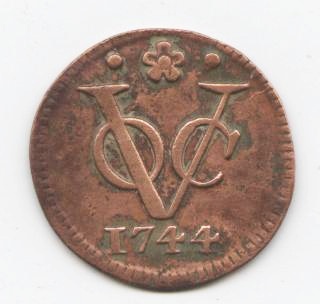
The VOC started pressing coins around 1650, both in the Netherlands and colonised parts of Asia.
7cf869d84fd46124db89d9089facf82df060cf09.jpg


In 1606, the first known Dutch slave ships sailed.
In 1621, the Vereenigde Westindische Compagnie (VWC, Dutch West India Company) was founded, to take over the African slave trade from Spain and Portugal. This was achieved by 1650, when the Dutch had seized most of the Spanish and Portuguese slave fortresses in West Africa. By 1700, the percentage of slaves was: 52% Batavia; 42% Capetown; 53% Colombo; 66% Makassar.
The Dutch took slaves from East Africa, Madagascar, New Guinea, the Philippines, Malaysia, and Indonesia. Between 1450 and 1850, at least 20 million Africans were either taken or killed as a result of the slave trade.
Of the total amount of slaves taken from Africa between 1500 and 1850, 70% were shipped between 1700 and 1800. The record was set in 1768, when 110,000 people were taken from Africa to be sold as slaves.

In 1650, Stadthouder Willem II (KG in 1645) died without successors. This initiated a 21 year period of civilian rule. From 1653 to 1672, Johan de Witt served as the Grand Pensionary of Holland and effectively ran the Dutch government, with his brother Cornelis de Witt.
In 1672, the French armies of Louis XIV occupied large parts of the Netherlands, who put Willem III of Nassau (KG in 1653) into power, who had the brothers De Witt executed...

Venice was not only alligned with Dutch “stadthouder” (city holder) Maurice of Nassau but also with the Venetian Party in London, grouped around Robert Cecil (1st Earl of Salisbury – KG in 1606; there have been 13 KG Cecils), Francis Bacon, and the Cavendish family.
In 1598, Sir Edwin Sandys was living in Venice and allegedly co-wrote a book with Paolo Sarpi. Nine years after leaving Venice, Sandys became one of the founders of the London Virginia Company, chartered by King James I, for the purpose of establishing English colonies in North America. From 1618 to 1623, Sandys effectively ran the company.

Under the rule of Paolo Sarpi’s friend Edwin Sandys, the Virginia Company brought the first slaves into Jamestown in 1618, and held the first public slave auction in 1638. By 1715, 24% of Virginia’s population were slaves. Sandys was also active in the British East India Company and later became an MP for many years where he introduced bills in support of “free trade”.
According to W.E.B. Du Bois, between 1600 and 1800, about 12 million slaves were brought into the Americas, about 60% of all trans-Atlantic emigration.

Many young British aristocrats traveled to Venice to meet Sarpi, including future British Prime Minister Robert Cecil, another founder of the London Virginia Company William Cavendish, and the “philosopher” Thomas Hobbes. The Cavendish family were the closest personal allies of Sarpi in England.
In 1603, James I became King of Scotland. His first Privy Council included Edward Wotton and Robert Cecil, who were on intimate terms with Sarpi’s Giovani leadership in Venice.

Another Sarpi ally was Henry Wotton, who would serve 3 times as the British Ambassador to Venice from 1604 to 1624. Wotton played an important role in recruiting and organising the Venetian circle at Oxford University, which included Robert Cecil, Thomas Walsingham, John Donne, and James Florio.
In 1614, William Cavendish accompanied Thomas Hobbes on a trip to Venice where they met Sarpi and his group. Cavendish maintained a 13 year correspondence with Sarpi and his secretary Micanzio, and introduced Francis Bacon to Sarpi. Bacon would spread Sarpi's method of “empiricism” into England.


From Amsterdam to London
Algernon Sidney had a close relationship with Dutch leader Johann de Witt. Sidney came under the influence of the English Ambassador William Temple and John Locke's employer, Anthony Ashley Cooper (the Earl of Shaftesbury), who were orchestrating a Dutch coup in England.
In England, the group that was plotting to install the House of Orange on the English throne included: William Cavendish, Robert Spencer (2[SUP]nd[/SUP] Earl of Sunderland, KG in 1687 installed by Charles II), Lord Orford (Edward Russell), and Bishop Compton.
William Cavendish, 1st Duke of Newcastle (1592 – 1676) became a Knight of the Garter in 1650. Since then at least 15 more members of the Cavendish family counts have become Knights of the Garter. Queen Elizabeth II counts the Cavendish family among her ancestors.

In 1666, Sidney – on the orders of Temple and Cooper - proposed to De Witt to launch an invasion of England to restore “Parliamentary rule”.
In 1678 a marriage was arranged between the Dutch Stadthouder Willem III of Orange and Mary, daughter of King James II, and the first in line of succession to the English throne. In 1679, Temple sent Algernon’s brother Henry back to the Netherlands to motivate the Dutch to invade; even offering the English crown to Willem III.
In 1682, Algernon Sidney was arrested for the “Rye House Plot” against King Charles II, and was executed along with several others.
In 1681, Henry Sidney became the English Ambassador to the Netherlands.

William Cavendish, First Duke of Devonshire (1640-1707), KG in 1689, was one of the “Immortal Seven” who signed the Letter of Invitation to Willem III of Orange in 1688, asking him to invade England:
If the circumstances stand so with your Highness that you believe you can get here time enough, in a condition to give assistances this year sufficient for a relief under these circumstances which have been now represented, we who subscribe this will not fail to attend your Highness upon your landing and to do all that lies in our power to prepare others to be in as much readiness as such an action is capable of...

In 1688, after Willem III landed in England, others rallied to the side of the Dutch, including John Churchill (Duke of Marlborough, KG in 1702), William Bentinck (Earl of Portland, KG in 1697) and Charles Montagu (Earl of Halifax, KG in 1714). Many of these Whig leaders were proteges of Anthony Ashley Cooper.
Dutch Stadthouder Willem III of Orange was crowned King William III of England and the Anglo-Dutch Empire was realised with the bloodiest penal code in Europe.

In 1690, John Locke’s Two Treatises on Government was published, to provide the “philosophy” for the transformation. The 2 banks of Venice and the Dutch VOC became the model for the Bank of England in 1694 and the VOC for “new” “British” East India Company in 1698.
While Amsterdam as a financial centre was already successful, in London the financial oligarchy became the de facto government. The Bank and East India Company were in private hands, and the third pillar of power, the Exchequer was effectively a fifth column of the oligarchy.
Even to this day, there is no British Constitution or a British “government” in any meaningful definition of that term.

William Paterson became the founder of the Bank of England. He had earlier been in Holland with Willem III, and was active in the Dutch invasion. The key government agent of the Bank of England was Charles Montagu, who had greeted Willem III at the dock when his invasion fleet landed. In 1697, the first of a series of Acts was passed by Parliament, with the end result being that the Bank had a total monopoly over banking in England.
In 1707, the Bank took over the national debt, which at £7 million was rising.
In 1742, Parliament gave the Bank of England the exlusive right to print money and for the next 80 years was the only jointstock bank allowed in England.

After 1690, and particularly after 1720, Dutch capital took over the English financial markets.
By the 1730s, 30% of East India Company (EIC) stock and 35% of Bank of England stock was in Dutch hands. Another 10% of these companies was held by Geneva-based Swiss investors.
By 1750, Dutch investors held 20% of the shares on the London Stock Exchange and 26% of England’s national debt.

In 1710, Jonathan Swift's faction, including Robert Harley, Henry St. John (Bolingbroke), Matthew Prior, and the Duke of Ormond, took control of the British government. In 1711, they founded the South Sea Company to challenge the Bank of England, and until 1713 £9.4 million of government debt were exchanged for South Sea stock, cutting the power of the Bank.
After Anne died in 1714, Harley and Prior were charged with treason and Bolingbroke and Ormond fled to France.
The "Act of Settlement" was used to make George I of Hanover the new British king. Within six months after his coronation, the Bank of England took over all government borrowing operations from the Exchequer, and by 1719 it controlled most government stocks. The manipulation of those stocks and loans to the government, were used to wage wars all over the globe.

Like the Dutch VOC, the East India Company had its own army, navy, to wage war, and take all the loot. In 1803, the EIC had a private army of about 260,000 — double the British Army.
In 1757, India - hundreds of millions of people - came under the rule of the EIC. India was its property.
With the defeat of the French in the Seven Years War in 1763, the EIC (also) took possession of the French colonies to establishe a worldwide private empire.
The East India Company coined its own money, see for example.
1803-madras-presidency-xx-cash-east-india-company-copper-coin.jpg


Conclusion
Because the last chapters in the book, from Chapter 11, are dedicated to praising the American System of Economics, it looks like the main conclusion of the writer Ingraham, is that the (protectionist) American System of Economics can protect us from the the British (Empire) System of Free Trade.
My most important conclusion is that the current system of bilateral treaties, World Bank, IMF, WTO, UN and privately owned state debt is really the consequence of what was started in the 16[SUP]th[/SUP] century (or even before in Venice) in the Netherlands and Britain: http://www.ronpaulforums.com/showthread.php?501823-Enslaved-by-World-Bank-and-IMF

Bertrand Russell in 1952 wrote:
At present the population of the world is increasing ... War so far has had no great effect on this increase...
I do not pretend that birth control is the only way in which population can be kept from increasing. There are others...
If a Black Death could be spread throughout the world once in every generation, survivors could procreate freely without making the world too full ... the state of affairs might be somewhat unpleasant, but what of it? Really high-minded people are indifferent to suffering, especially that of others.

From 1822 to 1838, the British-made Indian famines killed an estimated 29 million people.
The genocide against the people of Ireland was almost identical in method to that in India. In 1845, more than 75% of the Irish were tenant farmers, the equivalent of feudal serfs, owned by aristocratic Lords.
In 1846-1849, British officials exported from Ireland enough wheat, barley, oats, butter, pigs, and eggs to feed the entire population, while people were dying by the hundreds of thousands of starvation, causing more than 2 million Irish to die.
In 1844 the population of Ireland had been over 8 million. Today Ireland has an estimated population of 4.8 million...

By the 1830s, there were more than 10 million drug addicts in China; when in 1838 the Chinese government tried to wipe out the drug trade, the British responded by going to war.


Robert D. Ingraham - The Modern Anglo–Dutch Empire; its Origins, Evolution and anti-human Outlook (2008): http://wlym.com/archive/oakland/brutish/TheModernAngloDutchEmpire.pdf
(archived here: http://web.archive.org/web/20190517035636/http://wlym.com/archive/oakland/brutish/TheModernAngloDutchEmpire.pdf)
 
Gay paedophile knights – Mountbatten and Ted Heath

Recently the interesting book by Andrew Lownie, "The Mountbattens: their Lives & Loves", was published.

In August 1943, Lord Louis Mountbatten (who became a Knight of the Garter in 1946) was appointed Supreme Allied Commander of southeast Asia.
In 1944, the FBI interviewed Baroness Elizabeth de la Poer Beresford (Lady Decies), who said:
She states that in these circles Lord Louis Mountbatten and his wife are considered persons of extremely low morals.
She stated that Lord Louis Mountbatten was known to be a homosexual with a perversion for young boys.
According to Lady Decies, Mountbatten is unfit to direct any sort of military operations because of being a gay paedophile and that his wife Lady Mountbatten was “equally erratic”.
I couldn’t find the FBI files on which this is based...

Warden of Kincora Joseph Mains trafficked boys to Mountbatten´s Classiebawn Castle in Ireland. Two Kincora boys talked about being sexually abused by Mountbatten after Mains had sent them to him.
A third Kincora boy, Stephen Waring, died in November 1977 of a reported suicided a couple of months after he had been molested 4 times by Mountbatten at age 16.
Richard Kerr was sent on 2 trips to England with Steven Waring. Kerr has talked about what had happened to Waring.

Mountbatten’s chauffeur Ron Perks often drove him to the Red House gay brothel used by “senior naval officers” near Rabat in Malta.

One senior Garda officer told Village that he had heard disturbing rumours about Mountbatten’s sexual activities.
Another Garda intelligence source says that when he was living in India, Mountbatten had a 14-year-old boy to satisfy his sexual appetite: https://villagemagazine.ie/index.ph...ntbatten-committed-suicide-a-few-months-late/
(archived here: http://archive.is/cMAJ6)


Louis Francis Albert Victor Nicholas Mountbatten, 1st Earl Mountbatten of Burma (1900 – 1979) was an uncle of Prince Philip and second cousin once removed of Queen Elizabeth.
In June 1917, when the royal family stopped using their German names and adopted the more British-sounding "Windsor", Prince Louis of Battenberg changed his name to Louis Mountbatten.

Mountbatten was the last viceroy of India in 1947.
He was a mentor to his grand-nephew, Crown Prince Charles.

Anthony Daly, who was once a rent boy, told in an interview about Tom Driberg, who referred to him as “Mountbottom”:
Tom said Mountbatten had something of a fetish for uniforms — handsome young men in military uniforms (with high boots) and beautiful boys in school uniform.'

On 27 August 1979, Mountbatten was killed by a bomb on his boat, reportedly by the IRA: https://www.dailymail.co.uk/news/ar...version-young-boys-according-FBI-dossier.html


According Norman Nield, who worked for him as his chauffeur in 1942-43, Mountbatten used his power and position to abuse boys aged between 8 and 12. Lord Mountbatten asked him and Barbara Harris to bring two teenage girls with her to his home (but he didn´t have an appetite for the girls).
Harris spoke of the kinky antics of Mountbatten with boys dressed as girls.

There are also rumours of Mountbatten having an affair with his cousin Edward VIII, who was king of Britain for a couple of months in 1936.
See Edward and Mountbatten in a pool on the H.M.S. Renown during their 1920 Empire Tour.
9e163d3002ea77a7bf1e75d2667dec6c4908ebfc.jpg


Mountbatten’s elder brother George was also a promiscuous bisexual who was married to another bisexual: Nadeja, Countess of Torby (a niece of Czar Nicholas II).
George Mountbatten owned a vast collection of pornography, including pictures of family orgies in which children were sexually abused, which involved bestiality: http://gayinfluence.blogspot.com/2011/09/lord-mountbatten.html
(archived here: http://archive.is/3SHJe)


Jimmy Savile has told that he was first introduced to the Royal Family through his friend Lord Mountbatten in 1966.
Former Prime Minister Edward “Ted” Heath (from 1970-74) was also a good friend of Savile. Ted Heath became a Knight of the Garter in 1992.


Jimmy Savile´s nephew Guy Marsden said he and 3 friends, aged between 13 to 16, were taken to flats across London where "horrific, unbelievable" abuse took place.
Guy Marsden said his friend was only 14 when he was sexually abused by Ted Heath at at a party in London during the 1970s: https://www.irishmirror.ie/news/world-news/jimmy-saviles-nephew-claims-sir-6208663


Ted Heath was also a frequent visitor to the childrens care home Haute de la Garrene on Jersey.

Since the cops started investigating Sir Heath, more than 30 people have come forward with accusations of sexual abuse by Heath.
The police chief investigating found the claims that Sir Edward Heath was a paedophile “120 per cent” genuine. Wiltshire Chief Constable Mike Veale regards the allegations as “totally convincing”.
It contains disturbing stuff. Investigators have been shocked by what they have learned.

Links to a convicted brothel keeper known as Madame Ling-Ling are reported.
Labour peer Baroness Castle found out that Heath offered young boys trips on his yacht. One man said Sir Heath picked him up hitchhiking in Kent in the 1960s when he was only 12 and lured him to his Mayfair flat.

Labour MP Tom Watson also said he had received allegations about Sir Heath, dating from the 1960s to 1990s: https://www.dailymail.co.uk/news/article-4238188/Sir-Edward-Heath-paedophile-says-police-chief.html
(archived here: http://archive.is/HSZMv)


Ted Heath was also a good friend of the cofounder of Bilderberg, Prince Bernhard of the Netherlands.
See Jimmy Savile sharing a laugh with his paedo buddy Heath at BBC rehearsals in 1980.
51b891ae7a18b7dcbb5af72198d86c15749fe643.jpg


See the rare video of Sir Edward Heath being invested as a new Knight of the Garter in 1992, including the Page placing the Garter on his leg.


Here are King Willem-Alexander of the Netherlands (grandson of Heath’s friend Bernhard) in Garter gear, with sovereign of the Garter Elizabeth and his wife Maxima, 17 June 2019.
adf18108fe6c094d70988b9df79247caee40aba1


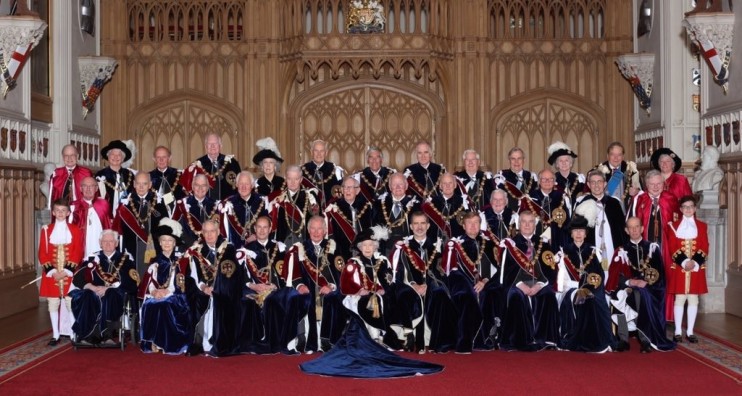
Here’s the whole gang of bloodsuckers at the Garter ceremony earlier this year, King Felipe of Spain was also installed this year, he’s sitting directly right of Elizabeth. Philip is missing...
Garter-ceremony-2019.jpg
 
Last edited:
Freemasonry, St. John, St. Nicholas

I´ve read a book by Paul Nadon, who tries to convince us that freemasonry is innocent, but when you think about it, it shows that freemasonry isn’t innocent at all (and the information in the book isn´t really that “secret”)...
I’m not sure whether the presented “history” is more factual of “speculative”, but it gave me a better understanding of freemasonry (which doesn’t mean much as I´m nothing near an expert on freemasonry).

According to Nadon, freemasonry in many ways is in imitation of the builders of Rome – masons, carpenters, builders and architects. He explains that these “masons” were in a hierarchical, secretive organisation.

Nadon also argues that freemasonry was founded on the foundation of the Knights Templars, after they were dissolved in 1312 (Templar knights went to Scotland to become freemasons).
According to Nadon, the English “freemason” is derived from “frank-mason” (because supposedly the subjects in the Kingdom of the Franks were “free”).

Nadon argues that freemasonry has always been close to the Christian Catholic church, while contradicting himself because workers joined the “Brotherhood” so they could become independent from the church. This also seems to contradict the fact that Jews were/are freemasons.
Nadon argues that people joined the “Brotherhood” so they could become independent from the Royal families, including tax exemption, while contradicting himself that Royals were often freemasons themselves or appointed the (Grand)masters of the masonic lodges.
The Grandmaster rank was often hierarchical.

What makes it all less than innocent...
First going back to the Roman masons, the most important buildings were places of worship and for armies. They were involved in building strong buildings for protection and offensive weapons as well, like catapults.

Nadon writes that modern freemasonry is “speculative”, instead of “operative” when masons were (only) involved in building activities.
When you combine this with the assualt on science, this “speculative” way of thinkering has actually taken over evidence-based science to destroy (genuine) science.

Freemasonry from its foundation in the 14[SUP]th[/SUP] century was built on legal procedures, which means that every high level freemason is basically (also) a lawyer.
Freemasons have the obligation to follow orders from their hierarchical leaders and to help, give charity to their fellow brothers.
When these freemasons become judges, attorneys, and politicians (lawmakers) it becomes apparent that our legal system can and will be used against us.

Paul Nadon – The secret history of freemasonry; Its origins and connection to the Knights Templar (1991): http://www.themasonictrowel.com/ebooks/freemasonry/eb0215.pdf
(http://web.archive.org/web/20191126...sonictrowel.com/ebooks/freemasonry/eb0215.pdf)


Paul Nadon has also written that the 2 Saint John’s were/are patron saints of freemasonry – St. John the Baptist and St. John the Evangelist.
Current day freemasonry came primarily from northern England and Scotland * where the Saints John were common among the Stonemason Guilds.

See the Masonic depiction of St. John the Baptist and St. John the Evangelist.
92190464cd3e60c62785d608f12ebed4f54c35ac.jpg


Some argue that freemasonry is descended from the Druids and other ancient Celtic priesthoods of the sun and isn’t really about God, but all about worshipping the Sun. This is supported by the fact that the feast days for St. John the Baptist and St. John the Evangelist are 24 June and 27 December respectively (just after the the summer and winter solstices, also note that the December celebration is one day after Christmas).

St. John the Baptist, was supposedly a cousin to Jesus Christ, who predicted the coming of the Messiah.
St. John the Baptist’s day, has been celebrated yearly by the Grand Lodge of England since 1717.

St. John the Evangelist is even more important as he is one of the 4 supposed writers of the New Testament. His yearly feast was instated some time after 1717.
In his Epistles, St. John the Evangelist supposedly describes how the Word and the Light are inevitably linked to each other and to Truth and Love.

In another freemasonic picture, the Point represents an individual brother and the Circle the boundary line of his duty. This Circle is embordered by 2 perpendicular parallel lines, representing St. John the Baptist and St. John the Evangelist; upon the top rest the Holy Scriptures.
2f633daf66f376e5eff6184c0f4b04059f474fc9.png


The Saints John were also referred to in Templar records.
When the Templars were suppressed in 1307 many Knights Templar in England joined the Hospitallers: http://www.freemasons-freemasonry.com/ward.html
(http://archive.is/X0RNE)


Paul Nadon has also written that Saint Nicolas de Champs was a patron saint of carpenters even before the foundation of freemasonry.
I couldn´t find anything on this St. Nicolas...

I’ve earlier posted in this thread on Sinterklaas, Santa Claus, Saint Nicholas and its connection to the Norse God Odin (a.k.a. the German Wodan).
I´ve found more interesting information on Saint Nicholas de Myra... Saint Nicholas de Myra was also the patron saint of sailors, merchants and... bankers!

The following fresco in the Santa Croce Basilica, Florence, shows that Saint Nicholas is the patron saint of bankers (that wonderful “charitable” institution). A man, wearing a green overcoat on top of a red coat, borrows money from a banker, in an orange coat.
As part of his promise to repay, he swears an oath on an image of Saint Nicholas (see the altarpiece of St. Nicholas in the background of the image on the right).
02fe14_68f567177c1e4584b5c8131dadf6b415.webp


The connection between Saint Nicholas and moneylenders is still visible in the international icon of pawnbroking: 3 gold balls (similar to balls hanging in the Christmas tree?) referring to St. Nicholas providing 3 poor girls with a dowry.
pawnbrokersymbol.jpg


The practice of the 3 gold balls hanging in front of the door of the money lenders was introduced by the Medici banking family of Florence, Italy, bankers for Charles Martel’s grandson Charlemagne. Schemes similar to modern-day pawnbroking, were advertised as donating money to the poor via low-interest loans.
In 1514, Pope Julius II declared Nikolaos of Myra patron saint of monetus pieatarius missions: http://jacozuijderduijn.wixsite.com.../11/18/Saint-Nicholas-patron-saint-of-bankers
 
Last edited:
Stanley Monteith - Brotherhood of Darkness

This post is about a relatively short book, only 69 pages, 4 chapters with good information on how Communists were installed by Capitalist in the US and Britain. I’m not sure if this is the complete book though...

Jacob Schiff financed the Bolshevik Revolution with $20 million. Other New York banks also contributed. It’s claimed that they did this because after the Protocols of the Elders of Zion were published in Russia in 1905, Russian Jews were persecuted. Because the Tsar refused to intervene, Jacob Schiff began plotting to depose him.
The Tsar ordered the Duma to disband but when it refused, he abdicated after which Alexander Kerensky was chosen to lead Russia until new elections. Kerensky intended to continue the Great War (WW I), that’s why the German High Command offered money and transportation to Lenin and Trotsky so they could overthrow Kerensky. After the Bolshevik Revolution, Lenin continued the war, so now they had to get money and supplies from elsewhere.

Colonel Edward Mandell House controlled President Woodrow Wilson and wrote about how he conspired to help the Bolsheviks:
I had a heart to heart talk with Clemenceau about Bolshevism in Russia and its westward march. I made him confess that military intervention was impossible... Later in the afternoon when Orlando called, I gave him very much the same kind of talk, and he too, agreed with my conclusions. I am trying, and have partially succeeded, to frighten not only the President, but the English, French and Italians regarding what might be termed the Russian peril. Personally, I really do not believe there is as much danger as I make it to them...
I would not confess that military intervention was an impossibility because I believe that it could be successfully accomplished if gone about properly. A voluntary and a mercenary army of very small proportions, equipped with artillery and tanks, would in my opinion do the work.
Later Colonel House controlled President Roosevelt, and much of the social legislation of the Roosevelt Administration came from Colonel House.

General Wrangel led the White Russian army in southern Russia to victory against the Bolsheviks, until British agents ordered him to withdraw his army to the Black Sea and leave Russia. If he refused, they would cut off his supplies, and his men would perish.
English agents destroyed the airplanes he had purchased, and eventually General Wrangel was forced to abandon his fight against the Bolsheviks.

Herbert Hoover catalogued the food and medical supplies sent to Russia from the USA:
To areas controlled by the Russian government - 27,588 tons in food and supplies; $332,508 charity.
To areas controlled by the Bolsheviks - 740,571 tons in food and supplies; $55,994,588 charity.

The Bolsheviks started a central bank that was funded from England and controlled by British and American bankers. Its board of directors featured former tsarist bankers and representatives from German, Swedish, and US banks, while the director of the Foreign Exchange division of the Bolshevik bank was Max May (vice president of the Guaranty Trust Company of J.P. Morgan).

In 1936, US ambassador to Germany William E. Dodd wrote a letter to Colonel House in which he asked why American corporations were building weapons for the Nazis when they couldn't get their profits out of Germany because of the exchange controls.

Britain did everything to delay the invasion of Europe; including opposing an invasion of southern France, and invading Italy instead.
This made it possible for the Red Army to conquer Eastern Europe.

Henry Ford supposedly financed Adolf Hitler because the Nazis would fight against those horrible Jews and Communists. The problem with this “conspiracy theory” is that Henry Ford also built a factory in the Soviet Union to help the same Communists!
The Ford Foundation has also funded Communist front organisations.
In 2000, the Ford Motor Company has 7 factories in Communist China, and plans to build more. Henry Ford helped the Bolsheviks in the 1930s, and today his company is helping the Chinese communists. Why?

Most people have been fooled to believe that the Communists simply beat the Nationalist Chinese. They couldn’t have without the support of US President Harry Truman.
General Chiang Kai-shek's armies were winning the civil war until the US State Department installed an arms embargo which prevented them from buying weapons or supplies anywhere in the world. Even the weapons they had already purchased on Okinawa and other Pacific islands were blocked. The US State Department intentionally brought Chairman Mao to power:
When the Chinese government did not effect coalition, by the summer of 1946 United States military assistance to China was brought to an end. Not only did the United States stop sending military supplies to the Chinese Government; the shipment of war materials actually purchased by the Chinese also was halted… The Chinese also had purchased surplus equipment that remained on Okinawa and other Pacific islands. Even the shipment of this was banned…
A complete embargo took effect in the summer of 1946. It was maintained at least until May 1947. General Chennault testified that the first shipment arrived in Shanghai in December 1948… Chennault further stated that the war material sent to China after the embargo did not arrive in time to aid the Chinese Nationalists in the field…
Admiral Cooke … testified that the Chinese had a number of divisions equipped with American arms... When the flow of American ammunition was stopped, these divisions lost their fire power and were defeated. Even after the Eightieth Congress appropriated $125,000,000 for aid to the Chinese, shipments were delayed and when the guns finally reached the Chinese general in north China they were without bolts and therefore useless.

Following the communist takeover of China in 1950, the US Senate appointed a special committee led by Congressman B. Carroll Reece to investigate why the State Department placed an arms embargo on the Nationalist Chinese to bring Chairman Mao to power.
The Reece Committee discovered that tax-exempt foundations were working with the Rhodes Trust, and Rhodes Scholars were assigned to strategic positions in US government. For example Dean Rusk, after returning from Oxford, worked for the Rockefeller Foundation until he was appointed Undersecretary of State for Far Eastern Affairs, where he could help the Communists in China. Later he returned to the Rockefeller Foundation where he stayed until President Kennedy appointed him Secretary of State, where he was largely responsible for starting the Vietnam War. In 1968, he became president of the Rockefeller Foundation.
Here are 4 important conclusions of the Reece Committee:
1. In 1915 the Carnegie Endowment for International Peace launched a propaganda program to force the United States into World War I.
2. Many of the large US foundations were promoting communism and socialism.
3. Foundations influenced State Department policy and were largely responsible for bringing communism to China.
4. Foundations were working to undermine our constitutional form of government.

Once again the US State Department brought the communist Fidel Castro to power.
This is detailed in the Senate Report on the fall of Cuba.

The American Communist Party was partly financed by J.P. Morgan. Senior partner in J.P. Morgan Tom Lamont, his wife Flora, and his son Corliss were sponsors and financers to a score of extreme Left organizations, including the Communist Party itself.
Member of the Central Committee of the American Communist Party before World War II, Bella Dodd, became disillusioned with Communism after a Soviet diplomat told her to contact 3 men at the Waldorf-Astoria Hotel if she needed the current Communist Party line. All 3 were well-known “capitalist” financiers. When she learned they were authorised to speak for the Soviet Union, she realized that Moscow was working with Wall Street.
KGB agent Thomas Schuman also found out that Western financiers were working closely with the Soviet leaders.

Andrew Carnegie was a wealthy socialist, who believed in monopoly capitalism and envisioned socialism to be used to create a ruling class. Under socialism everyone is controlled by the government, the government is controlled by politicians, and politicians are bought by wealthy men and corporations.
After selling Carnegie Steel (U.S. Steel) to J.P. Morgan, Carnegie funded several foundations to transform society and promote world government.

By 1917, J.P. Morgan and co controlled 25 of the most influential American newspapers. They published completely fake stories on the supposed atrocities committed by the Germans.
On 9 February 1917, US Congressman Oscar Callaway inserted in the Congressional Record:
In March, 1915, the J.P. Morgan interests … and their subsidiary organizations, got together 12 men high up in the newspaper world and employed them to select the most influential newspapers in the United States and sufficient number of them to control generally the policy of the daily press of the United States. These 12 men worked the problem out by selecting 179 newspapers, and then began, by an elimination process, to retain only those necessary for the purpose of controlling the general policy of the daily press throughout the country.
They found it was only necessary to purchase the control of 25 of the greatest papers. The 25 papers were agreed upon; emissaries were sent to purchase the policy, national and international, of these papers; an agreement was reached; the policy of the papers was bought, to be paid for by the month; an editor was furnished for each paper to properly supervise and edit information regarding the questions of preparedness, militarism, financial policies, and other things of national and international nature considered vital to the interests of the purchasers. This contract is in existence at the present time, and it accounts for the news columns of the daily press of the country being filled with all sorts of preparedness arguments.

In 1884, the Fabian Socialist Society was organised which included George Bernard Shaw.
Shaw explained Socialism as follows:
I also made it quite clear that socialism means equality of income or nothing, and that under Socialism you would not be allowed to be poor. You would be forcibly fed, clothed, lodged, taught, and employed whether you liked it or not.
If it were discovered that you had not character and industry enough to be worth all this trouble, you might possibly be executed in a kindly manner; but whilst you were permitted to live you would have to live well... As far as I know I was the first Socialist writer to whom it occurred to state this explicitly as a necessary postulate of permanent civilization.

Cecil Rhodes wrote in 1877 about his plan to bring the world under British rule and recolonise the United States:
The idea gleaming and dancing before ones eyes like a will-o-the-wisp at last frames itself into a plan. Why should we not form a secret society with but one object, the furtherance of the British Empire, for the bringing of the whole uncivilized world under British rule, for the recovery of the United States, for the making [of] the Anglo-Saxon race but one Empire.
In February 1891, Cecil Rhodes’ first 3 recruits were William T. Stead, Lord Alfred Milner, and a man now known as Lord Esher. Rhodes and his fellow conspirators orchestrated the Boer War.
According to A. Goulevitch, Knight of the Garter Lord Alfred Milner financed the March 1917 revolution.

H.G. Wells wrote that in the Coefficients dinner club there were 2 factions: 1) Fabian Socialists Bertrand Russell, George Bernard Shaw, H.G. Wells, and Sidney Webb; and 2) British aristocracy Lord Milner, Leopold Amery, Lord Brand, Sir Edward Grey, and Lord Cecil. Milner, Lord Brand, and Leo Amery were also members of Rhodes' secret society, and Sir Edward Grey was closely aligned with it.
After WW I ended, Great Britain was bankrupt, and Lord Milner's men asked Frederic Howe to arrange a meeting with the US delegation to ask if they would take the leadership of their program. Colonel House as head of the American delegation, agreed. Subsequently, the Royal Institutes of International Affairs were established in 5 Commonwealth nations, and the Council on Foreign Relations in the US.

In 1923, Alice Bailey organised the Lucis Trust to publish and distribute her and Madame Blavatsky's writings, which are the foundation of New Age thought.
Robert Muller belongs to the Lucis Trust. He was Assistant Secretary General of the United Nations, and his World Core Curriculum is being used in schools to introduce students to the occult.

In Morals and Dogma, Albert Pike explained that the lower “blue” level freemason are deceived:
The Blue Degrees are but the outer court or portico of the Temple. Part of the symbols are displayed there to the Initiate, but he is intentionally misled by false interpretations.
It is not intended that he shall understand them; but it is intended that he shall imagine he understands them. Their true explication is reserved for the Adepts, the Princes of Masonry.

Dr. Dennis Cuddy has stated that:
The huge investment banking firm of Goldman Sachs has included dozens of [Rhodes] scholars over the past half century, but never as many as in the 1990s, when at any given moment at least a half dozen have been partners.

Six of the last 9 US presidents were members of the CFR, and at least 5 of the last 11 presidents were Masons. A sixth president, William Jefferson Clinton, was a Rhodes Scholar and a member of the boys' club for Masons, de Molays.
President Harry Truman was a 33rd Degree Mason. Truman stacked the US Supreme Court with Masons, gave China and Eastern Europe to the communists, created the United Nations, got the US in a no-win war in Korea, and fired General MacArthur when he tried to win that war.

Henry Ford was also a 33rd Degree Mason.
Winston Churchill was both a Mason and a Druid.

In 2000, Maurice Strong was senior advisor to both Secretary-General of the UN Kofi Annan and president of the World Bank James Wolfensohn. Some “conspiracy theorists” have concluded that Maurice Strong actually runs the UN. From 1971 to 1978, Strong was a trustee of the Rockefeller Foundation.
Strong was the chairman of both the Earth Council and the World Resources institute, co-chairman of the Council of the World Economic Forum and a member of Toyota's International Advisory Board. He has also been president of the World Federation of the UN Association, a trustee of the Aspen institute, director of the World Future Society, and a director of finance of the Lindisfarne Association. In 1972, Strong was the Secretary-General of the First Earth Summit in 1992 also of the Second Earth Summit, and of the Earth Summit Plus Five in 1997.

Both Mikhail Gorbachev and Maurice Strong are associated with the Club of Rome, and they co-authored the Earth Charter, a plan for control over us – the slaves – in the future.
Isn’t it strange that Communists and capitalists apparently share the same ideal of complete control over the masses?

Stanley Monteith – Brotherhood of Darkness (2000): http://www.mediafire.com/file/zivtbub8iuxccj2/rdsxtcfcfygvvvvvvvvvvvvvv.pdf/file


One of the references in the Monteith book is Bruce Lockhart’s 1932 memoirs.
In February 1917, Lord Alfred Milner visited Russia shortly before the Tsar was deposed. After the Bolshevik Revolution had started, Milner sent Lockhart to Saint Petersburg and board member of the Federal Reserve Bank William Boyce Thompson sent Raymond Robins to Russia to monitor the Bolshevik Revolution.

Bruce Lockhart described an incident that shows how an Englishman and American had access to leader of the Communists, Vladimir Lenin:
Another new acquaintance of these first days in Bolshevised St. Petersburg was Raymond Robins, the head of the American Red Cross Mission... Although a rich man himself, he was an anti-capitalist...
Hitherto, his two heroes had been Roosevelt and Cecil Rhodes. Now Lenin had captured his imagination... Robins was the only man whom Lenin was always willing to see, and who ever succeeded in imposing his own personality on the unemotional Bolshevik leader...
I returned from my interview to our flat only to find an urgent message from Robins requesting me to come to see him at once. I found him in a state of great agitation. He had been in conflict with Saalkind, a nephew of Trotsky and then Assistant Commissar for Foreign Affairs. Saalkind had been rude, and the American, who had a promise from Lenin that, whatever happened, a train would always be ready for him at an hour's notice, was determined to exact an apology or to leave the country. When I arrived he had just finished telephoning to Lenin. He had delivered his ultimatum, and Lenin had promised to give a reply within ten minutes. I waited, while Robins fumed.
Then the telephone rang and Robins picked up the receiver. Lenin had capitulated. Saalkind was dismissed from his post. He was an old member of the Party. Would Robins have any objection if Lenin sent him as a Bolshevik emissary to Berne? Robins smiled grimly. 'Thank you, Mr. Lenin,' he said. 'As I can't send the [expletive deleted] to hell, burn is the next best thing you can do with him.'

R.H. Bruce Lockhart - Memoirs of a British Agent (1932): https://archive.org/details/in.ernet.dli.2015.237389/page/n3
 
The following post from another thread fits in here nicely...
The Scots and the Irish were tricked at the very important and formative Battles of Culloden and the Boyne by the Knights of the Garter (English Order of Knights founded in Woodstock, Oxford in 1348).

The Knights of the Garter controlled both sides of the warring factions....

i.e. they couldn't lose

KG - Knight of the Garter

The Irish Battle of the Boyne 1690

The Battle of the Boyne was a battle in 1690 between the Jacobite forces of the deposed
King James II (KG #439 appointed 1642) of England and Ireland, VII of Scotland and
the Williamite forces of King William III (KG #456 appointed 1653) who, with his wife
Queen Mary II (his cousin and James's daughter), had acceded to the Crowns of England
and Scotland in 1689.

The battle took place across the River Boyne close to the town of Drogheda in the Kingdom of Ireland, modern-day Republic of Ireland, and resulted in a victory for William.

King James II’s commanders included James FitzJames, 1st Duke of Berwick (KG #495 appointed 1688)

Jacobite Commander - James FitzJames, 1st Duke of Berwick (KG #495
appointed 1688)

William's commander-in-chief was Frederic Herman de Schomberg, 1st Duke of Schomberg.(KG #497 appointed 1689)

Williamite Commander - Frederic Herman de Schomberg, 1st Duke of
Schomberg.(KG #497 appointed 1689)

The best Williamite infantry were from Denmark supplied by Prince George of
Denmark (KG #487 appointed 1684).

William III KG #456 and Prince George of Denmark KG #487 at the Battle
of the Boyne, 1690 by Jan Wyck (1645–1700)

The battle took place on 1 July 1690. William's forces defeated James's army, which
consisted mostly of raw recruits in a somewhat one-sided affair.

Both sides of the battle were controlled by the Knights of the Garter.
The final result had been carefully planned long before the battle took place.

The Battle of Culloden was the final confrontation of the Jacobite Rising of 1745. On 16 April 1746, the Jacobite forces of Charles Edward Stuart (Knight of the Garter) were decisively defeated by Hanoverian forces commanded by William Augustus, Duke of Cumberland (KG #546 appointed 1730), near Inverness in the Scottish Highlands.

Queen Anne, the last monarch of the House of Stuart, died in 1714, with no living children. Under the terms of the Act of Settlement 1701, she was succeeded by her second cousin George I of the House of Hanover, who was a descendant of the Stuarts through his maternal grandmother, Elizabeth, a daughter of James VI and I.

Raising an army consisting mostly of Scottish clansmen along with smaller units of Irish and Englishmen from the Manchester Regiment, Charles' efforts initially met with success and at one point began to threaten London. However, a series of events forced the army's return to Scotland, where they were soon pursued by an army raised by the Duke of Cumberland. The two forces eventually met at Culloden, on terrain that made the highland charge difficult and gave the larger and well-armed British forces the advantage. The battle lasted only an hour, with the Jacobites suffering a bloody defeat. Between 1,500 and 2,000 Jacobites were killed or wounded in the brief battle. In contrast, only about 300 government soldiers were killed or wounded.

The Hanoverian victory at Culloden halted the Jacobite intent to overthrow the House of Hanover and restore the House of Stuart to the British throne; Charles Stuart never again tried to challenge Hanoverian power in Great Britain. The conflict was the last pitched battle fought on British soil.


Jacobite Rising of 1745 – The Knights of the Garter Influence

Knights of the Garter - Hanoverians

Prince William Augustus, Duke of Cumberland, KG #546 appointed 1730. Best remembered for his role in putting down the Jacobite Rising at the Battle of Culloden in 1746. He is often referred to by the nickname - 'Butcher' Cumberland.

Charles Lennox, 2nd Duke of Richmond KG#544 appointed 1726. Richmond was a Lieutenant-General in the British Army and served under the notorious Duke of Cumberland in the Hanoverian campaign against the Jacobite rising of 1745.

John Montagu, 2nd Duke of Montagu KG #532 appointed 1718. In 1745, Montagu raised a cavalry regiment known as Montagu's Carabineers, which, however, was disbanded after the Battle of Culloden.

Thomas Pelham-Holles, 1st Duke of Newcastle KG #533 appointed 1718. By late 1745 he had rallied all the southern militias and regular forces against the Jacobites who withdrew to northern Scotland.

William Cavendish, 3rd Duke of Devonshire KG #550 appointed 1733. During the Jacobite rising of 1745 the Duke raised a militia unit in support of the King known as the Derbyshire Blues, which mustered at the George Inn, Derby, on 3 December 1745.

Evelyn Pierrepont, 2nd Duke of Kingston-upon-Hull KG #557 1741 When the Jacobite rising of 1745 broke out he raised a regiment called "Kingston's light horse," which distinguished itself at the Battle of Culloden. The Duke attained the rank of general in the army


Knights of the Garter - Jacobites

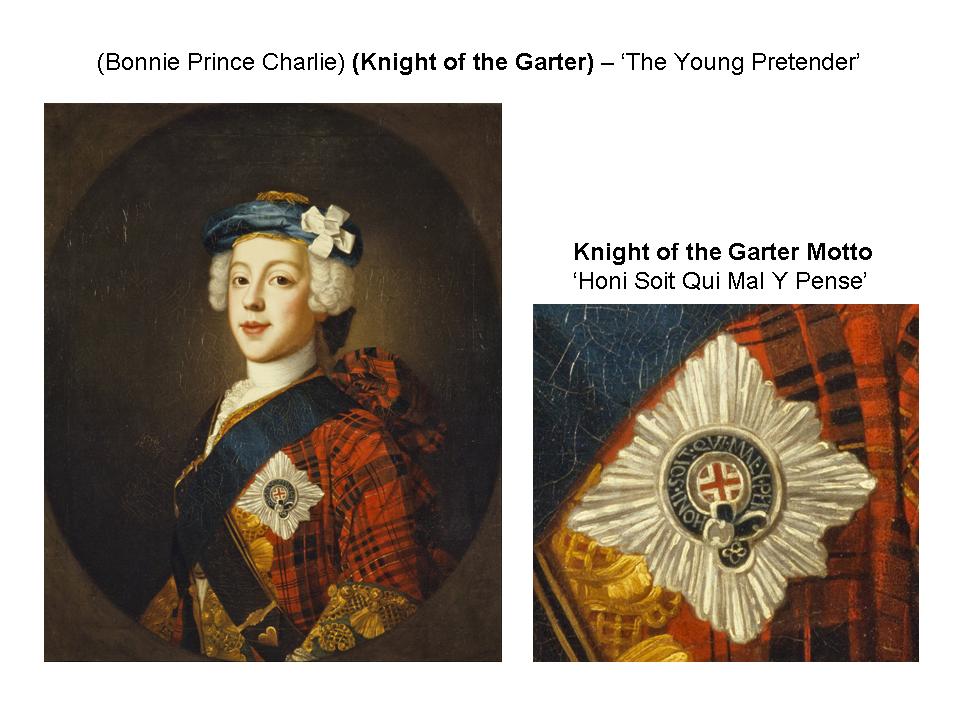
Charles Edward Louis John Casimir Sylvester Severino Maria Stuart (Bonnie Prince Charlie) (Knight of the Garter) – ‘The Young Pretender’.

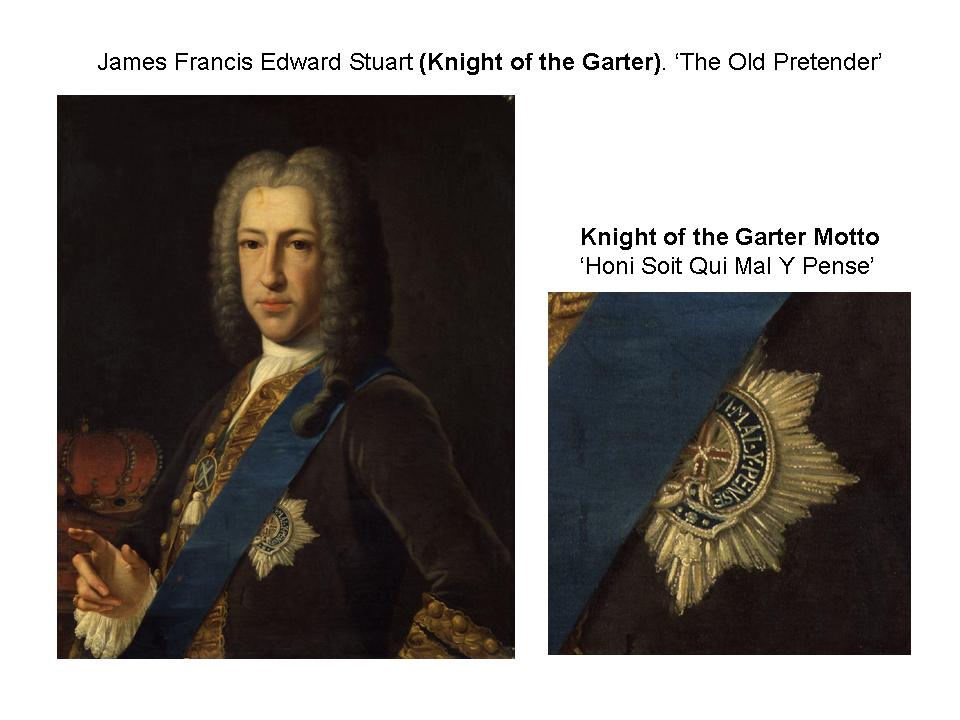
James Francis Edward Stuart (Knight of the Garter). ‘The Old Pretender’.

Charles ignored the advice of General Lord George Murray and chose to fight on flat, open, marshy ground where his forces would be exposed to superior government firepower. He commanded his army from a position behind his lines, where he could not see what was happening. He hoped that Cumberland's army would attack first, and he had his men stand exposed to the British Royal artillery. The Jacobite attack was uncoordinated, charging into withering musket fire and grapeshot fired from the cannons, and it met with little success.


Knights of the Garter – Both Hanoverian and Jacobite Supporter?

Richard Boyle, 3rd Earl of Burlington KG #548 appointed 1730. It has also been suggested that, despite apparently being a pillar of the Hanoverian establishment, Burlington covertly and treasonably engaged in Jacobite activities.


Bonnie Prince Charlie - After Culloden

Charles ultimately evaded capture and left the country aboard the French frigate L'Heureux, arriving in France in September. With the Jacobite cause lost, Charles spent the remainder of his life on the continent, except for one secret visit to London.

Charles died in Rome of a stroke on 31 January 1788, aged 67. He was first buried in Frascati Cathedral near Rome, where his brother Henry Benedict Stuart was bishop. At Henry's death in 1807, Charles's remains (except his heart) were moved to the crypt of St. Peter's Basilica in the Vatican where they were laid to rest next to those of his brother and his father near the monument to the Royal Stuarts. His mother is also buried in St. Peter's Basilica. His heart remained in Frascati Cathedral, where it is contained in a small urn beneath the floor under a monument.


Coat of arms of ‘The Young Pretender’ in the Palazzo di San Clemente in Florence clearly displaying the Knights of the Garter motto – ‘Honi Soit Qui Mal Y Pense’.
800px-Palazzo_di_San_Clemente%2C_stemma_Stuart_2.jpg
 
Palmerston Zoo

The following is a good collection of essays from the Lyndon LaRouche network (?) with British Intelligence as the common thread. I have already posted some of these essays separately on this forum…

Gottfried Wilhelm von Leibniz and Jonathan Swift together fought against the “black Nobility” of the Order of the Garter. The Marlboroughs resorted to deceit, terror, and treachery to cut off political relations between Queen Anne and Sophie of Hanover. Swift succeeded in breaking Marlborough's gang’s domination of Queen Anne's cabinet. During 1710 and 1711, Swift drove the Marlboroughs and their cronies from office.
The Order of the Garter hurled Isaac Newton into the fray against Leibniz, lying that differential calculus was his invention while it had been figured out by Leibniz.
Leibniz himself died in 1716. Jonathan Swift fought on from Ireland, where he was made Dean of St. Patrick's Cathedral in Dublin by Queen Anne. He became the political leader of all Ireland during the 1720s, building a mass-based movement on the principles of man's God-given right to liberty.

Knight of the Garter William Petty, Earl of Shelburne and Marquis of Lansdowne, selected Jeremy Bentham, Adam Smith and Edward Gibbon as his stooges. These were the founders of British philosophical radicalism.
The reign of terror in the French Revolution was the work of agents and dupes of Shelburne among the Jacobins. At this time, British policy was in the hands of Shelburne's protégé, William Pitt the Younger (whose older brother was a Knight of the Garter).
The beneficiaries of the war brought on Europe by Napoleon, financed by state bonds using US president Jefferson sold by the British Baring Bank, and his defeat were the British.

Knight of the Garter Lord Palmerston's Three Stooges were Giuseppe Mazzini, Louis Napoléon Bonaparte, and David Urquhart.

In 1836, later emperor of France, Knight of the Garter Napoléon III started a failed coup of France and was exiled to America. Then Napoléon was educated at the new British Museum reading room and by Lord Palmerston. He was also in contact with Giuseppe Mazzini.
In 1848, Napoléon III was working as a special constable in Britain; to squash an expected Chartist revolution. He was then shipped to Paris, where he became President. In 1860, Napoléon III signed a “free trade” treaty with Britain.

British Foreign Minister Palmerston launched Zionism in 1840, when he wrote that the Jews wanted to “return” to Palestine and a month later British troops landed in Palestine.
In 1843, B'nai B'rith was started officially in New York, as a secret society "like Freemasonry" for Jews.

The founder of Zionism in its “modern” British-sponsored form is not Theodor Herzl, but a certain Moses Hess.
It was the same Hess, who converted Friedrich Engels to communism, and was ghost writer for parts of Marx's Ideology.

When John Wilkes Booth murdered President Lincoln at Ford's Theatre, his old friend Benjamin Peixotto was international president of the B'nai B'rith.
Only hours before he shot Lincoln, Booth met with his old friend, B'nai B'rith Washington chief Simon Wolf. Wolf was later a prime founder of the Anti-Defamation League (ADL).
Memphis B'nai B'rith leader Abraham Frankland was an intimate friend of Albert Pike. Frankland lists assorted gods passed down by tradition from ancient times, including "Four of the thirteen great Gods of Assyria" plus the god "Bel". Bel is another name for Baal, who was worshipped by the Babylonians as the supreme god.

“The Palmerston Zoo”; Solving the Paradox of Current World History: http://www.redmoonrising.com/Solving the Paradox of Current World History.doc
(http://archive.is/kfFUw)
 
Charles Edward Louis John Casimir Sylvester Severino Maria Stuart (Bonnie Prince Charlie) (Knight of the Garter) – ‘The Young Pretender’.

James Francis Edward Stuart (Knight of the Garter). ‘The Old Pretender’.
It looks like the “independent” Wikipedia has deleted some important information. Usually this is done to hide some terrible scandal…

In Wikipedia’s List of Knights and Ladies of the Garter, both the “Old Pretender” James Francis Edward Stuart and his son the “Young Pretender” Charles Edward Stuart (a.k.a. Bonnie Prince Charlie) are missing: https://en.wikipedia.org/wiki/List_of_Knights_and_Ladies_of_the_Garter


The personal Wikipedia page of James Francis Edward Stuart confirms that he was a Knight of the Garter (installed in 1692): https://en.wikipedia.org/wiki/James_Francis_Edward_Stuart


While the personal Wikipedia page of Charles Edward Stuart doesn’t say that he was a Knight of the Garter, he was pictured with the Garter star and sash and his coat of arms confirm he was a Knight of the Garter (see below):
https://en.wikipedia.org/wiki/Charles_Edward_Stuart
800px-Palazzo_di_San_Clemente%2C_stemma_Stuart_2.jpg


The following Wikipedia page confirms that Charles Edward Stuart became a Knight of the Garter in 1722, when he was only 1 years old (less than a week before his second birthday): https://en.wikipedia.org/wiki/Jacobite_peerage


The best Williamite infantry were from Denmark supplied by Prince George of
Denmark (KG #487 appointed 1684).
The Danish infantry is missing from the story of Prince George. They insinuate that he was some sort of enemy of King William III (Dutch Stadthouder Willem III of the House of Orange Nassau).

Prince George was forewarned of Willem’s 5 November 1688 invasion by the Danish envoy in London, Frederick Gersdorff.

George accompanied the King James' troops to Salisbury in mid-November, but on 24 November George deserted him and sided with Willem (at his own expense).
In early April 1689, (now) King William naturalised George as an English subject, and created him Duke of Cumberland, Earl of Kendal and Baron of Okingham (Wokingham).

Wikipedia also insinuates that William didn’t pay George the promised interest and compensation, but admits that he WAS paid in 1700: https://en.wikipedia.org/wiki/Prince_George_of_Denmark
 
Last edited:
It looks like the “independent” Wikipedia has deleted some important information. Usually this is done to hide some terrible scandal…

In Wikipedia’s List of Knights and Ladies of the Garter, both the “Old Pretender” James Francis Edward Stuart and his son the “Young Pretender” Charles Edward Stuart (a.k.a. Bonnie Prince Charlie) are missing: https://en.wikipedia.org/wiki/List_of_Knights_and_Ladies_of_the_Garter

I’m in agreement with Firestarter that James Stuart (the Old Pretender) and Bonnie Prince Charlie (the Young Pretender) are not listed by Wikipedia as being Knights of the Garter.

I’ve also undertaken a conscientious check of all the Knights of the Garter listed by EH Fellowes MVO, MA, Mus.Doc, Minor Canon of Windsor, Hon Fellow of Oriel College, Oxford in his book ‘The Knights of the Garter 1348 – 1939'.

The copy of this book was once owned by Arthur Cochrane, Clarenceux King of Arms so I would have expected it to be a complete list of Knights of the Garter. However, it appears James and Charlie have been omitted for some reason.


James Stuart by Prince Arthur, on Flickr

Bonnie Prince Charlie by Prince Arthur, on Flickr

https://pubastrology.com/new-world-order-of-the-knights-of-the-garter/
https://pubastrology.files.wordpres...d-order-of-the-knights-of-the-garter-v2_3.pdf
 
I’m in agreement with Firestarter that James Stuart (the Old Pretender) and Bonnie Prince Charlie (the Young Pretender) are not listed by Wikipedia as being Knights of the Garter.

I’ve also undertaken a conscientious check of all the Knights of the Garter listed by EH Fellowes MVO, MA, Mus.Doc, Minor Canon of Windsor, Hon Fellow of Oriel College, Oxford in his book ‘The Knights of the Garter 1348 – 1939'.

The copy of this book was once owned by Arthur Cochrane, Clarenceux King of Arms so I would have expected it to be a complete list of Knights of the Garter. However, it appears James and Charlie have been omitted for some reason.
That they have been deleted from the List of all Knights of the Garter, also from other sources, certainly makes it all the more probable that these wars in Ireland and Scotland were really AGAINST the Jacobites.

While the Most Noble of the Garter is a very exclusive club, it looks like you and me are part of another “exclusive” club, of the very few people that investigate the Order of the Garter.
 
War against the Netherlands

I’ve been looking into how the European Royals conspired to install the Orange-Nassau family into power of the Netherlands…
It’s really another example of war waged not between the commanders of the army, but really against the population.
While this was sold as a war between Catholics and Protestants, in reality the “Protestant” leaders were also cosy with the Papestry.

The supposed “Father of the Fatherland” of the Netherlands, the German Willem of Nassau-Dilenburg, Willem the Silent or Willem of Orange. Willem the Silent was a henchman for the Von Habsburgs of Spain and the Holy Roman Empire (starting with Holy Roman Emperor Charles V, KG in 1508).


Willem the Silent’s son, Stadthouder (city holder) of Holland Maurits of Orange-Nassau, who became a Knight of the Garter (KG) in 1612 didn’t marry, so – per definition – didn’t have any legitimate children.

Maurits was made into a Dutch “hero” by the invasions by the Spain ruled by King Philip II of Spain, KG in 1554, married to his first cousin Queen Mary of England, Lord of the Seventeen provinces of the Netherlands since 1555.

In 1584, Willem the Silent was assassinated by Balthasar Gérard, after Philip II had offered a reward of 25,000 crowns to kill him, calling him a "pest on the whole of Christianity and the enemy of the human race".

Upon Mary's death, the English throne went to Elizabeth I, while Philip II remained close to England. He even sent a proposal of marriage to Elizabeth.
Maurits continued to fight “against” Philip, with the aid of Queen Elizabeth of England.
The war came to an end in 1648, when the Orange-Nassaus were firmly established as the hereditary Stadthouders of the Dutch Republic, and recognised by the Spanish Crown as independent: https://en.wikipedia.org/wiki/Philip_II_of_Spain


“Virgin Queen” Elizabeth I sent her “favourite” Robert Dudley, 1st Earl of Leicester (they were rumoured to have an affair), KG in 1559, to the Netherlands to help in “pacifying” the population the hard way.

See Robert Dudley, 1st Earl of Leicester, ca. 1587.
3b5c716e2d169907e1d0f3c75f0c4065.jpg


Dudley’s brother-in-law had been close to the Spanish nobles around King Philip II of Spain, then Queen Mary's husband (half-sister of Elizabeth).
Another chief adviser to Elizabeth I was William Cecil, 1st Baron Burghley, founder of the Cecil dynasty (Marquesses of Exeter and of Salisbury), KG in 1572.

When Dudley’s wife died, supposedly fallen of the stairs while alone in her house, it was widely suspected that Dudley had killed her so he could marry Elizabeth.
A marriage was arranged between Dudley and Queen Mary of Scotland, but Dudley refused!

Since 1565, Dudley had flirted with the first cousin once removed of Queen Elizabeth I, Lettice Knollys, wife of Walter Devereux, 1st Earl of Essex. They were rumoured to have an affair.
In September 1576, Devereux died of dysentery after he returned to Ireland, supposedly caused by poison, on the orders of Dudley.
Dudley finally drew a line under his relationship with Douglas Sheffield, with whom he had a son, so he could secretly marry Lettice Knollys on 21 September 1578.
When Queen Elizabeth was finally told on this marriage, she supposedly was furious.

In the 1570s Dudley became a friend of Stadthouder Willem the Silent. In 1584, after Willem the Silent was murdered, in August 1585 he was sent to the Netherlands.
On 25 January 1586, Dudley was appointed Governor-General of the United Provinces of the Netherlands. On Queen Elizabeth’s "commandment", he was forced to resign and return to her in December 1586: https://en.wikipedia.org/wiki/Robert_Dudley,_1st_Earl_of_Leicester


At the same time of the wars in the Netherlands, Philips II of Spain was also fighting “with” the “Catholic” King Henry IV of France, KG 1590, who was also in an alliance with the “Protestant” Maurits: https://www.britannica.com/biography/Maurice-stadholder-of-The-Netherlands
 
The Lord of the Rings - The Knights of the Garter

While the Most Noble of the Garter is a very exclusive club, it looks like you and me are part of another “exclusive” club, of the very few people that investigate the Order of the Garter.

JRR Tolkien – a very important investigator of the ‘Most Noble Order of the Knights of the Garter’….

The Knights of the Garter founded 1348 in Woodstock, Oxford (a British Order with NINE Holy Roman Emperors as Past Members).
LOTR_1 by Prince Arthur, on Flickr

I think JRR Tolkien was trying to tell everyone that 'The Lord of the Rings' refers to the 'Knights of the Order of the Garter'.

(Tolkien was Merton Professor of English Language and Literature and Fellow of Merton College, Oxford, from 1945 to 1959).
The Order of the Knights of the Garter was founded in Woodstock, Oxford, eight miles distant from where Tolkien would meet with the Inklings in the Eagle and Child Public House in Oxford.

Tolkien 1 by Prince Arthur, on Flickr

The Eagle and Child symbolism was adopted by the Earls of Derby (which included a significant number of Knights of the Garter).

(THE EAGLE AND CHILD WAS THE FAMILY CREST OF THE STANLEY FAMILY WHICH INCLUDED THE EARLS OF DERBY. ORIGINALLY THE CREST OF THE LATHOM FAMILY FROM LANCASHIRE, WHEN THE FAMILIES UNITED THROUGH THE MARRIAGE OF ISABELLA DE LATHOM AND SIR JOHN STANLEY IN 1385 THE STANLEY FAMILY ADOPTED THE EAGLE AND CHILD CREST).

Ref: https://www.periodoakantiques.co.uk/antique-sales-archive/a-deeply-carved-16th-century-english-oak-panel-of-the-eagle-and-child-family-crest-of-the-stanley-family-circa-1530-27-stockno-1025/

Eagle and Child Pub where Tolkien would meet with the Inklings

(Eagle and Child - Aquila and Antinous Star Constellation refers to Emperor Hadrian and his Boy Lover, Antinous)

Ref: http://www.ianridpath.com/startales/antinous.htm

'Honi Soit Qui Mal Y Pense' - Shame on He Who Thinks Bad Of It. (French motto for the Order of the Garter).

LOTR_2 by Prince Arthur, on Flickr

Some characteristics of the One Ring:


  1. a magic ring of invisibility


  1. malevolent power created to win dominion over Middle-earth


  1. unlike other rings, the One Ring was not susceptible to DRAGON FIRE


  1. The Ring slowly but inevitably corrupted its bearer, regardless of the bearer's initial intent


  1. The Ring had the ability to change size adapting to it’s new owner


  1. Normally the One Ring appeared perfectly plain and featureless, but when heated its inscription appeared in fiery letters.


The Order of the Garter with the ‘George and the Dragon’ symbolism


• An air of invisibility and malevolence

• Impervious to ‘Dragon Fire’

• When heated its inscription appeared in fiery letters

• Adjustable to fit the wearer
 
JRR Tolkien – a very important investigator of the ‘Most Noble Order of the Knights of the Garter’….
Nicholas de Vere was my starting point for this thread.
He has written the following about Tolkien…
Considering the foregoing, it is interesting to note that in Tolkien’s ’Silmarillion’ - the background mythology that supports his ’Lord of the Rings’ - we find a vocabulary and etymology that includes the following words - Ainur, Ainu, Vala, Maiar, Eldar, Ea.

Tolkien’s word Ainur means the "Holy Ones" of which the singular is Ainu. There are two orders of these gods in his mythology - the Valar and the Maiar. The plural Ainur and the singular Ainu are clearly derived from the Sumerian father of the gods - Anu and the Anunnaki, whilst Valar appears in the Aryan pantheon as Vala "The encircler", reminiscent of the Orobourus, the alchemical Dragon Ring that Tolkien wrote so much about. We will also remember the Val-Kyrie at this juncture.

The word Maia is spelt Maja in Spanish and denotes a female line of nobility and royalty. The ’i’ was originally ’j’ and came, along with the word majesty, from the Latin majes or majus, a variant of which is magi or magus, from the Greek magos - magos, a bloodline member of a caste or genetic strain comprising of individuals heritably steeped in magic, (OED), in other words the Arya - or Scythian Derkesthai - The Dragon Goddess Queens and God Kings.

At this point we return to the concept of the derkesthai and the bloodline of the dragon god-kings - the Asuras and the Anunnaki. In the ’Silmarillion’ Maia becomes Maiar and it accords with the ancient concept of deific royalty - Maia - which, related to Mana is the ’spirit of the gods carried in the blood’, the attribute of a goddess-queen or god-king of the Dragon who are in themselves collectively an ’order of the gods’ - the ’elves’ - the shining ones - or ’gods incarnate’- the Devas and Avatars.

The ’spirits of the gods - the ancestors - carried in the blood’ we will remember are the spirits summoned from the ’deeps’, the subconscious, by the witch, (Vampire or Druid) who gains her or his name - wicce or wicca - from the ability to yield or bend to, or rather to draw to the surface of consciousness, these spiritual intelligences and their wisdom from her or his ancestral, and thus genetic, inheritance. In other words their waking consciousness is pacified or "yields", to allow the older spirit, or racial memory, to give voice.

Avatar is a word Tolkien includes in his Silmarillion as Aratar the eight most powerful of his Valar or order of old gods which, it seems obvious, were intended to mimic the Egyptian gods of the Ogdoad, the eight Anunnaki who tended the Holy Mountain after the Black Sea flood.

Another of Tolkien’s words similar to Avatar - Avathar - to him means "The Shadows" which he uses as a name for a land near his ’Bay of Eldemar’. Comparably, in our world, an Avatar is a ’god made flesh’ - a Dragon King or Queen who often occupied tombs and would have been thought of as a "shadow", a spirit of the otherworld, the realm of the Shining Ones.

So in the Vala and Maiar we have two orders of gods taken from the Dragon tradition itself whilst, according to the legends of Tolkien’s elves, the word Eldar became used as a name for the three elven kindreds, one of which Tolkien named the Vanyar, who appear to be the Vanir Gods of the Danes, cousins of the Tuadha d’Anu. Tolkien’s largest variety of wicked Orcs he named the Uruks and Uruk a City State of the Anunnaki. The Orcs he said were once fair elves who had been imprisoned and tortured in the Land of Mordor.

’Eldar’, explains Tolkien, means ’People of the Stars’, echoing a traditional Gaelic epithet for the Tuadha d’Anu and also one of the original meanings of the name Anunnaki - People of the Stars.

Of men, Tolkien concurs that they are the second, younger race which his elves called the Atani, (Adamae) a name, says Tolkien, that later became the Edain, obviously the children of Eden. Again we have a borrowing of Dragon Lore where the Elves, the Children of Anu, the Anukim or Repha’im of the Old Testament, appeared first, followed by our Adamae, or the Atani as Tolkien would have it.

Edain is obviously Eden, whilst he uses Eä as a name for the Earth which in Sumerian is the name for the dragon god of the ’Earth and Waters’ - Enki-Samael, the leader of the elder "Eldar" gods - the Aesir. Tolkien, in his epic works, with their plethora of borrowed names and borrowed linguistics and their elder and younger races, is obviously writing about the family, particularly when one peruses his vocabulary and discovers the name Avallónë, a haven and city of the Eldar - the Elves - situated on ’the lonely isle’ - Tol Eressea, which was drawn across the ocean and rooted finally in the Bay of Eldemar, adjacent to Avathar - the land of Shadows: our Avalon or Otherworld.

The various names by which our planet is known all stem from the word Eridu, which was the first city founded by Enki-Samael in Mesopotamia. As a variant of Eridu, in the Silmarillion, Tolkien has Eriador and his Elven word for Earth is Arda, which is also derived from Eridu.
https://www.bibliotecapleyades.net/dragons/esp_sociopol_dragoncourt02_12.htm
 
Garter wars to install House of Orange

Maurits of Nassau forced his brother, Frederik Hendrik, to marry so he could inherit his titles. Frederik Hendrik quickly married Amalia of Solms-Braunfels in 1625. Frederik Hendrik became stadthouder (city holder) after Maurits’ dead and Knight of the Garter (KG) in 1627.
His illegitimate son by Margaretha Catharina Bruyns, Frederick Nassau de Zuylestein, had already been born in 1624. This son later became the governor of the young Willem III of Orange for 7 years.

Frederik Hendrik was involved in many local sieges and captures against the Dutch population.
For most of this time the Dutch Republic was allied with France “against” Spain, including the 1635 treaty under which Frederik Hendrik could continue waging wars even if the assembly of Holland refused finance.
But in his last years Frederik Hendrik made a separate peace deal with Spain: https://www.britannica.com/biography/Frederick-Henry
(http://archive.is/f7wDX)


When Pensionary of the States Johan de Witt (no KG) was the most powerful politician in the Republic, something had to be done…
The Dutch had received French support during the 1665-1667 Second Anglo-Dutch War.

The Dutch Republic opened talks with Charles II of England, KG in 1638, which led to the Triple Alliance in 1668, between England, the Netherlands and Sweden.
Then in 1671, the English Royal Navy attacked a Dutch merchant convoy in the Channel.

See King Charles II of England in Garter robes, ca. 1685.
portrait-of-charles-ii-of-england-1630-1685-in-the-robes-of-the-order-of-the-garter-MPTT94.jpg


In May 1672, France invaded the Netherlands, which started the Franco-Dutch War that lasted to 1678.
The French invasion was used to make Willem III of Orange (KG in 1653, who later became King William III of England, Scotland and Ireland) Stadthouder of the Netherlands (in 1672)!

France had the support of England and Sweden, while the Dutch Provinces were supported by Spain, the Holy Roman Empire and Denmark. Denmark and Sweden were supposedly archenemies, while Sweden maintained good diplomatic relations with England and France.
King Christian V of Denmark and Norway, who supported the Dutch Provinces, had become a KG in 1662.
King Charles XI of Sweden, who supported France, had become a KG in 1668.

In August 1673, Dutch naval forces defeated an Anglo-French fleet at Texel and captured Nieuw Amsterdam (a.k.a. New York City), and England made peace with the Republic in the February 1674 Treaty of Westminster.
Later in December 1674, Sweden attacked Brandenburg-Prussia; this was followed by Swedish involvement in the 1675–1679 Scanian War and the Swedish-Brandenburg War against the armies of Brandenburg, some minor German principalities and the Danish Army: https://en.wikipedia.org/wiki/Franco-Dutch_War
 
Last edited:
When Pensionary of the States Johan de Witt (no KG) was the most powerful politician in the Republic, something had to be done…
The Dutch had received French support during the 1665-1667 Second Anglo-Dutch War.

The Dutch Republic opened talks with Charles II of England, KG in 1638, which led to the Triple Alliance in 1668, between England, the Netherlands and Sweden.
Then in 1671, the English Royal Navy attacked a Dutch merchant convoy in the Channel.

See King Charles II of England in Garter robes, ca. 1685.

Makes alot more sense when the Garter is stitched into the fabric of events in European and World History - thanks.
 
Makes alot more sense when the Garter is stitched into the fabric of events in European and World History - thanks.
Thanks for the encouraging words. I guess that you’ve already found out that this topic is simply too big to investigate.
This is the part of my previous post that I've investigated further (see my next post)...

The 17[SUP]th[/SUP] century was obviously an era of many, many wars, both between countries and civil wars.
All of this preceded the wars against the Jacobites in Ireland and Scotland, with on the one side mercenaries (catholic Jacobites) fighting for deposed King James (Jacobus being the Latin name for James) and the others fighting for his daughter, Queen Mary (protestant Williamites). That Willem III as husband (and cousin) of the Queen was named William III was obviously to make the Orange bastards more respectable.

After Mary died without offspring another daughter of James, Anne, became Queen this time her husband remained “Prince” George (of Denmark).

I’m not sure on the backgrounds of everything, but what appears to be true is that at the time the House of Habsburg were the rulers of the Holy Roman Empire and Spain. What’s also true is that the Kings of the Holy Roman Empire, Spain and France weren’t Knights of the Garter.
What makes it even harder to “understand” is that all of those royal families, whether Knights of the Garter or not, interbred, and are part of the same Carolingian bloodline.
 
Johan de Witt, Oliver Cromwell

Firestarter said:
When Pensionary of the States Johan de Witt (no KG) was the most powerful politician in the Republic, something had to be done…
I’ve looked into Johan de Witt and found some interesting information that shows that at the time not only the Netherlands was a republic, but also for some 11 years, England was a republic without a Royal head of state.

In 1649, King Charles I was executed, after he was blamed for the decade of bloodshed in civil wars and the High Court of Justice sentenced him for high treason “against the realm of England”.
Charles denied the legality of the court and pleaded:
I have a trust committed to me by God, by old and lawful descent, I will not betray it, to answer a new unlawful authority … I do stand more for the liberty of my people, than any here that come to be my pretended judges…

King Charles’ death warrant was signed by 59 commissioners; the third signatory was Oliver Cromwell, who then became “Lord Protector” of the Commonwealth Republic.
The House of Commons now abolished the monarchy, on the grounds that it was "unnecessary, burdensome and dangerous to the liberty, safety and public interest of the people" and also the House of Lords as "it is useless and dangerous to the people of England".
Lands owned by the royal family and the church were sold and the money was used to pay the parliamentary soldiers.

I don’t see Cromwell as some sort of “hero” though. He wasn’t a fan of democracy in any way, and after Oliver died in 1658, his son Richard Cromwell became the second lord protector (which looks similar to the Crown Prince inheriting the crown of his father, King)


In 1652, the Commonwealth won the English Civil War against the royalists, with its navy blockading the royalist fleet of Prince Rupert of the Rhine, Duke of Cumberland, in Lisbon; KG in 1642 and grandson of William the Silent.
During the English Civil War, Dutch stadthouder Frederik Hendrik gave major financial support to King Charles I of England. As a consequence, Oliver Cromwell considered the House of Orange an enemy.
In 1656, Charles II turned to Spain for support to reclaim “his” throne, and an alliance was made.

When Frederik Hendrik died, his son Willem II of Orange became stadthouder (city holder) in 1647, but the States of Holland asked Cromwell for support against Willem II.
When Willem II died in 1650, the States of Holland didn’t need Cromwell's support against the Orange bastards anymore.

The Hague was still the residence of the widow of Willem II, Charles I's daughter Mary Henrietta Stuart. The Hague became a gathering place for English Royalist bulwark and was an Orangist stronghold. The English delegation members could only go on the streets under armed escort, for fear of being assaulted by Royalists or large Orangist mobs in the pay of the Royalists.
The English delegation propsed Cromwell’s plan to divide the world into 2 spheres of influence: the Dutch could control Africa and Asia and would help the English in conquering both Americas from the Spanish. The Dutch Provinces didn’t want to join the Commonwealth under any circumstances.

In May 1652, the First Anglo-Dutch war started in the English Channel near Dover between the fleets of General at Sea Robert Blake for the Commonwealth and Dutch Lieutenant-Admiral Maarten Tromp. The Dutch gained control of the Channel, the North Sea, and the Mediterranean, with English ships blockaded in port.
Cromwell was exasperated that two Protestant republics were fighting and convinced the Rump Parliament to make secret peace contacts with the Dutch. In February 1653, Adriaan Pauw sent a letter from the States of Holland in response indicating their desire to reach a peace agreement.

Cromwell again proposed Dutch assistance in the conquest of Spanish America, but this (again) was rejected. Then Cromwell proposed that all Royalists had to be expelled and that the Dutch should abandon Denmark in its war against Sweden, this was also unacceptable to the Dutch. In the end Cromwell gave in.
On 15 April 1654 peace was declared with the signing of the Treaty of Westminster. The treaty had a secret annex, the Act of Seclusion, forbidding the Dutch to ever appoint the son of Willem II, the 4-year-old Willem III grandson of the beheaded Charles I, as Stadthouder. It is not clear whether this secret clause was inserted on demand by Cromwell or the leading Dutch States party politicians, notably the new State Pensionary Johan de Witt and his uncle Cornelis de Graeff.

It took until 1660, when Charles II (son of Charles I) became King of England, and the English Monarchy was restored. When he ascended to the throne the Act of Seclusion was rescinded, but De Witt still refused to allow Willem III of Orange to be appointed stadthouder or captain-general: https://en.wikipedia.org/wiki/First_Anglo-Dutch_War


At the time, Charles II with his new Covenanter allies continued to fight against the Commonwealth English Republic in (more) civil wars.
In 1649–50, Cromwell led a Parliamentary invasion of Ireland.
Cromwell's army eventually crushed the Royalist army in Scotland under the command of David Leslie: https://en.wikipedia.org/wiki/Scotland_in_the_Wars_of_the_Three_Kingdoms


Oliver Cromwell died suddenly in 1658…
The sickness which eventually killed Cromwell reportedly began at the end of July 1658. From then until 3 September Cromwell suffered 5 bouts of illness, interspersed by interludes of apparent recovery. Cromwell suffered from recurrent bouts of fever, sweating, hot and cold “fits”, pain in his stomach, back and elsewhere, vomiting and diarrhoea.

The fifth and final bout of illness began on 2 September and he died at around 3pm on 3 September.
By common consensus, malaria killed Cromwell.

In 2000, the American Professor H.F. McMains argued that Cromwell had been deliberately poisoned in the summer 1658, initially with antimony, then with mercury, and finally finished off with a lethal dose of arsenic administered on 2 September.
McMains also highlights the (deliberately?) vague and inconclusive nature of the autopsy report of the Royalist George Bate.
McMains concludes that the evidence suggests that Cromwell was poisoned by Bate, assisted by Thomas Clarges and the future bishops of London and Worcester.

In 1961, the corpse of the late Lord Protector Oliver Cromwell was hung in chains at Tyburn and then beheaded: http://www.olivercromwell.org/wordpress/?page_id=1757
(http://archive.is/vsEAn)


While mainstream history falsifiers call the idea that Cromwell was murdered an insane “conspiracy theory”, there is no denying that Johan de Witt and his brother Cornelis were brutally murdered on 20 Augustus 1672 and their bodies mutilated.
7877cee2a655b8287eee74e3e264e25f5e387080


Ronald Prud’homme has argued that Willem III conspired to have de brothers De Witt murdered.

On 21 June 1672, in The Hague Johan de Witt was stabbed, which seriously injured Johan de Witt, who had to remain in bed to recover until 1 August.
On 29 June, Willem III was appointed Stadthouder by the States of Holland.
On 4 August 1672, Johan de Witt resigned as State Pensionary and Willem III personally made sure that this wasn’t “with honours”.

On 23 July, Willem Tichelaar, asked Cornelis de Witt for help to murder Willem III and then accused De Witt of offering him 30.000 guilders to murder Willem III. After filing charges, Cornelis de Witt was arrested, who in turn accused Tichelaar of asking him to participate in killing Willem III and Tichelaar was also arrested.

On 17 August 1672, eyewitnesses saw Willem III talking at the Valkhuis with 2 confidants, Willem Adriaan van Nassau-Odijk and Frederik van Nassau-Zuilenstein (both relatives of Willem III).
On 20 August, eyewitness Adriaen Copmoijer saw Nassau-Odijk, Nassau-Zuilenstein and Admiral Cornelis Tromp meeting at De Beuckelaer inn near the Gevangenpoort, where Cornelis de Witt was held captive. Tromp was embittered at Johan de Witt because Michiel de Ruyter was chosen as commander of the Dutch fleet instead of him. Those 3 were conspiring to have the brothers De Witt killed.

On 20 August, Tichelaar was acquitted and Cornelis de Witt was banned from the Netherlands for life. Johan de Witt was asked to pick his brother up after his release.
At the time several pamphlets were spread throughout The Hague and the released Tichelaar was also calling for the head of De Witt because he conspired to kill poor Willem III.

While the Gevangenpoort was defended by the cavalry, a false rumour was spread that farmers from the Westland and Delft were going to plunder The Hague. Willem III refused to send troops.
When Count De Tilly was ordered to take the cavalry away to defend The Hague, he knew that the brothers De Witt were “dead men walking”. Their place was taken by Orangists, who had been given enough to drink at De Beuckelaer, refused to defend the brothers De Witt against the angry mob that included Willem Tichelaar.
After the murder, parts of their bodies were cut out and eaten by the mob and fed to the dogs.

None of the murderers were sentenced to jail. Cornelis Tromp was invited by Willem III only 2 days after the murder.
Several of the murderers – Willem Tichelaar, Johan Kievit, Johan van Banchem, Hendrick Verhoeff - later were rewarded by Willem III, by money and/or a job (in Dutch): https://historiek.net/moord-op-gebroeders-de-witt-zorgvuldig-voorbereid/21743/
(http://archive.is/WSRHO)
(in Dutch) https://anemaa.home.xs4all.nl/ges/onderwerpen/moord_op_gebroeders_de_witt_moord.htm
(http://web.archive.org/web/20190531174015/https://anemaa.home.xs4all.nl/ges/onderwerpen/moord_op_gebroeders_de_witt_moord.htm)

Here’s a (bad) English translation on the murder of the brothers De Witt: https://www.dagvantoen.nl/politieke...de-menigte-lyncht-gebroeders-de-witt/?lang=en
 
The evolving New Testament

This might even convince some of the staunchest supporters of the “holy” church that the Bible isn’t God’s word, but merely the word of the church…


I’ve earlier posted in this thread on the foundation of Christianity: http://www.ronpaulforums.com/showthread.php?511234-Dragon-court&p=6753064&viewfull=1#post6753064


Council of Nicaea – Constantine
In about 321, Roman Emperor Constantine the Great was initiated into the order of Sol Invictus cult that regarded the Sun as the one and only Supreme God.
After Constantine conquered the East in 324, he saw an opportunity to create a new and combined State religion, protected by law, and issued a decree commanding all presbyters and their subordinates "be mounted on asses, mules and horses belonging to the public, and travel to the city of Nicaea" in the Roman province of Bithynia in Asia Minor and take their texts to the rabble, "bound in leather" for protection during the long journey, and surrender them to Constantine upon arrival in Nicaea. Their writings totalled, "in all, two thousand two hundred and thirty-one scrolls and legendary tales of gods and saviors, together with a record of the doctrines orated by them".

Constantine instructed Eusebius to convene the first of 3 sittings of the Council of Nicaea on the summer solstice, 21 June 325, and it was "held in a hall in Osius's palace".
The Council of Nicaea at first didn’t reach consensus on the new deity but instead narrowed it down to a shortlist of 5: Caesar; Krishna; Mithra; Horus; Zeus.
Constantine ruled that the name of the great Druid god, Hesus, be joined with the Hindu Saviour-god, Krishna (Krishna is Sanskrit for Christ). The name Hesus Krishna was accepted as the official name of the new Roman god, with a majority of 161 votes to 157. The name later evolved into "Jesus Christ".

Constantine instructed Eusebius to organise the uniform collection from the more than 2000 religious scrolls submitted at the council. Eusebius effectively joined the orations of Eastern and Western presbyters "to form a new universal belief" and had the ”god" stories of Mithra and Krishna merged with British Culdean beliefs. In ca. 331 the "New Testimonies” are the first historical record of the New Testament. Constantine decreed that the New Testimonies would thereafter be called the "word of the Roman Saviour God" and official to all presbyters sermonizing in the Roman Empire.
Constantine ordered earlier presbyterial manuscripts and the records of the council "burnt" and declared that "any man found concealing writings should be stricken off from his shoulders".

When Eusebius assembled scribes to write the New Testimonies, he first produced a single document, which is now called the Gospel of Mark. The Church admits that the Gospel of Mark was "the first Gospel written" (Catholic Encyclopedia, Farley ed.); today it appears second in the New Testament.

According to Dr. Von Tischendorf and Professor Bordeaux, Vatican findings reveal that the allegory of Jesus Christ derived from the fable of Mithra, “the divine son of God”.

The Second Council of Nicaea in 786-87 tried to annul "decisions passed by men with troubled brains" of the First Council of Nicaea and denounced it as, "a synod of fools and madmen".
Dr. Richard Watson concluded that "the clergy at the Council of Nicaea were all under the power of the devil, and the convention was composed of the lowest rabble and patronized the vilest abominations".


Church admits New Testament from 4th century
Bizarrely the Catholic Church has admitted that the “authenticity” of the New Testament is dubious.
See some quotes from the Catholic Encyclopedia, Farley ed.:
Our documentary sources of knowledge about the origins of Christianity and its earliest development are chiefly the New Testament Scriptures, the authenticity of which we must, to a great extent, take for granted.

(…) the most distinguished body of academic opinion ever assembled [admits that the Gospels] do not go back to the first century of the Christian era.

(…) the earliest of the extant manuscripts [of the New Testament], it is true, do not date back beyond the middle of the fourth century AD.

(…) the conclusion of Mark is admittedly not genuine ... almost the entire section is a later compilation.


Oldest Bible – Sinaiticus
On 4 February 1859, Dr. Constantin von Tischendorf (1815-1874) discovered 346 leaves of an ancient codex at St Catherine's monastery at Mt Sinai, written in Greek on donkey skins, scheduled to be burned. Archaeologists have dated it at around the year 380.
This is the oldest version of the Bible, containing both the Old and New Testaments, called the Codex Sinaiticus (Sinai Bible).
81d5QMzZq4L.jpg


The New Testament Sinaiticus contains 14,800 editorial alterations compared to a modern-day New Testament.
The Sinaiticus begins with the Gospel of Mark, which was the "first" story on Jesus Christ in the New Testament. It starts with Jesus "at about the age of thirty" (Mark 1:9), and doesn't include Mary, a virgin birth or the mass murder of baby boys by Herod.
In contrast to today's editions (Mark 1:1), Jesus Christ is not described as "the son of God", and the "messianic bloodline" isn’t traced back to King David.

No supernatural resurrection of Jesus Christ is recorded in the ancient Gospels of Mark. Not only are those narratives missing from the Sinaiticus, but also from the Alexandrian Bible, the Vatican Bible, the Bezae Bible and an ancient Latin manuscript of Mark, code-named "K" by analysts. This is also absent from the oldest Armenian version of the New Testament, in sixth-century manuscripts in Ethiopic and ninth-century Anglo-Saxon Bibles.
Some 12th-century Gospels include the now-taught resurrection verses.

Maybe even more damaging, one could argue that the Sinaiticus simply missed some pages, is that there were 3 Gospels that have since been deleted: 1) the Shepherd of Hermas (written by resurrected ghosts Charinus and Lenthius); 2) the Missive of Barnabas; and 3) the Odes of Solomon.


Evolving New Testament
The original New Testimonies of Constantine were continually expanded during the following centuries, and "interpolations" were added or changed.

The scribes of the Gospels of Matthew and Luke depended upon the Mark Gospel.
The Gospel of John is independent of those writings, and was written later to support the earlier writings. The final chapter of the Gospel of John (21) is a sixth-century addition, entirely devoted to Jesus' resurrection.
The Church admits in the Catholic Encyclopedia, and New Catholic Encyclopedia:
The sole conclusion that can be deduced from this is that the 21st chapter was afterwards added and is therefore to be regarded as an appendix to the Gospel.

Arguably the most important addition is that in 397 John "golden-mouthed" Chrysostom restructured the writings of Apollonius of Tyana, a first-century wandering sage, and included them in the “new” New Testimonies. The Latinized name for Apollonius is Paulus (who in English is then called Paul). Apollonius's personal attendant, the Assyrian scribe Damis, is Demis in the “new” New Testament.
These days the “holy” Church calls those writings the Epistles of Paul.

St Jerome (who died in 420) declared that the the fifth book of the New Testament, Acts of the Apostles, was also "falsely written".


Vatican corrections – 1562, 1587
In 1562, the Vatican established the censoring unit called Index Expurgatorius. Its purpose was to delete "erroneous passages of the early Church Fathers" that opposed “modern-day” doctrine. When Vatican archivists came across, "genuine copies of the Fathers, they corrected them according to the Expurgatory Index".
In 1587, Pope Sixtus V (1585-90) established an official Vatican publishing division and explained "Church history will be now be established ... we shall seek to print our own account".

Professor Edmond S. Bordeaux in “How The Great Pan Died” wrote:
The Church ante-dated all her late works, some newly made, some revised and some counterfeited, which contained the final expression of her history ... her technique was to make it appear that much later works written by Church writers were composed a long time earlier, so that they might become evidence of the first, second or third centuries.
https://www.bibliotecapleyades.net/biblianazar/esp_biblianazar_40.htm
(http://archive.is/V4IqA)


The story of Jesus Christ's trial is highly suspicious. It is claimed, by the Romans, that the Roman Pontius Pilate was some sort of saint, who desperately tried to save Jesus but was coerced into obeying the demands of the Jews to execute Jesus.
The whole notion that the Romans would give Jews the choice of freeing guilty criminals at Passover (or any other time of the year) is preposterous.

The historical Pontius Pilate was a despot, who hated Jews and never delegated any authority to them.
However, in Christian mythology, he is portrayed as a concerned ruler who distanced himself from the vile accusations against Jesus.

According to the myth, Pilate gave the Jews the choice of freeing Jesus Christ or a murderer named Jesus Barabbas. The Jews allegedly enthusiastically chose “Jesus Barabbas”.
How strange this story really is becomes clear is when you realize that "Barabbas" is the Greek form of the Aramaic "bar Abba", which means "son of the Father". Thus "Jesus Barabbas" originally meant "Jesus the son of the Father", which would mean Jesus Christ: http://www.humanreligions.info/jesus_hby.html
(http://archive.is/C0zoI)
 
Bee, Beehives from ancient Egypt to freemasonry

The Beehive is one of Freemasonry’s most important symbols, because of all insects; “only the Bee has a King”…
The Beehive is an emblem of industry, and symbolises that all created beings should practice that virtue.

The Egyptian God RA cried Bees for tears.
Bee hieroglyph – Luxor.
P1022.jpg

http://andrewgough.co.uk/articles_bee1/


Minoan Gold Bee pendant from Crete, circa 2000 BC.
P2005.jpg


Indian Bee goddess – Bhramari Devi.
P2046.jpg


Three images of the Mayan Bee God Mok Chi; transformed into a Bee on the right.
P2049.jpg


The SS ritual centre beneath the North Tower was designed in the shape of a Beehive.
P2041.jpg

http://andrewgough.co.uk/articles_bee2/
(archived here: http://archive.is/22t2d)


In France, the Bee and the Fleur-de-lys were iconic for the Merovingian dynasty, the long-haired Kings. The Merovingian bloodline was founded by Meroveus.
See the Bees found in the Tomb of Merovingian King Childeric I.
Abeilles_de_Child%C3%A9ric_Ier.jpg


See George Washington’s Masonic Apron, with a Beehive top centre.
P3004.jpg


One of the reasons why the Bee is also associated with esoteric and spiritual cults is that the Bee serves others before it serves itself.
The mystical dimension of Islam, Sufism, has a secret brotherhood called Sarmoung (Sarman) - Bee.

In the famous story of the bear Winnie the Pooh: honey and the Bee are important.
Both the Bee and bear were revered across the ancient world, especially by the Merovingians.

Karl Von Frisch won the Nobel Prize for his “research” on Bees: http://andrewgough.co.uk/articles_bee3/
(archived here: http://archive.is/3ZdZF)
 
Back
Top