Dragon court

I was looking for more information on the European aristocrats that supported the German Nazis: https://www.lawfulpath.com/forum/viewtopic.php?f=7&p=5573#p5572

I looked in particular for the predecessors of Montagu Norman and Otto von Habsburg.


The Order of the Garter is the continuation of the Knights Templar of London, who covertly manage the City of London Corporation which was founded by Templars.

The ascendants of Montagu Norman, include the Montagu family are that came from Italy before settling in France. They became British Peers around 1149 and further gained baronages through serving King Edward III of England.
The Montagu family are British Peers with dukedoms all over the United Kingdom. The Montagu, Douglas, Scott, and Percy families are all intermarried and claim to be related to Normans which claim to be relatives of Norsemen.
The Percy family came to England in the 11[SUP]th[/SUP] century. They have bloodline relations to Saxons, Anglicans, and the originally Turkish-Scythian Alans which settled in France around the 5th century.

William de Montagu (a.k.a. William de Montacute), 2nd Earl of Salisbury, 4th Baron Montagu, King of Man was a founding Knight of the Order of the Garter.
See his Coat of arms, with the triskelion that was adopted in the Coat of arms of Man.
Coat_of_Arms_of_Sir_William_de_Montacute%2C_2nd_Earl_of_Salisbury%2C_KG.png


The House of Montagu is deeply involved in merchant banking and are strong supporters of British-Zionism while posing as “anti-Zionists”. The Montagu family originally established the Bank of England for the British Crown.
The Montagu Barons have even greater international influences in banking than the Rothschild family as the co-founders of the Bank of England and connections with HSBC and their Norman agents’ connections to the Bank for International Settlements. The Montagus are Roman Catholic.

Walter Montagu was a secret agent working with the Medicis in France and the Vatican. Charles Montagu, the 1st Earl of Halifax, worked at the Crown’s Treasury and after developing the Bank of England he became the Chancellor of the Exchequer. The Montagu family of Manchester own the British Cheetham Hill Gang crime firm.
The Montagus of Manchester established residences in Australia. Sharp End International is a private military company in Australia and New Zealand.
HSBC recently incorporated The Montagu’s of Swaythling’s Samuel Montagu & Co. into their multibillion dollar private equity firm called the Montagu Private Equity under HSBC which manages about 5 billion in assets.

Count Gustaf Douglas from the Scottish Douglas clan is a Swedish billionaire noble.

The head of the Percy family is Duke Ralph Percy and has the same grandfather as Duke Richard Montagu-Douglas-Scott. His sons are Earl of Percy, George Percy, and Max Ralph Percy who married Princess Nora Oettingen-Spielberg of Germany.
Barbara Bush was born a Pierce and is closely related with the Percy family which formerly used the name Pierce-Eye. Charles “Don Carlos” Percy of the Percy family established Trail Lake Plantation in the South of the US which intermarried with the Walker family, like the Bush, Pierce and Walker families have intermarried.
The Walkers were slave traders and the Percy family owned slaves. US President Franklin Pierce was a cousin of the slave owning Percy’s and was against ending slavery: https://ahuwahzeus583992924.wordpress.com/2018/02/10/montagu-banking-cartel/
(archived here: http://archive.is/Sxh95)


An interesting story is that (another) founding Knight of the Garter, Thomas de Holland, at 24 married the 11-year old Joan Plantagenet in 1339. Joan was the daughter of Edmund, earl of Kent, granddaughter of Edward I and cousin of King Edward III.
Then, while Thomas was fighting abroad, Joan married again in February 1341 to William de Montagu.

After Thomas de Holland had made a name for himself, and became a Knight of the Garter, in 1348, he petitioned the papal court to confirm the validity of his marriage and have Joan returned to him. Joan testified that the marriage had been “consummated” almost immediately after the wedding ceremony.
In November 1349, the Pope annulled Joan’s marriage to Montagu and she was ordered back to Holland.

After De Holland died, Joan, would marry “Black Prince” Edward IV, and their son would be crowned in 1377 as King Richard II: https://historytheinterestingbits.com/tag/william-montagu/


Of the 9 (I thought only 8!) Holy Roman Emperors that were also Knights of the Garter; 8 were of the House of Habsburg.

Albert the Magnanimous (Albert V) was King of Hungary, Croatia, Bohemia and Germany, Duke of Luxembourg and, Archduke of Austria – and Knight of the Garter since 1438.


Frederick III was the first emperor of the House of Habsburg and the third member of the House of Habsburg to be “elected” King of Germany – and Knight of the Garter since 1457.

Maximilian I ruled jointly with his father from ca. 1483 to his father's death in 1493. Maximilian expanded the influence of the House of Habsburg through war and his marriage in 1477 to the heiress to the Duchy of Burgundy – and Knight of the Garter since 1489.

Charles V was Archduke of Austria, Duke of Burgundy (including part of the Netherlands and France) and ruler of Spain (including part of Italy). He brought under his rule extensive territories in West, Central and South Europe and the Spanish viceroyalties in the Americas and Asia. He was the heir of Habsburg of Austria, Valois of Burgundy and Trastámara of Spain (the Crowns of Castile and Aragon). Through Castile he owned part of the Americas and Asia – and Knight of the Garter since 1508 (at only 8 years?).

See Charles’ Coat of arms.
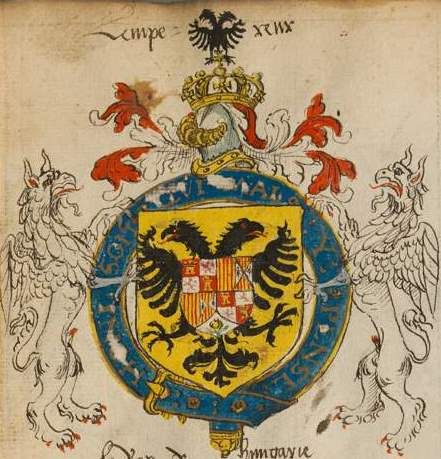
04798e01e748c2cff75d3db284c3f4a0.jpg


Ferdinand I was King of Hungary, Croatia and Bohemia – and Knight of the Garter since 1522.

Rudolf II was King of Hungary, Croatia, Bohemia and Archduke of Austria – and Knight of the Garter since 1587.

Maximilian II was King of Hungary, Croatia andBohemia – and Knight of the Garter since 1567.

Francis II (1768 – 1835) was the last Holy Roman Emperors from 1792 to 1806, when he dissolved the Holy Roman Empire of the German Nation, after being defeated by Napoleon. In 1804, he became the first Emperor of Austria. He was also Apostolic King of Hungary andBohemia – and Knight of the Garter since 1814.


Other Knights of the Garter of the House of Habsburg (that weren’t crowned Holy Roman emperor) include.

Philip I (1478 – 1506) was the first was the first King of Castile (by marriage) of the House of Habsburg, he inherited the greater part of the Duchess of Burgundy (including part of the Netherlands). The son of Maximilian I and father of Emperor Charles V – and Knight of the Garter since 1503.

Franz Joseph I (1830 – 1916) was Emperor of Austria and Monarch to many states of the Austro-Hungarian Empire, including King of Hungary – and Knight of the Garter since 1867.

Rudolf (1858 – 1889) died before he could follow in the footsteps of his father Franz Joseph I by suicide – and Knight of the Garter since 1887.

Archduke Franz Ferdinand (1863 – 1914) was never crowned. His assassination has been called the reason for WW I – and Knight of the Garter since 1902.
 
Or maybe nobody's really in control at any level, and the best our authorities can manage is projecting power... Maybe the greatest trick the powers that be ever pulled, was convincing the world they had control.

The reason for all the heraldry, the bloodlines etc, is to convince people they are something special, something other than just vanilla humans whose grandparents were especially good at murderin'
 
Princess Beatrix of the Netherlands (like her mother Juliana was) is a Stranger Lady of the Garter, her son King Willem-Alexander became a Knight of the Garter earlier this year.
King Felipe VI of Spain and his predecessor, Juan Carlos I, are concurrently Stranger Knights of the Garter.

See Juan Carlos second from left, Beatrix second from right, and King Harald V of Norway on the far right, front row. In the centre of the front row: Philip, Elizabeth and Charles, at the Garter ceremony in 2002.
e8622cc8a74b8307036de85568d595795e7439e3.png


Another interesting story is of the Dutch King of Britain from 1689 to 1702, William of Orange (Willem van Oranje in Dutch), who had become a Knight of the Garter in 1653.
af644e86f16d7fc38c72bf4669fd77305761511c.jpg


He was never King of the Netherlands though: http://www.dailymail.co.uk/news/article-560614/The-1688-invasion-Britain-thats-erased-history.html


The first King of the Netherlands, King William I, was effectively made king in 1815 after the invasion by the French under Napoleon Bonaparte made him popular, he had become a Knight of the Garter in 1814…
f6d0ac1202b05341ddde774b2b09a95594407c7e.jpg


Tsar Alexander I of Russia, who became a Knight of the Garter in 1813, played a central role in making William the first king of the Netherlands: https://en.wikipedia.org/wiki/William_I_of_the_Netherlands


Napoleon’s nephew and heir, Napoleon III, became a Knight of the Garter in 1855.
See Queen Victoria knighting Emperor of France Napoleon III at the Garter ceremony, 18 April 1855.
4bcfe4238e02d0a003aa8b87b94c6459b376cf9f.jpg
 
Last edited:
Garter – Girdle

The official tale on the founding of the Order of the Garter is something like - that the countess of Salisbury Joan of Kent, Edward´s cousin and daughter-in-law, dropped her garter when dancing at a ball. King Edward III picked it up, put it on his own leg and uttered “Honi soit qui mal y pense”.
Edward III then said that even knights should be honoured to wear that garter, and so founded the Order of the Garter.
This tale was first written in 1360, so after the Order was founded.

According to Nicholas de Vere the Garter is really just another tail eating snake (Ouroborus).
I think that both explanations are wrong and at the very least don’t explain why St. George is the patron saint of the Order of the Garter...

There is a third explanation that involves a late 14 century poem, involving Knight Gawain, the Green knight and a girdle that ends with “honi soit qui mal y pense”.
As this poem was written AFTER the Order of the Garter was founded in 1348, this couldn’t be an explanation either: https://en.wikipedia.org/wiki/Sir_Gawain_and_the_Green_Knight


The best explanation I found is from the tale of St. George...
St. George is the patron saint of a number of countries, including: England, Portugal, Georgia, Lithuania, and Greece.

St. George is believed to have been born in Cappadocia (in Turkey) and was born in the second hald of the 3rd century AD.
He served as a soldier in the Roman army. In protest against the persecution of Christians by Roman Emperor Diocletian (244-311) at the beginning of the 4th century, St. George resigned from his military office.
When St. George tore up the emperor’s order against the Christians, Diocletian had him imprisoned and tortured. George refused to reject his Christian faith, so he was dragged through the streets of Diospolis (a.k.a. Lydda) in Palestine and beheaded.
See the 15[SUP]th[/SUP] century painting (note the halo).
5928a7b0b321be164e4167d881313e9285512240.jpg


The most popular tale of St. George involves slaying a dragon. St. George is most commonly depicted as a knight mounted on a horse and spearing a dragon.
The best known form of this legend is in the “Legenda Aurea, written by archbishop of Genoa Jacobus de Voragine in the 13th century.

Beside the city Silene in Libya was a pond with a “dragon which envenomed all the country”. The people of the city fed the beast 2 sheep each day. The people of the city also sacrificed humans to it.
St. George passed Silene one day, when the king’s daughter would be offered to the dragon. When St. George heard about it and saw the princess; he decided to slay the beast:
Thus as they spake together the dragon appeared and came running to them, and S. George was upon his horse, and drew out his sword and garnished him with the sign of the cross, and rode hardily against the dragon which came towards him, and smote him with his spear and hurt him sore and threw him to the ground.
And after said to the maid: Deliver to me your girdle [belt], and bind it about the neck of the dragon and be not afeard. When she had done so the dragon followed her as it had been a meek beast and debonair.

St. George then then slayed the dragon and converted the king and his people to the Christian faith.
In another tale, during the First Crusade, St. George is said to have helped the crusaders during their successful siege of Antioch in 1098: https://www.ancient-origins.net/his...ing-famous-legend-st-george-and-dragon-005794
(archived here: http://archive.is/gWtWk)

I guess that you won´t be surprised that I think that the garter represents the girdle that was bound around the dragon´s neck...
 
Mithras - serpent

I looked for a connection between dragons and Mithras, which seems to have been more influential in the foundation of the Christian Church than the teachings of Jesus Christ...

Mithras was accompanied by a snake, a.k.a. serpent, a.k.a. dragon.
The bull slaying scene that is mostly associated with Mithras is really in reference to astrology/astronomy, where the snake represents the Hydra constellation.

Mithra or Mehr (translation: love, sun), worshipped since at least 1400 BC, was supposedly born of his virgin mother Anahita and the seed of Zarathustra (from the waters of Lake Hamun in the Persian province of Sistan). His birth took place in a cave, where shepherds attended him at the winter solstice and presented him gifts.
According to another tale, Mithras was born from a rock; shown with a serpent coiled around the rock.
5fe651d3ff81475dc509b929ca3b1d321b6c0570.jpg


In Hinduism he is praised as Mitra-Varuna. Hymn 3.59 of the Rig Veda is dedicated to Mithra.
In Persia, Mithra was the protector god of the tribal society until the Zoroastar's reformation of Persian polytheism (628-55 BC).
In the Avesta, Mithra is the protector of the Aryan nation, giving victory to those who lie not unto Mithra.

On 25 December 274, Roman Emperor Aurelian proclaimed the Sun God the principal patron of the Empire and dedicated a temple to Him in the Campus Martius.
Catholicism has remained close to Mithraism, including: the timing of Christmas and Bishops adaptation of miters. The Christian church adopted 25 December as Jesus' birthday in the Fourth century. Christians priests are called Father. Mithraic Holy fathers wore red garment and cap, a ring, and carried a shepherds staff.

Mithra is also found in Chinese mythology, where he is known as “The Friend” and in statues is shown as a Military General.
Traces of the inner teachings of Mithraism can also be found in Sufisim (the mystical cult in Islam). At the end of the initiation ritual for the Miles degree a mark was branded (there are current practices of branding marks, for example in Bronfman’s NXIVM cult). During the ritual meal they drink wine, with their cup they offered devotional love. The bread represents flesh of the bull in whose death was life.
Mithras is also present in the autoerotic 7th degree and homoerotic 11th degree of Ordo Templi Orientis (OTO) of the infamous Satanist Aleister Crowley.

Mithras´ battle with the Sun resulted in the formation of a friendship between Mithras and his “companion” Sol Invictus (Invincible Sun).
Mithras is asked by the sun to kill the Bull, but refuses at first. The Raven, as messenger of the Sun, comes to him again with the request. Mithras goes into the field and captures the Bull and drags him to the cave of his birth. When Mithras kills the bull, from his blood comes wine and all the plants on earth.
The Bull that Mithra sacrifices represents his ego.

The scene shows Mithras slaying the Bull while he looks away. He stabs the bull in the neck. Around him are his companions the snake, scorpion, and dog. The 2 torch bearers of Mithras, Cautopates and Cautes, stand at either side of the bull slaying scene.
In the upper left corner is Sol Invictus (note the similarity to the Statue of Liberty in New York) and in the upper right corner the crescent moon.
See the Roman marble of Mithras slaying the bull, 2nd/early 3rd Century AD.
Mithras-Bull.png


There is also an interesting relation to astrology/astronomy.

The bull slaying tale represents the constellation Persus (Mithras), Taurus (Bull), Canis Minor (dog), Hydra (snake), Corvus (raven), Scorpio (scorpio). The wheat is the star Spica (the brightest star in Virgo) and the blood is the Milky Way.
At the spring equinox Mithras moves the earth back into Aries, raising energy and power.
See Mithras with the 12 signs of the zodiac around him, showing he rules the cosmos, with the snake wrapped around him.
87182d38a44173e0c3e76a156c956e6ee1e9f60e.png


In Mithraism, there were 7 degrees of initiation.
The first degree was of corax (Raven) under Mercury.
The second degree of Nymphus (male-bride) under Venus. The neophyte wears a veil and carries a lamp in his hand. He makes a vow to the cult, and becomes celibate for at least duration of this stage. He is a bride(lover) of Mithra. He also offers a cup of water to the statute of Mithras.
On reaching the third degree Miles (solider) under Mars, the neophyte had to kneel naked, blindfolded with hands tied. He was then offered a crown on the point of a sword, which he ultimately puts away.

The fourth stage of Leo (lion) under Jupiter is the first of the senior degrees. He is entering the element of fire and is not allowed to touch water during the ritual, and instead honey was offered to the initiate to wash his hands and anoint his tongue.
The fifth degree of Perses (Persian) under moon, where he receives the highest revelations of wisdom of Magi. The initiate was purified with honey “associated with” purity and fertility.
In the sixth grade of Heliodromus (sun runner) under sun, the initiate imitates Sun at the ritual banquet. Sitting next to Mithra (Father), dressed in red, color of sun, fire and blood of life.
The seventh, highest, grade was of Pater (father) under Saturn: https://www.whitedragon.org.uk/articles/mithras.htm
(archived here: http://archive.ph/imXb4)


See Mithras as Kronos (Aeon) with wings and a snake wrapped around him, standing on the Earth globe.
794726306f2c8ee245248df486783e3c880a3ca9.png
 
I looked for a connection between dragons and Mithras, which seems to have been more influential in the foundation of the Christian Church than the teachings of Jesus Christ...

Mithras was accompanied by a snake, a.k.a. serpent, a.k.a. dragon.
The bull slaying scene that is mostly associated with Mithras is really in reference to astrology/astronomy, where the snake represents the Hydra constellation.

Mithra or Mehr (translation: love, sun), worshipped since at least 1400 BC, was supposedly born of his virgin mother Anahita and the seed of Zarathustra (from the waters of Lake Hamun in the Persian province of Sistan). His birth took place in a cave, where shepherds attended him at the winter solstice and presented him gifts.
According to another tale, Mithras was born from a rock; shown with a serpent coiled around the rock.
5fe651d3ff81475dc509b929ca3b1d321b6c0570.jpg


In Hinduism he is praised as Mitra-Varuna. Hymn 3.59 of the Rig Veda is dedicated to Mithra.
In Persia, Mithra was the protector god of the tribal society until the Zoroastar's reformation of Persian polytheism (628-55 BC).
In the Avesta, Mithra is the protector of the Aryan nation, giving victory to those who lie not unto Mithra.

On 25 December 274, Roman Emperor Aurelian proclaimed the Sun God the principal patron of the Empire and dedicated a temple to Him in the Campus Martius.
Catholicism has remained close to Mithraism, including: the timing of Christmas and Bishops adaptation of miters. The Christian church adopted 25 December as Jesus' birthday in the Fourth century. Christians priests are called Father. Mithraic Holy fathers wore red garment and cap, a ring, and carried a shepherds staff.

Mithra is also found in Chinese mythology, where he is known as “The Friend” and in statues is shown as a Military General.
Traces of the inner teachings of Mithraism can also be found in Sufisim (the mystical cult in Islam). At the end of the initiation ritual for the Miles degree a mark was branded (there are current practices of branding marks, for example in Bronfman’s NXIVM cult). During the ritual meal they drink wine, with their cup they offered devotional love. The bread represents flesh of the bull in whose death was life.
Mithras is also present in the autoerotic 7th degree and homoerotic 11th degree of Ordo Templi Orientis (OTO) of the infamous Satanist Aleister Crowley.

Mithras´ battle with the Sun resulted in the formation of a friendship between Mithras and his “companion” Sol Invictus (Invincible Sun).
Mithras is asked by the sun to kill the Bull, but refuses at first. The Raven, as messenger of the Sun, comes to him again with the request. Mithras goes into the field and captures the Bull and drags him to the cave of his birth. When Mithras kills the bull, from his blood comes wine and all the plants on earth.
The Bull that Mithra sacrifices represents his ego.

The scene shows Mithras slaying the Bull while he looks away. He stabs the bull in the neck. Around him are his companions the snake, scorpion, and dog. The 2 torch bearers of Mithras, Cautopates and Cautes, stand at either side of the bull slaying scene.
In the upper left corner is Sol Invictus (note the similarity to the Statue of Liberty in New York) and in the upper right corner the crescent moon.
See the Roman marble of Mithras slaying the bull, 2nd/early 3rd Century AD.
Mithras-Bull.png


There is also an interesting relation to astrology/astronomy.

The bull slaying tale represents the constellation Persus (Mithras), Taurus (Bull), Canis Minor (dog), Hydra (snake), Corvus (raven), Scorpio (scorpio). The wheat is the star Spica (the brightest star in Virgo) and the blood is the Milky Way.
At the spring equinox Mithras moves the earth back into Aries, raising energy and power.
See Mithras with the 12 signs of the zodiac around him, showing he rules the cosmos, with the snake wrapped around him.
87182d38a44173e0c3e76a156c956e6ee1e9f60e.png


In Mithraism, there were 7 degrees of initiation.
The first degree was of corax (Raven) under Mercury.
The second degree of Nymphus (male-bride) under Venus. The neophyte wears a veil and carries a lamp in his hand. He makes a vow to the cult, and becomes celibate for at least duration of this stage. He is a bride(lover) of Mithra. He also offers a cup of water to the statute of Mithras.
On reaching the third degree Miles (solider) under Mars, the neophyte had to kneel naked, blindfolded with hands tied. He was then offered a crown on the point of a sword, which he ultimately puts away.

The fourth stage of Leo (lion) under Jupiter is the first of the senior degrees. He is entering the element of fire and is not allowed to touch water during the ritual, and instead honey was offered to the initiate to wash his hands and anoint his tongue.
The fifth degree of Perses (Persian) under moon, where he receives the highest revelations of wisdom of Magi. The initiate was purified with honey “associated with” purity and fertility.
In the sixth grade of Heliodromus (sun runner) under sun, the initiate imitates Sun at the ritual banquet. Sitting next to Mithra (Father), dressed in red, color of sun, fire and blood of life.
The seventh, highest, grade was of Pater (father) under Saturn: https://www.whitedragon.org.uk/articles/mithras.htm
(archived here: http://archive.ph/imXb4)


See Mithras as Kronos (Aeon) with wings and a snake wrapped around him, standing on the Earth globe.
794726306f2c8ee245248df486783e3c880a3ca9.png
In ancient times all men had the true gospel including prophecies of Christ's coming but almost all corrupted what they had and created heresies, that is why so many lies are similar to the truth.
 
In ancient times all men had the true gospel including prophecies of Christ's coming but almost all corrupted what they had and created heresies, that is why so many lies are similar to the truth.
Do you really think that this sentence adds something worthwhile to this thread?
So your explanation for the similarities between Mithraism and Christianity is something like, that Mithras worshippers, in anticipation of Joshua of Nazareth, already had much of the New Testament and Christianity mapped out in advance...
Or maybe that Mithraists had the “true gospel”?!?

That seems a bit improbable against the historic fact that the New Testament was written and Christianity was effectively founded by the Mithras, Sol Invictus, worshipping Roman Emperor Constantine; who then made it the Roman state religion.
To a simple guy like me it makes more sense that Constantine corrupted the teaching of Joshua of Nazareth, making him some kind of “Christ” freak born of a virgin mother and the “Holy Spirit” (whatever that may be), while destroying the followers of Joshua from the inside.

Emperor Nero adopted the radiating crown as the symbol of his sovereignty to show that he was an incarnation of Mithras.
When Emperor Commodus (Emperor 180-192 AD) was initiated into the Mithraic religion, there began an era of strong support of Mithraism that included emperors such as Aurelian, Diocletian, and Julian the Apostate, who called Mithras "the guide of the souls".

Mithras later was referred to by Roman worshippers as “Sol invictus” (invincible sun). The sun itself was considered to be "the eye of Mithras". The title Sol invictus was later transferred to Mithras. The Roman erected several Mithraeums, where Mithras was worshipped. Emperor Diocletian, who ruled 284-305 AD, gave Mithras the title "The Protector of the Empire".
The New Testament was only written during the reign of Constantine. The Council of Nicaea officially recognised the New Testament as being written by God in 325 AD (almost 300 years after “Jesus Christ” was crucified).

The official story is that Emperor Constantine (Emperor 306-337 AD) converted from Mithraism to Christianity on the eve of a battle in 312 AD. Constantine made Christianity the state religion. All subsequent emperors were openly hostile towards Mithraism.
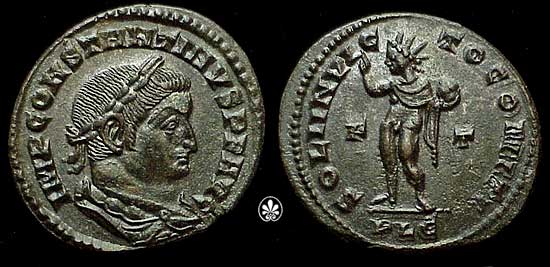
That seem improbable as he maintained the title “Pontifex Maximus” - the high priest of paganism. And Constantine’s coins were inscribed with: “SOL INVICTO COMITI” (TO MY COMPANION THE INVINCIBLE SUN) and showed Sol at least until 323 AD.
Follis-Constantine-lyons_RIC_VI_309.jpg

http://www.cais-soas.com/CAIS/Religions ... ianity.htm
(archived here: http://archive.is/YnS6B)

The first Roman Emperor to omit “Pontifex Maximus” from his title was Gratian (Emperor 375-383 AD).

The following third century mosaic of the Vatican grottoes under St. Peter's Basilica, allegedly represents Christ as the sun-god Helios/Sol Invictus riding in his chariot.
d8348c86f5a4027666b64c951e1adeb6e7d56ca4.jpg
 
Last edited:
In ancient times all men had the true gospel including prophecies of Christ's coming but almost all corrupted what they had and created heresies, that is why so many lies are similar to the truth.

Traditions of men that make void the Word of God.

Satan's many names throughout the Bible:

Abaddon (destroying angel), Revelation 9:11.

Angel of the bottomless pit, Revelation 9:11.

Apollyon (destroyer), Revelation 9:11.

Accuser of our brethren (the devil is the chief complainer against those who believe in God), Revelation 12:10.

Adversary (opponent), 1Peter 5:8.

Angel of light (messenger of light), 2Corinthians 11:14.

Antichrist (opponent of the Messiah), 1John 4:3.

Beelzebub (the dung god, ruler of the devils), Luke 11:15.

Belial (worthlessness), 2Corinthians 6:15.

Crooked serpent, Isaiah 27:1.

Devil, Matthew 4:1, 5, 8, 11, 9:32, etc.

Dragon, Revelation 12:7.

Enemy (the hateful, hostile one), Matthew 13:39.

Father of Lies, John 8:44.

God of this world (god of this age), 2Corinthians 4:3 - 4.

Great dragon, Revelation 12:9.

Great fiery red dragon (serpent), Revelation 12:3.

Liar (a falsifier), John 8:44.

Man of sin (man of offense), 2Thessalonians 2:3.

Murderer, John 8:44.

Old Serpent, Revelation 12:9.

Power of darkness (power of obscurity), Colossians 1:13.

Prince of the devils (Matthew 12:24).

Prince of the power of the air (ruler who has authority over air), Ephesians 2:1.

Roaring Lion, 1Peter 5:8.

Ruler of this world (prince of this world), John 12:31.

Satan (the devil), Revelation 12:9, 20:2.

Serpent (snake), Genesis 3:1, 2Corinthians 11:3.

Son of perdition (son of destruction), 2Thessalonians 2:3.

Tempter (the tester, one who entices), Matthew 4:3.

Thief (stealer), John 10:9 - 10.

Wicked one (the devil), Matthew 13:38.
 
Traditions of men that make void the Word of God.

Satan's many names throughout the Bible:
It’s interesting how many of these quotes from the Bible refer to dragons or serpents...

I'm not very interested in the supposed Satan or God as I believe that it's (only) human's doing that causes the sorry state of our Brave New World.
Here are some quotes mostly on wrong "types" of men.

Also the “barbarian” Scythians are mentioned...
Firestarter said:
3 Maccabees 7:5
These friends also drove them along in chains, treating them harshly as slaves, or rather, as traitors. Without any investigation or trial they attempted to destroy them, displaying a cruelty more savage than the barbarians from Scythia.


Matthew 21:12-13: money changers and doves sellers.
Mithraists and Jews sacrificed birds…

Matthew 7:15 (KJV): false prophets

Matthew 24:24 (KJV): false Christs and false prophets

2 Corinthians 11:13-15 (KJV): false apostles, deceitful workers.


I think that one of biggest mind control techniques that is used against us, is turning us into hypocrites (of course political correct!).
Matthew 23:14-33
Woe unto you, scribes and Pharisees, hypocrites! for ye devour widows' houses, and for a pretence make long prayer: therefore ye shall receive the greater damnation.
Woe unto you, scribes and Pharisees, hypocrites! for ye compass sea and land to make one proselyte, and when he is made, ye make him twofold more the child of hell than yourselves.
Woe unto you, ye blind guides, which say, Whosoever shall swear by the temple, it is nothing; but whosoever shall swear by the gold of the temple, he is a debtor!
Ye fools and blind: for whether is greater, the gold, or the temple that sanctifieth the gold?
And, Whosoever shall swear by the altar, it is nothing; but whosoever sweareth by the gift that is upon it, he is guilty.
Ye fools and blind: for whether is greater, the gift, or the altar that sanctifieth the gift?
Whoso therefore shall swear by the altar, sweareth by it, and by all things thereon.
And whoso shall swear by the temple, sweareth by it, and by him that dwelleth therein.
And he that shall swear by heaven, sweareth by the throne of God, and by him that sitteth thereon.
Woe unto you, scribes and Pharisees, hypocrites! for ye pay tithe of mint and anise and cummin, and have omitted the weightier matters of the law, judgment, mercy, and faith: these ought ye to have done, and not to leave the other undone.
Ye blind guides, which strain at a gnat, and swallow a camel.
Woe unto you, scribes and Pharisees, hypocrites! for ye make clean the outside of the cup and of the platter, but within they are full of extortion and excess.
Thou blind Pharisee, cleanse first that which is within the cup and platter, that the outside of them may be clean also.
Woe unto you, scribes and Pharisees, hypocrites! for ye are like unto whited sepulchres, which indeed appear beautiful outward, but are within full of dead men's bones, and of all uncleanness.
Even so ye also outwardly appear righteous unto men, but within ye are full of hypocrisy and iniquity.
Woe unto you, scribes and Pharisees, hypocrites! because ye build the tombs of the prophets, and garnish the sepulchres of the righteous,
And say, If we had been in the days of our fathers, we would not have been partakers with them in the blood of the prophets.
Wherefore ye be witnesses unto yourselves, that ye are the children of them which killed the prophets.
Fill ye up then the measure of your fathers.
Ye serpents, ye generation of vipers, how can ye escape the damnation of hell?

Matthew 6:1-6
Take heed that ye do not your alms before men, to be seen of them: otherwise ye have no reward of your Father which is in heaven.
Therefore when thou doest thine alms, do not sound a trumpet before thee, as the hypocrites do in the synagogues and in the streets, that they may have glory of men. Verily I say unto you, They have their reward.
But when thou doest alms, let not thy left hand know what thy right hand doeth:
That thine alms may be in secret: and thy Father which seeth in secret himself shall reward thee openly.
And when thou prayest, thou shalt not be as the hypocrites are: for they love to pray standing in the synagogues and in the corners of the streets, that they may be seen of men. Verily I say unto you, They have their reward.
But thou, when thou prayest, enter into thy closet, and when thou hast shut thy door, pray to thy Father which is in secret; and thy Father which seeth in secret shall reward thee openly.

Matthew 15:7-11
Ye hypocrites, well did Esaias prophesy of you, saying,
This people draweth nigh unto me with their mouth, and honoureth me with their lips; but their heart is far from me.
But in vain they do worship me, teaching for doctrines the commandments of men.
And he called the multitude, and said unto them, Hear, and understand:
Not that which goeth into the mouth defileth a man; but that which cometh out of the mouth, this defileth a man.


And my favourite quote from the Bible...
Luke 6:41-45
And why beholdest thou the mote that is in thy brother's eye, but perceivest not the beam that is in thine own eye?
Either how canst thou say to thy brother, Brother, let me pull out the mote that is in thine eye, when thou thyself beholdest not the beam that is in thine own eye? Thou hypocrite, cast out first the beam out of thine own eye, and then shalt thou see clearly to pull out the mote that is in thy brother's eye.
For a good tree bringeth not forth corrupt fruit; neither doth a corrupt tree bring forth good fruit.
For every tree is known by his own fruit. For of thorns men do not gather figs, nor of a bramble bush gather they grapes.
A good man out of the good treasure of his heart bringeth forth that which is good; and an evil man out of the evil treasure of his heart bringeth forth that which is evil: for of the abundance of the heart his mouth speaketh.
 
It’s interesting how many of these quotes from the Bible refer to dragons or serpents...

Yes because Satan has many names.

I'm not very interested in the supposed Satan or God as I believe that it's (only) human's doing that causes the sorry state of our Brave New World.

Well, I am not here to judge your understanding, but using discernment, if you read and study the Bible (Chapter by Chapter & Verse by Verse), with understanding, you get the wisdom and knowledge you need to figure out what is really going on. God made all humans, including Satan. Our time here (which is a very short time) is basically a test. You can choose Good or you can choose Evil. We all fall short, in the flesh, and that is the very reason God sent his son, in the flesh, to forgive us when we repent for our foolishness to do Evil.
 
We all fall short, in the flesh, and that is the very reason God sent his son, in the flesh, to forgive us when we repent for our foolishness to do Evil.
When Christians call everybody a sinner, my usual reply is: was Jesus a sinner?
Now if Jesus was born a mortal man, more talented than average, we would all have the same responsibilities. To stand up against the psychopaths that make "our" world a living hell.
Now when Jesus is some sort of freak half-God Christ, it's undertstandable that we can't be expected to fight against evil, even if this means that "they" would murder us.
And then there is the aspect of believing in some all-powerful God that decides what happens. So why would we fight in the first place? Even more so as everything is predestined?
And so the Christians become enslaved by the fable that when you're a good slave in this life, you will be rewarded in the "eternal life" after death. Isn't it strange that most Christians are afraid to die?


Well, I am not here to judge your understanding, but using discernment, if you read and study the Bible (Chapter by Chapter & Verse by Verse), with understanding, you get the wisdom and knowledge you need to figure out what is really going on. God made all humans, including Satan. Our time here (which is a very short time) is basically a test. You can choose Good or you can choose Evil.
But when I read your post, you implicitely "judge" me...

How would you know that the Bible is such a wonderful book, if you haven’t studied other religions?!? You could only “rate” the Bible as the “Word of God” if you can compare it...
When I first read the Bible, when I was something like 26, it disgusted me. I can hardly think of a bigger insult to God than calling this the Word of God. The Tanach (a.k.a. Old Testament) is a book of genocide, slavery, paedophilia, and greed.
The New Testament became officially recognised as written by God by the Council of Nicaea in 325 AD. Why would anybody believe some council under the rule of the Roman, sun worshipping Emperor Constantine?

The only good thing about the whole Bible are some of the things “Jesus Christ” said. The problem here is that this was written down hundreds of years after the Romans had him executed. And then when the Romans compiled the Bible, they made the mass murderor Pontius Pilate into a hero that supposedly tried to save Him.
Why would Jesus tell the Jews to pay taxes to the Emperor?


There are some similarities between the teachings of Buddha and Jesus. If I remember correctly in the New Testament there are some paragraphs dedicated to how Jesus was as a child, then from age 16/17 till 30 years old nothing about how Jesus lived. What did he do in these years? Did he work as a carpenter, like Josef? Did he remain in “Israel” or did he go abroad (maybe India) to study other religions?
In my opinion Buddhism could be closer to Jesus’ teachings than the Tanach or New Testament.


The later Buddha was born as Prince Siddhartha Gautama. When he reached the age of 16, his father reputedly arranged his marriage to a cousin of the same age and he lived a life of comfort. At the age of 29 Siddhartha took a trip to meet his subjects. Siddhartha saw an old man, a diseased man, a decaying corpse, and an ascetic. He couldn’t go on with his wealthy lifestyle knowing that people were suffering. He couldn’t find a teacher that could answer all his questions and settled on a lifestyle where he had to overcome every need, this included fasting for days and meditation. He preferred being a homeless man (like Jesus) and he begged for food.

According to legend Siddhartha became the (or “a”) Buddha when meditating under the Bodhi tree for days. After he became Buddha he taught his disciples the middle way. The description of how Buddha was attacked by “Mara” before reaching enlightenment is something like:
Mara attempts to tempt Buddha, both with promises of glory and pleasure, and then begins to warn of consequences for breaking away from the prince's religious and secular duties. Buddha easily rejects these, knowing they are meaningless.
Mara uses force against Buddha, appearing as a hideous demon and sending an army of likewise revolting and terrible creatures, bent on the bodily destruction of Buddha. They launch a volley of arrows at Buddha, but as these projectiles approach they are transformed into flowers and fall harmlessly to the ground. Buddha invokes the earth goddess to wash away the demons in a flood—the earth goddess obliges. The daughters of Mara try to coerce and seduce Buddha, but he recognizes them as they are, and is not swayed from his goal.
Finally Mara mocks Buddha, and tells him his work is for nothing, as there is no one there to recognize his achievement. Buddha responds that the earth will be his witness, and after touching the ground the earth trembles in agreement. Thus Mara admits defeat for the moment; however, he is determined to carry on harassing the Buddha and his followers
http://www.newworldencyclopedia.org/entry/Mara


This is very similar as the description of how Jesus was tempted when he fasted in the desert for 40 days (Buddha also fasted regularly and for long periods).
Matthew 4:1-11:
Then was Jesus led up of the Spirit into the wilderness to be tempted of the devil. And when he had fasted forty days and forty nights, he was afterward an hungred. And when the tempter came to him, he said, If thou be the Son of God, command that these stones be made bread. But he answered and said, It is written, Man shall not live by bread alone, but by every word that proceedeth out of the mouth of God.
Then the devil taketh him up into the holy city, and setteth him on a pinnacle of the temple, And saith unto him, If thou be the Son of God, cast thyself down: for it is written, He shall give his angels charge concerning thee: and in their hands they shall bear thee up, lest at any time thou dash thy foot against a stone. Jesus said unto him, It is written again, Thou shalt not tempt the Lord thy God.
Again, the devil taketh him up into an exceeding high mountain, and sheweth him all the kingdoms of the world, and the glory of them; And saith unto him, All these things will I give thee, if thou wilt fall down and worship me. Then saith Jesus unto him, Get thee hence, Satan: for it is written, Thou shalt worship the Lord thy God, and him only shalt thou serve. Then the devil leaveth him, and, behold, angels came and ministered unto him.
 
The official story is that Emperor Constantine (Emperor 306-337 AD) converted from Mithraism to Christianity on the eve of a battle in 312 AD. Constantine made Christianity the state religion. All subsequent emperors were openly hostile towards Mithraism.
That seem improbable as he maintained the title “Pontifex Maximus” - the high priest of paganism. And Constantine’s coins were inscribed with: “SOL INVICTO COMITI” (TO MY COMPANION THE INVINCIBLE SUN) and showed Sol at least until 323 AD.
Follis-Constantine-lyons_RIC_VI_309.jpg

http://www.cais-soas.com/CAIS/Religions ... ianity.htm
(archived here: http://archive.is/YnS6B)
Most of the following link is identical to the previous story, but the big bonus of this version is that it comes with nice pictures (and some recent updates).

Ulansey believes the images of Mithras slaying the bull (Taurus) are astronomical star maps. He claims that just about all the iconography and even initiation ceremonies are consistently astronomical. Mithras’ killing of the bull symbolizes his power to move the entire universe.
Depiction of Mithras with Persian dress slaying the sacred bull at the Santa Maria Capua Vetere.
628f0c01918e6688eeaedc9a602cc0b43ad56ec6.jpg


Besides Christ and Mithras, there are many other deities - like Osiris, Tammuz, Adonis, Balder, Attis, and Dionysus – that died and were resurrected.
Many classical heroes – like Hercules, Perseus, and Theseus – were born through the a virgin mother and divine father.

The veneration of Mithra began around 3000 BCE in Persia but only in about 2800 BC, Mithra was transformed to a major gods.
Mithraism spread east through India to China, and west throughout the entire length of the Roman frontier. Sites of Mithraic worship have been found in Britain, Italy, Romania, Germany, Hungary, Bulgaria, Turkey, Persia, Armenia, Syria, Israel, and North Africa.
Mithraism was especially strong in Armenia, where the Parthian princes were priests of Mithras, and an entire district of this land was dedicated to the Virgin Mother Anahita. Many Mithraeums were built in Armenia, which remained one of the laststrongholds of Mithraism.

Mithras represented a system of ethics in which the brotherhood should unify against evil. Mithras worshippers believed in a celestial heaven and an infernal hell.
Purification through a ritualistic baptism was required of the faithful, who also took part in a ceremony in which they drank wine and ate bread to symbolize the body and blood of the god.

In the seventeen or eighteen century B.C., the Persian pantheon was drastically reformed by Zarathustra (known in Greek as Zoroaster). Ahura-Mazda became supreme god of goodness, whereas Ahriman became the ultimate embodiment of evil. The reformation of Zarathustra retained the hundreds of Persian deities, ordered into a hierarchical system of “Immortals” and “Adored Ones” under the rule of either Ahura-Mazda or Ahriman.
Within this pantheon of gods, Mithras became the “Judger of Souls’, the divine representative of Ahura-Mazda on earth, and protected the righteous from the demonic forces of Ahriman. Mithras was omniscient, undeceivable, infallible, eternally watchful, and never-resting. Mithras had 1000 eyes (so he could see everything), was the God of Truth, Lord of Heavenly Light and The Lord of the Wide Pastures (who caused the plants to spring forth from the ground).
Mithras was the guardian of arms, and patron of soldiers and armies.

According to the Avesta, the holy book of the religion of Zarathustra, Ahura-Mazda created Mithras in order to guarantee contracts and of promises. The name Mithras, in fact, became the Persian word for “contract”.
The handshake was developed by those who worshipped him as a token of friendship and as a gesture to show that you were unarmed. When Mithras later became the Roman god of contracts, the handshake gesture was imported throughout the Mediterranean and Europe by Roman soldiers.
Mithras at the left in Iranian attire shaking hands with the Hellenic God Zeus. This may be one of the first depictions of the handshake symbolizing the “Payman” (pact), Eski Kale (Turkey), circa 300 BC.
58b1466e5329aca3b4b231ee2a932c80b2f12a3b.jpg


The Babylonians also incorporated their belief in destiny into the Mithraic worship of Zurvan, the Persian god of infinite time and father of the gods Ahura-Mazda and Ahriman.
Mithras worshippers prayed: “Abide with me in my soul. Leave me not [so] that I may be initiated and that the Holy Spirit may breathe within me.”

Sacrificial offerings of cattle and birds were made to Mithras, along with the hallucinogenic drink Haoma (similar to “Soma” from Vedic scriptures).

See from left to right: Mithra, Ardashir II and the supreme God Ahuramazda; standing on a lotus. See the “Sun Rays” coming from the head of Mithras and the object held by Mithras, which could be a ceremonial broadsword.
6d01c36c641c5c157b3a4c0f550e907100ebf910.jpg


The great festival of the Mithraic calendar on December the 25th, and the 16th of every month was kept holy to Mithras.
The Mithraic priests were called Patres Sacrorum (Fathers of the Sacred Mysteries). They had the titles Leo and Hierocorax, and presided over the priestly festivals of Leontica (for lions), Coracica (for ravens), and Hierocoracica (sacred ravens).
Mithras was worshipped almost exclusively by men, most of the wives and daughters of the Mithraists worshipped Magna Mater, Ma-Bellona, Anahita, Cybele, and Artemis. These goddess religions practiced the ritual known of the Taurobolium (bull sacrifice), in which the blood of the slaughtered animal drenched the initiate. Mithraists soon adopted the Taurobolium ritual as their own. This blood baptism symbolised renewal of the human soul.

See the stages of Roman Mithraism: 1-Cerax (Raven); 2-Nymphos (Bride); 3-Miles (Soldier); 4-Leo (Lion); 5-Perses (Persian); 6- Heliodrommus (Sun-Runner); 7-Pater (Father).
In the final grade is a distinct Persian cap symbolizing the cap of Mithras.
78cbd8c1b2d3f42b70662f6fc05477079e8b0c4e.jpg


Mani and many of his followers were persecuted and (Many died in 276 AD). Manichaeism was a major religion in the East until the 14th century. It later led to the creation of several early Christian “heresies”, like the Cathars (a.k.a. Albigenses).
The Knights Templar, founded by Crusaders in Jerusalem in 1118, came into contact with Manichean heretics who despised the Cross, regarding it as the instrument of Christ’s torture. This was followed by the Templars, who were charged with blasphemy in 1312 for committing homosexual acts, worshipping Baphomet, and spitting upon crucifixes in their rituas.
The Knights Templar have been imitated by dozens of mystical sects and secret societies, including the Freemasons, the Hermetic Order of the Golden Dawn and the Ordo Templi Orientallis of Alistair Crowley.
Worshippers of Mithras were the first in the western world to preach the doctrine of divine right of kings. It was the worship of the sun, on which the Sun-King Louis XIV (1638-1715) and other deified sovereigns of the West founded their monarchial absolute dictatorship.

In Iran, up until at least 1979, traditional Mithraic holidays and customs still continued to be officially practiced. The celebrations have continued with the support of the supposed Iranian Islamic extremism. The Iranian New Year celebration of “Now-Ruz” takes place in the spring for 13 days. The “Mihragan” festival in honor of Mithras, Judge of Iran, runs for a period of 5 days.
Mithras is also still venerated today by the Parsis, the descendants of the Persian Zoroastrians now living mainly in India. Their temples to Mithras are called “dar-i Mihr” (The Court of Mithras): https://kavehfarrokh.com/arthurian-legends-and-iran-europe-links/the-mithraic-mysteries/
(archived here: http://archive.is/qYgeu)
 
When Christians call everybody a sinner, my usual reply is: was Jesus a sinner?
Now if Jesus was born a mortal man, more talented than average, we would all have the same responsibilities. To stand up against the psychopaths that make "our" world a living hell.
Now when Jesus is some sort of freak half-God Christ, it's undertstandable that we can't be expected to fight against evil, even if this means that "they" would murder us.
And then there is the aspect of believing in some all-powerful God that decides what happens. So why would we fight in the first place? Even more so as everything is predestined?
And so the Christians become enslaved by the fable that when you're a good slave in this life, you will be rewarded in the "eternal life" after death. Isn't it strange that most Christians are afraid to die?

Well here are some scriptures you can mull over. Jesus was God in the flesh.

John 1:1 - In the beginning was the Word, and the Word was with God, and the Word was God.

John 1:14 - And the Word was made flesh, and dwelt among us, (and we beheld his glory, the glory as of the only begotten of the Father,) full of grace and truth.

John 10:30 - I and [my] Father are one.

Isaiah 9:6 - For unto us a child is born, unto us a son is given: and the government shall be upon his shoulder: and his name shall be called Wonderful, Counsellor, The mighty God, The everlasting Father, The Prince of Peace.

John 20:28 - And Thomas answered and said unto him, My Lord and my God.

John 8:58 - Jesus said unto them, Verily, verily, I say unto you, Before Abraham was, I am.


If you have faith enough with understanding, the evil loses in the end. So I am not particularly worried about the evil, because with God on your side who could be against us? (Psalm 118:6)

But when I read your post, you implicitely "judge" me...

How would you know that the Bible is such a wonderful book, if you haven’t studied other religions?!? You could only “rate” the Bible as the “Word of God” if you can compare it...
When I first read the Bible, when I was something like 26, it disgusted me. I can hardly think of a bigger insult to God than calling this the Word of God. The Tanach (a.k.a. Old Testament) is a book of genocide, slavery, paedophilia, and greed.
The New Testament became officially recognised as written by God by the Council of Nicaea in 325 AD. Why would anybody believe some council under the rule of the Roman, sun worshipping Emperor Constantine?

The only good thing about the whole Bible are some of the things “Jesus Christ” said. The problem here is that this was written down hundreds of years after the Romans had him executed. And then when the Romans compiled the Bible, they made the mass murderor Pontius Pilate into a hero that supposedly tried to save Him.
Why would Jesus tell the Jews to pay taxes to the Emperor?


There are some similarities between the teachings of Buddha and Jesus. If I remember correctly in the New Testament there are some paragraphs dedicated to how Jesus was as a child, then from age 16/17 till 30 years old nothing about how Jesus lived. What did he do in these years? Did he work as a carpenter, like Josef? Did he remain in “Israel” or did he go abroad (maybe India) to study other religions?
In my opinion Buddhism could be closer to Jesus’ teachings than the Tanach or New Testament.


The later Buddha was born as Prince Siddhartha Gautama. When he reached the age of 16, his father reputedly arranged his marriage to a cousin of the same age and he lived a life of comfort. At the age of 29 Siddhartha took a trip to meet his subjects. Siddhartha saw an old man, a diseased man, a decaying corpse, and an ascetic. He couldn’t go on with his wealthy lifestyle knowing that people were suffering. He couldn’t find a teacher that could answer all his questions and settled on a lifestyle where he had to overcome every need, this included fasting for days and meditation. He preferred being a homeless man (like Jesus) and he begged for food.

According to legend Siddhartha became the (or “a”) Buddha when meditating under the Bodhi tree for days. After he became Buddha he taught his disciples the middle way. The description of how Buddha was attacked by “Mara” before reaching enlightenment is something like: http://www.newworldencyclopedia.org/entry/Mara


This is very similar as the description of how Jesus was tempted when he fasted in the desert for 40 days (Buddha also fasted regularly and for long periods).
Matthew 4:1-11:

There is only one Judge and that is God. Therefore, he has given us the gift of discernment. I discerned from your earlier posts that you may have read the Bible but you did not understand. That's key. You need to study it, and read it chapter by chapter and verse by verse to understand the subject, context and the language.

II Timothy 2:15 - KJV
Study to shew thyself approved unto God, a workman that needeth not to be ashamed, rightly dividing the word of truth.
 
Well here are some scriptures you can mull over. Jesus was God in the flesh.
You don't have a clue what you're talking about. You're using your "Christianity" as some sort of ball and chain to keep yourself from finding the truth within yourself.
Your Christianity has first put you in the shackles of mind control, and now you use your misguided ideas on the "Word of God" as a defence mechanism for your ego!

To call the Bible the "Word of God" is just about one of the biggest insults anybody could make "God". The authors of the Bible supported: slavery, paedophilia, corruption, and genocide.
Just the idea that God would have any need to write a book is preposterous.


There is only one Judge and that is God. Therefore, he has given us the gift of discernment. I discerned from your earlier posts that you may have read the Bible but you did not understand. That's key. You need to study it, and read it chapter by chapter and verse by verse to understand the subject, context and the language.
Who do you think you´re fooling? Me, God or yourself.
You´re not even capable of reading a book the size of the Tanach, and remember what you read a hundred pages before. That´s why you need to cut it up in small sections - verse for verse...

Who gave you the right to "judge" me and make demands like: you "need to study it"?!?
Who gave you the right to speak for God?

The Tanach (that you in all ignorance probably call Old Testament) is at least a "real" book, while the New Testament was compiled under the express orders of the Sun, Mithras worshipping Roman Emperor Constantine.

Do you even realise that the New Testament was declared the "Word of God" hundreds of years after Joshua of Nazareth was, executed on the orders of the Roman oppressor of Israel, by some "holy" Roman Council?
Can you tell me about the "studies" that you did?
Why don´t you read the scientific articles on vaccines instead of copy-pasting article that often misrepresent the studies?

How can you claim to have read the Bible when you don't even speak Hebrew or Roman?


As you're not capable of getting the context of the Bible, here's my favourite quote from the Bible again that should be within the limits of your understanding!
Firestarter said:
Luke 6:41-45
And why beholdest thou the mote that is in thy brother's eye, but perceivest not the beam that is in thine own eye?
Either how canst thou say to thy brother, Brother, let me pull out the mote that is in thine eye, when thou thyself beholdest not the beam that is in thine own eye? Thou hypocrite, cast out first the beam out of thine own eye, and then shalt thou see clearly to pull out the mote that is in thy brother's eye.
For a good tree bringeth not forth corrupt fruit; neither doth a corrupt tree bring forth good fruit.
For every tree is known by his own fruit. For of thorns men do not gather figs, nor of a bramble bush gather they grapes.
A good man out of the good treasure of his heart bringeth forth that which is good; and an evil man out of the evil treasure of his heart bringeth forth that which is evil: for of the abundance of the heart his mouth speaketh.
 
Last edited:
You don't have a clue what you're talking about. You're using your "Christianity" as some sort of ball and chain to keep yourself from finding the truth within yourself.
Your Christianity has first put you in the shackles of mind control, and now you use your misguided ideas on the "Word of God" as a defence mechanism for your ego!

To call the Bible the "Word of God" is just about one of the biggest insults anybody could make "God". The authors of the Bible supported: slavery, paedophilia, corruption, and genocide.
Just the idea that God would have any need to write a book is preposterous.


Who do you think you´re fooling? Me, God or yourself.
You´re not even capable of reading a book the size of the Tanach, and remember what you read a hundred pages before. That´s why you need to cut it up in small sections - verse for verse...

Who gave you the right to "judge" me and make demands like: you "need to study it"?!?
Who gave you the right to speak for God?

The Tanach (that you in all ignorance probably call Old Testament) is at least a "real" book, while the New Testament was compiled under the express orders of the Sun, Mithras worshipping Roman Emperor Constantine.

Do you even realise that the New Testament was declared the "Word of God" hundreds of years after Joshua of Nazareth was, executed on the orders of the Roman oppressor of Israel, by some "holy" Roman Council?
Can you tell me about the "studies" that you did?
Why don´t you read the scientific articles on vaccines instead of copy-pasting article that often misrepresent the studies?

How can you claim to have read the Bible when you don't even speak Hebrew or Roman?


As you're not capable of getting the context of the Bible, here's my favourite quote from the Bible again that should be within the limits of your understanding!

Yes great verses, but the whole chapter is more enlightening to read with understanding. Many traditions of men have made void the Word of God. This particular chapter points that out.

What does those verses mean? Who was speaking those words? What does Sabbath mean?
 
Has anybody heard the story of the 3 wise men (or kings) from the East visiting the newborn baby Jesus after following the star?
Here’s a painting from ca. 1320 showing the “baby” Joshua of Nazareth visited by the “three” wise men from the East. Jesus, Maria and Josef with halos.
b4ecc815eab4862cd566203fe1b46bbb33e26554.jpg


According to the New Testament:
- They were an unnumbered amount (instead of a defined 3);
- They only started travelling to Bethlehem AFTER Jesus had already been born (the star had already disappeared); so Jesus was probably still a baby (not completely sure) but NOT newborn.

Matthew 2:1-11 (KJV)
1 Now when Jesus was born in Bethlehem of Judaea in the days of Herod the king, behold, there came wise men from the east to Jerusalem,
2 Saying, Where is he that is born King of the Jews? for we have seen his star in the east, and are come to worship him.
3 When Herod the king had heard these things, he was troubled, and all Jerusalem with him.
4 And when he had gathered all the chief priests and scribes of the people together, he demanded of them where Christ should be born.

5 And they said unto him, In Bethlehem of Judaea: for thus it is written by the prophet,
6 And thou Bethlehem, in the land of Juda, art not the least among the princes of Juda: for out of thee shall come a Governor, that shall rule my people Israel.
7 Then Herod, when he had privily called the wise men, enquired of them diligently what time the star appeared.
8 And he sent them to Bethlehem, and said, Go and search diligently for the young child; and when ye have found him, bring me word again, that I may come and worship him also.

9 When they had heard the king, they departed; and, lo, the star, which they saw in the east, went before them, till it came and stood over where the young child was.
10 When they saw the star, they rejoiced with exceeding great joy.
11 And when they were come into the house, they saw the young child with Mary his mother, and fell down, and worshipped him: and when they had opened their treasures, they presented unto him gifts; gold, and frankincense, and myrrh.


The supposed 3 Magi (wise men) from the East were later named: Balthasar, Melchior and Caspar.
Alternately they were called Bithisarea, Melichior and Gathasp (or Casper of Gasper).

Subsequent traditions embellished the narrative. In the 3rd century the magi were considered to be kings.
In Western churches, Balthasar is often represented as a king of Arabia or Ethiopia, Melchior as a king of Persia, and Gaspar as a king of India.

The Adoration of the Magi became one of the most popular themes in Christian art, the first known painting on the subject is the fresco in the Priscilla Catacomb of Rome from the 2nd century (when Christians were still persecuted by Rome).
e9f50c0ae33cb4e409849dcb028c12f820aed635.jpg


Eastern tradition sets the number of Magi at 12, “based” on the number of gifts: https://www.britannica.com/topic/Magi


Mithras is often pictured wearing a (red) Mithras cap, a.k.a. Phrygian cap.
See the “Three” Wise Men from the “east” (Persia) in a painting at Basilica of Sant' Apollinare Nuovo in Ravenna, Italy; wearing Mithras caps, 6[SUP]th[/SUP] century AD.
48a5c9f37dbdfe31d208c17d8703ea82f4476425.jpg


The Mithras cap is a popular theme in the biggest “Christian”, Mithras worshipping, nation in the world, the USA.

See Columbia “Miss Liberty” with the Mithras cap on a US coin from 1831.
1ca418f6c652f3de2ee6c7b1e5ea19cf7f59b5c2.jpg


See “Miss Liberty” with the Mithras cap on an American World War 1 propaganda poster.
6435310f58fe8659a5e2886c257cc504b7cfa9da.jpg


Phrygia was located in what is roughly now Turkey, where Mithraism flourished.
Phrygia was also a centre of snake, serpent worshipping.

Sabazios is the horseman and sky father god of the Phrygians and Thracians. Probably the god's origins are in Macedonia and Thrace.
The migrating Phrygians brought Sabazios with them to Anatolia in the early first millennium BC. One of the native religion's creatures was the Lunar Bull.

Under Roman Emperor Gordian III (of the knot?), probably from an Anatolian family, the god on horseback appears on coins minted at Tlos, in neighboring Lycia, and at Istrus, in the province of Lower Moesia, between Thrace and the Danube.
See the coin with the riding god and serpent.
adc639810c11186e63f24b3aca36df0acb47e15b.jpg


The image of the god on horseback battling the chtonic serpent, on which his horse tramples, was easily transformed into the image of Saint George and the Dragon, the patron saint of the Order of the Garter, whose earliest known depictions are from tenth- and eleventh-century Cappadocia and eleventh-century Georgia and Armenia: https://en.wikipedia.org/wiki/Sabazios
 
Last edited:
Sabazios, Mithras, St. George

It looks like Mithras wasn’t (isn’t) even the Supreme God, the Father, in Mithraism but Ahura-Mazda...
Firestarter said:
In the seventeen or eighteen century B.C., the Persian pantheon was drastically reformed by Zarathustra (known in Greek as Zoroaster). Ahura-Mazda became supreme god of goodness, whereas Ahriman became the ultimate embodiment of evil. The reformation of Zarathustra retained the hundreds of Persian deities, ordered into a hierarchical system of “Immortals” and “Adored Ones” under the rule of either Ahura-Mazda or Ahriman.
(...)

According to the Avesta, the holy book of the religion of Zarathustra, Ahura-Mazda created Mithras in order to guarantee contracts and of promises. The name Mithras, in fact, became the Persian word for “contract”.
(...)

The Babylonians also incorporated their belief in destiny into the Mithraic worship of Zurvan, the Persian god of infinite time and father of the gods Ahura-Mazda and Ahriman.

In Hinduism, with its Trinity god, Mithras is praised as Mitra-Varuna.
There is also an obvious Trinity in Mithraism - Ahura-Mazda, Ahriman and Mithras – like in Christianity.


I was trying to put together Mithraism, serpent (dragon) worshipping and the legend of St. George (patron saint of the Order of the Garter)...

Phrygia was a centre of snake, serpent worshipping and - Sabazios.
Sabazios is the horseman and sky father god of the Phrygians and Thracians that seems to be the (copied) myth for the dragon slaying St. George. Phrygia is roughly what is now the Asian part of Turkey, where Mithraism flourished; Thrace is roughly the European part of Turkey...
See a Roman bronze statue of Mithras-Sabazios, 2[SUP]nd[/SUP]/3[SUP]rd[/SUP] century AD.
77a1c6c4223f93eb6ba70bb6492ec73fc6337024.jpg


See the depiction of St. George of Labechina, Georgia, 11th century.
e24fe21b2e0ccd9ec97ba2f3dba1966847484cec.png


See St. George and the dragon on the 1823 Gold Two Pound Coin and 1887 Queen Victoria Jubilee Crown.
StGeorgeCoins.jpg

d163c0599a94ba99a46d08c3604cd3021e4cd296.jpg


See St. George and the dragon on the stained glass window at St George’s Hall.
0bcc502c8b9ede0a886bde769f257926678a495d.jpg


The cult of Sabazios (the Thracian Horseman) was popular in Classical Greece, and later spread throughout the Roman empire. We also know that it showed a good deal of simmilarites to the cult of Dionysus/Bacchus.

The Thracian Horseman is depicted as young, and usually shown wearing a cloak and armed with a lance. His image is usually accompanied by some adversarial animals: most often a snake twined around a tree, and sometimes by lions and other wild beasts.
See a typical image of Sabazios, here hunting a boar. The boar was a particularly ‘celtic’ image, whereas the serpent was more Greek or Eastern (compare this to St. George)...
0fd6c2601faa2dd634b7e5664a76cdc2c7f5f7a1


The celebrant-priestesses, Maenads, became hysteric during ceremonies. This was probably caused by dance, chanting, but most importantly by the blood from the ritual slaughter of animals; in some cases ritually torn apart by the Maenads in sacrifice to the god: https://atlanticreligion.com/2014/08/10/sabazios-the-other-thracian-god/
(archived here: http://archive.is/Si5BB)


At the basis of the so-called Roman Mithraism lies the Sabazios religion of the Thracian cult to the sun. The ritual pictures Mithras ritually killing Sabazios (personified by the bull?) so that the new Sun is born.
On the Thracian horseman from Constantinople there are an eagle and snake on the tree of life. The horseman holds 3 tied twigs in his hand, for the trinity – Spirit of life,Earth, Sky.
8b75d588882552105df9324289039e415e0988bf.jpg


In the iconography, Dionysus is marked by a young lion (for youth and strength). On the Mithra relief of the National Museum of History, Sofia, over the bull, is the ancient sign of the Sun, swastika. This emphasizes that the bull is a symbol for Sabazios.
6d46d6630bf5be9a1110b4394d2d7a91bd7cb941.jpg


Another interesting image is the “Hand of Sabazios”; sometimes depicted as the Orphic Egg. All have a serpent or basilisk representing the chthonic ideal. Most hands show a mother lying with her child on the wrist. This could be an allusion to Ariadne, wife of Dionysus in the Cretan-Greek version of the myth.
The birth and rebirth of Dionysus were central parts of the Orphic mystery-legend.
28bfce44323d6cd20b41d8561016140603a0c966


Other iconcography commonly associated with these hands include the Caduceus or wand of Hermes/Mercury, a set of scales, eagle, vines or ritual objects like a sacrificial knife. Some of these hands show an Orphic Egg.
On some hands, including that from Gradnitsa, along with the crested snake, the fir-cone and the lion, there is also a bull. What does the bull from “Sabazios’ hands” symbolise?
675ef07a519bd7c05c785ef16d98b78519e21b6d.jpg

http://www.academia.edu/32038374/Thracian_Horseman_Sabazios_Mithra._Iconography
 
Last edited:
Sinterklaas, Santa, Odin

I sometimes think that adults are even more gullible than children.
According to the official story (for adults): Santa Claus is based on the Dutch, Belgian Sinterklaas, who in turn was based on St. Nicholas of Myra (located in what is now called Turkey)...

I investigated the origins of Sinterklaas, Santa Claus because I saw several things that look like a connection to Mithraism:
Sinterklaas wears a red hat (mijter).
St. Nicholas comes from Turkey.
Sinterklaas rides a white horse (schimmel); like St. George.
Christmas is staged on 25 December; the day the Romans celebrated the birth day of Mithras.
In Christmas festivities the Christmas tree is central; Sabazios was often pictured with a fir-cone.

Here´s some information on one of the great Dutch successes - Sinterklaas. Sinterklaas - Sint Klaas
The Dutch word “Sint” would be translated “Saint” in English (instead of the anagram of Satan “Santa”).
Sinterklaas (“de Sint” in short) lives in Spain and comes to the Netherlands (and Belgium) in the beginning of November by boat.

Sinterklaas rides on a white horse (schimmel) and has black helpers (zwarte pieten).
Sinterklaas+.jpg


Part of the legend of Sinterklaas is that only “sweet” kids get presents, while “naughty” kids get beaten up with some sticks (de roe), and really bad kids are taken in a bag to Spain.
Sinterklaas rides over the rooftops accompanied by his zwarte pieten, which go down through the chimney to deliver the presents.

Usually the kids sing in front of the chimney in the evening (most houses don’t have these anymore) to get presents in their shoe, they often leave a carrot for the horse to find presents in their shoe the following morning. These are usually relatively small present: often a piece of chocolate (pepernoten are also typical for Sinterklaas).
It is the parents that tell the kids how many times (not every evening) they can sing for presents. On December 5 is the big party when the presents are brought in a bag. The December 5 celebration is often with some riming verses that is either read to a kid or is read by the object of the rime.

On 25 December, the Romans also held festivities for the god Saturnus (Saturnalia).

See the following image of Mithras, dressed in red, with his white horse, 4[SUP]th[/SUP] century AD.
Hawarte-sciana.jpg


In Belgium the black helpers of Sinterklaas aren’t portrayed like black Africans (like the “zwarte piet” in the Netherlands) but as the “oel” demons.

Also interesting is that the red “mijter” worn by Sinterklaas is really the mitra worn by the high priest, Pontifex Maximus, of Mithraism...
The mitra was originally based on the dagon hat worn by the priest in the Dagon, fish worshipping cult.
5246609_orig.jpg


Nicholas of Myra was the the son of wealthy parents. When he was young, his parents died and his uncle, the local bishop, adopted him. Nicholas later became a priest and then also a bishop. In one of those strange coincidences, Nicholas even attended the First Council of Nicaea in 325 AD, convened by Roman Emperor Constantine, that would proclaim the Bible as the word of God.
St. Nicholas often gave gifts to the poor and died on 6 December 343 (aged 73): https://ahundredandfortycharactersisusuallyenough.wordpress.com/tag/sinterklaas/

What is missing in St. Nicholas is just about everything in the tale of Sinterklaas and Santa Claus.

It looks like the tale of Sinterklaas was mostly based on the Norse God Odin (the tale of Santa Claus changed his home to the North Pole). One of Odin's most popular titles is Allfather.
Odin had a long white beard (one eye) and sometimes visited earth, in disguise, in a cloak and broad-brimmed hat or hood. See on the left an early image of Santa Claus and on the right Odin...
santa-odin-comparison_large.jpg


Most historians agree that many of our Christmas traditions come from the ancient Norse festival known as Yule or Yuletide. The Norse sang Yule carols with their children singing from door-to-door wearing masks.
Vikings in Yule decorated trees with food, gifts, and small carvings. The Christmas tree could also be a reference to the Persian Tree of life...
Loki, the god of mischief and misfortune murdered the god Baldur, with a spear made from mistletoe. The Mistletoe berries later became a symbol of love in the same story, hence the tradition of kissing under it...

Norse stories sometimes describe Odin flying through the sky on a chariot pulled by his 8-legged flying white horse Sleipnir, visiting homes in the middle of the night and leaving gifts for children in their boots by the fireplace during the Yule season. Odin also rode in a flying chariot (or sleigh) pulled by Sleipnir.
Originally Santa’s single horse pulled his sleigh. This only became 8 reindeer after “Twas the Night Before Christmas” (1823).

In anticipation of Odin’s return from the Great Hunt, the Yule, Norse children left their boots stuffed with straw by the fireplace. In the morning Odin had taken the straw and left sweets and presents in the boots.
Odin’s 2 ravens, Huginn and Muninn, were his eyes and ears and always watching the Vikings (like Mithras). Ravens also play an important role in Mithraism: https://sonsofvikings.com/blogs/history/viking-origins-of-christmas-yule-traditions
(archived here: http://web.archive.org/web/20190201150437/https://sonsofvikings.com/blogs/history/viking-origins-of-christmas-yule-traditions)
 
Last edited:
Odin, Thrace

Odin is another interesting topic, but I’m not sure within the context of this thread...


Over 170 names are recorded for the Norse Odin.
In German his name was Wuotan or Wotan and in old English and Saxon Woden and Wodan.

Odin has only one eye. There are many “masonic” pictures with the one eye motto. Most of them don´t mention that this could be in reference to Odin...
Odin died either by hanging from or crucifixion on the ”world tree” (Yggdrasil). See the picture, 1895.
75283fc4b2692e9725d5779adc96ce36b0823b91


Mithras wore a Phyrgian cap and was accompanied by a raven, a dog and a serpent (snake).
Odin had 2 wolves and 2 ravens for companion. See a picture of Odin (I don’t know what the snake means).
9e3b85459980622c666b3893f8cb1f150591ef72.jpg


See another picture of Odin, one eye, in red with a cape and a yellow sun, with 2 ravens, 18th century.
23eecceecd4d601fb05254d595570afaf473956a.jpg


The modern English “Wednesday” comes from Old English wodnesdæg, like the Dutch “woensdag” is derived from wodensdach – Odin day. Also the Dutch “woede” (anger), is derived from Wodan (Odin): https://en.wikipedia.org/wiki/Odin
(archived here: http://archive.is/NUXuM)


I found the following interesting long article (not only on Odin!)...

The Norse Trinity consisted of Odin (the father), his son Thor (who is crucified), and son of inspiration (the Holy Ghost) Freyr.
See a detail from runestone in the Swedish Museum of National Antiquities in Stockholm. The 3 men are interpreted as Odin, Thor and Freyr.
98a20e259375eaf9e46473396b2a6e7d65b70f5a


Constantine had the writings of Arius burned; that was closer to the teachings of Joshua of Nazareth than the New Testament Jesus Christ.
See Roman Emperor Constantine and the Council of Nicaea, with Arius's books burned, Italy, ca. 825.
a53d37f8f37a595fe15acc874f7f6f3cad0ede6b


The number 12 – zodiac signs, number of months, sons of Jacob (Israel) and apostles – dates back all the way to the Sumerians. See the following Sumerian tablet, dated 3000 BC or older.
95201123e066b48326894e25b47c73fef19c9e92

https://arthuride.wordpress.com/tag/odin/
(archived here: http://archive.is/TtDxI)


In one of those strange coincidences, according to the Prose Vedda (dated 9[SUP]th[/SUP] to 12[SUP]th[/SUP] century), Odin (Voden), the son of Fríallaf, originally came from Thrace (now Turkey), home of snake and Mithras worshipping, before moving to what is now Scandinavia.
The genealogy begins with Noah from the Tanach (Old Testament), whose ark landed in what is now Turkey: https://is.cuni.cz/studium/predmety/index.php?do=download&did=62028&kod=ARL100252
 
Tree of life

Thursday (donderdag in Dutch) was named after Odin´s son Thor.
Also note the “world tree” from which Odin was hanged...


An interesting symbol is the Tree of life that first appears in the Tanach (Old Testament) in Genesis 2:9 and 3:22-24 as the source of eternal life. It reappears in the last book of the New Testament, the Book of Revelation.

The Tree of life already appeared in the Indo-Iranian religion before Zoroastrianism. Ancient mythology of Iran includes the myth of 2 trees as ancestors of all living beings.
66b87d98cba99b34b0d385f44046c04b4a622956.jpg


The Assyrian Tree of life was represented by a series of nodes and criss-crossing lines, often attended to by human or eagle-headed winged genies, or the King.
In ancient Urartu, the Tree of life was a religious symbol. The branches of the tree were equally divided on the right and left sides of the stem. See a fragment of a bronze helmet with the Tree of Life.
66f5133d32d6f824df3a2306dc6e0687b754030a


According to a Taoist story a tree produces a peach of immortality every 3000 years.
See the following bronze Tree of life, with a dragon at the base, and a bird-like (Phoenix) creature with claws at the top from a sacrificial pit at Sanxingdui, China, around 1200 BC.
2db97c444bfda98615d0397d38abd293fd394127.jpg


There is also a “tree of life” in the mystical Judaism sect, Kabbalah: https://en.wikipedia.org/wiki/Tree_of_life
(archived here: http://archive.is/r2R1B)


See the cup of the Sumerian King Gudea of Lagash with 2 winged dragons, a caduceus of uniting snakes (the incarnation of the god Ningizzida).
c40de232980c52babedef155471c0ffbeb5ca2e6.jpg


Babylonians had a Tree of life, Palm style (later copied by the mystical Sufi Islam).

The following map shows the first migration of the Indo-European language south into Iran, then north into Central Asia (through Scythia) and finally turning back along the northern route into Europe.
e453ef0e3bd791cbaebf152e2d3182fd81623bbe.gif

Only archived version left: http://archive.is/leuZu


The following clay tablet shows a man and a woman (with a serpent “tempting” her) seated below the Tree of Life, 2500 BC.
ad7e85494799e56b2d3b318c421d3b0f4f6e7dd6


See the Sumerian cylinder seal for Shamash/An with the sun, cedar Tree of life, tended by Enki, Enlil with the eagle-headed Apkallu.
71fcbb9b0a6d89b49cf7d25092bc044bdff7fb3c

https://treespiritwisdom.com/reincarnation/sumerian-babylonian-iraq/
(archived here: http://archive.is/Jtt7g)


See the Scythian buckle, found in burial mounds in Siberia, 600-400 BC.
9e739a95da316631f12a5ead5736714791702e60.jpg
 
Last edited:
Back
Top